


As of August 1, 2026, an important supply chain rule of International Seafood Sustainability Foundation (ISSF) no longer applies only to large long-line vehicles. Nature conservation measure 3.6 now covers all longline boats, regardless of their size. It is intended to reduce bycatch of sharks, sea turtles and seabirds in tuna fisheries.
The leverage lies not in a new government fishing regulation, but in trade. Processors, traders, importers, marketers and other companies in the fishing industry should only do business with longline vessels whose owners provide a publicly available guideline for concrete bycatch reduction practices. For the companies participating in ISSF, the measure is part of their mandatory nature conservation standards.
What changed on August 1st
The measure was passed in 2017 and has applied to large long-line vessels since July 2018. With the new deadline, this size limit no longer applies. A smaller ship cannot therefore remain outside the procurement specifications simply because of its size if it sells goods into a supply chain covered by the ISSF.
This is an expansion of economic scope, not a worldwide law for every longline boat. The rule binds the companies participating in ISSF and also applies to ProActive Vessel Register (PVR). Their practical reach therefore depends on how much tuna is traded through these companies and their supply chains.
Four guidelines for the protection of sharks and other animals
For a longline vessel to be eligible for relevant transactions, its owner’s public policy must require the following practices under Measure 3.6:
- Circle hooks and only monofilament leaders; Wire leaders are prohibited.
- Only whole fish may be used as bait.
- So-called shark lines, i.e. additional lines aimed at sharks, may not be used at any time.
- In southern temperate latitudes, at least two measures against seabird bycatch must be combined – weighted side lines, night sets or scarecrow lines – or they must Devices must be used to protect the hook until it sinks.
The seabird requirement has been in effect since April 1st, 2026. With the extension on August 1st, the entire catalog of requirements now applies to longline vessels of all sizes.
Why the supply chain becomes a checkpoint
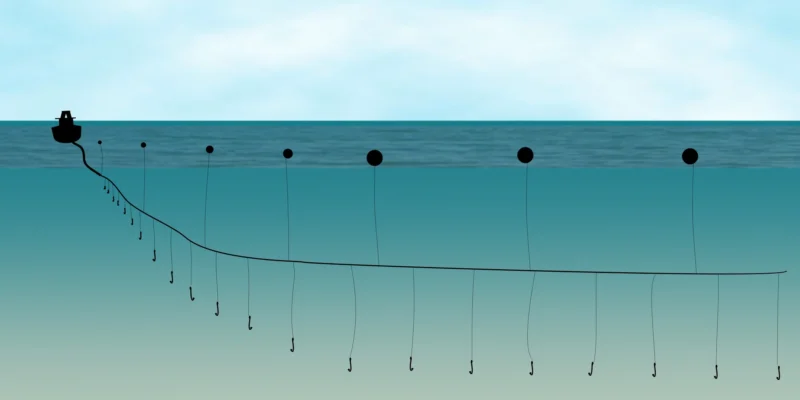
Longlines can stretch for many kilometers and carry thousands of hooks. In addition to the target species, sharks also bite; Sea turtles can be hooked while seabirds grab the bait as it is deployed. The ISSF therefore combines several technical and operational measures rather than relying on a single equipment specification.
The ban on shark lines is particularly clear: These additional lines are aimed specifically at sharks and thus stand in the way of protection against shark bycatch. For the remaining requirements, the impact and side effects can vary depending on the fishery and species. The measure nevertheless sets a uniform minimum standard for access to the affected supply chains.
Public policy and independent audits
The ISSF describes its nature conservation measures as binding for participating companies. According to information from the organization, compliance and the requirements for PVR ships are checked by the independent auditor MRAG Americas. Results appear in annual compliance reports as well as individual company reports.
There is an important limit to note: the text of measure 3.6 first requires a public directive from the ship owner that makes the practices binding. The mere existence of such a document does not prove that every fishing trip is completely compliant with the rules. How resilient the standard is also depends on evidence, controls and the response to violations.
More range, but no global fishing ban
The innovation closes a noticeable gap: Even smaller longliners must meet the procurement requirements if they want to retain access to the recorded supply chains. This allows large buyers to enforce standards across national borders and different fleet sizes.
However, a private supply chain standard alone is not enough to reduce shark bycatch worldwide. Vehicles that sell to other buyers are not automatically included. State fishing regulations, controls at sea, observer programs and reliable catch data therefore remain crucial. The August 1 deadline makes the ISSF rule broader – but not universal.