


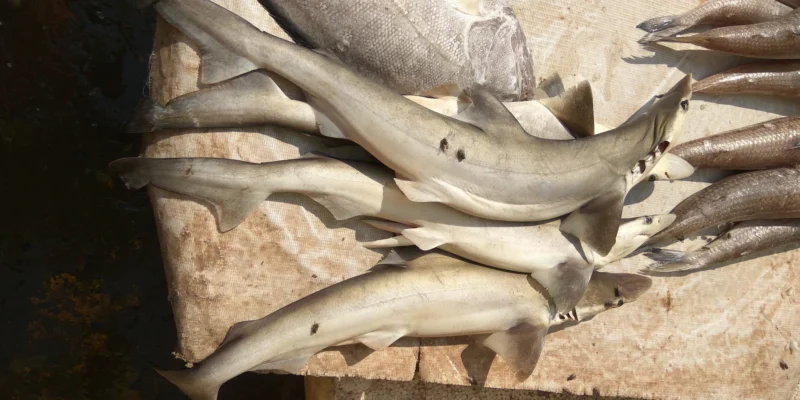
A new risk analysis for India’s artisanal fisheries classifies the great hammerhead shark as particularly vulnerable to fishing pressure. The report for the Indian Ocean Tuna Commission (IOTC) compares it with the silky shark and the pelagic thresher shark.
The study is designed as an exploratory study. It does not replace a complete stock assessment but combines biological characteristics with the likelihood that species encounter the fishing gear used and survive after being caught. Especially for data-poor, tropical small-scale fisheries, this method can provide indications of where protective measures should be implemented first.
Hammerhead shark with highest risk value
The so-called productivity-susceptibility analysis resulted in a risk value of 2.04 for the bowhead hammerhead shark. This placed it in the ‘high’ category. The silky shark reached 1.82 and was rated as ‘moderate’, the pelagic thresher shark with 1.68 as ‘low’.
These categories only apply within the model used and the fishery context studied. “Low” therefore does not mean that the pelagic thresher shark is globally not at risk. Rather, the result indicates that it appeared less vulnerable in this specific analysis than the other two species.
Young animals dominated hammerhead and silky sharks
For the size analysis, the team evaluated landings from the year 2025 along the Indian coast. For the silky shark, 2,292 animals measuring between 56 and 278 centimeters in total length were recorded; the most common size class was 100 to 110 centimeters. The study assesses the landings overall as being dominated by juveniles.
The sample of scalloped hammerhead sharks included 480 animals ranging from 34 to 292 centimeters. Most were only 50 to 60 centimeters long, while animals over 170 centimeters were rare. Young hammerhead sharks frequently stay in coastal waters and encounter gillnets, longlines, trawl nets, and other artisanal fishing gear there.
It was different with the pelagic thresher shark: Among 783 measured animals, adult specimens dominated; the most common size class was from 190 to 200 centimeters. Data from various fishing gears were combined for the size distribution, which is why they do not allow direct comparisons of individual fisheries.
Minimum size of 220 centimeters proposed for hammerhead sharks
A legal minimum size of 220 centimeters total length has already been proposed for the bowhead hammerhead shark. In the authors’ assessment, however, implementation would need to be widely discussed with fishers and other stakeholders. For silky sharks and pelagic thresher sharks, species-specific minimum sizes should urgently be determined and evaluated.
A minimum size can prevent particularly young animals from being legally kept and traded. However, it does not solve the problem on its own: if smaller sharks are thrown back dead or badly injured after being caught, the landing may decrease, but not necessarily the fishing mortality. Therefore, the fishing gear, release practices, controls, and survival rate after release are also decisive.
Possible protected areas around Gujarat and the Andamans
The research trips from 2020 evaluated in the IOTC-session document IOTC-2026-WPEB22-39 show different spatial focuses. Silky sharks were recorded mainly at the edge of the Indian economic zone in front of Gujarat. Pelagic thresher sharks occurred most frequently around the Andaman and Nicobar Islands. Hammerhead sharks were rare in the surveys; the highest relative value was in front of Maharashtra.
The researchers suggest examining the areas near Gujarat and in the Andamans more closely as possible Important Shark and Ray Areas. Because silky and thresher sharks roam widely beyond the boundary of the Indian economic zone, protective measures in adjoining international waters would only be effective through the cooperation of multiple countries.
Exploratory study shows priorities, but no inventory size
The analysis relies on expert assessments and limited observational data for several susceptibility characteristics. The distribution maps are also based on research catches with low relative capture rates. Therefore, the results cannot be used to derive national stock sizes or precise mortality rates.
Despite these limitations, the study connects three practically important signals: high susceptibility of the bowhead hammerhead shark, a large proportion of young animals in the landings of hammerhead and silky sharks, and spatial focal points for further research. This thus provides concrete starting points for minimum sizes, more sustainable fishing practices, and targeted area protection.