


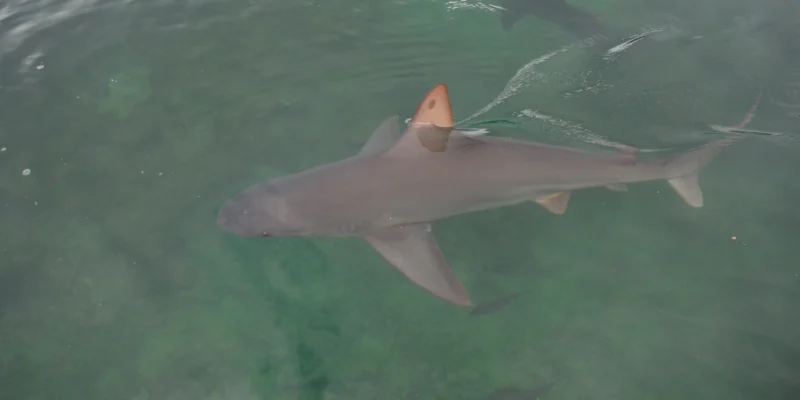
People who experience sharks at sea and learn more about them may subsequently become more involved in protecting them. This is suggested by a new study of guided shark tours off the north shore of Oahu, Hawaii. Published on 9 October 2026, the research combines surveys from 2016 with a follow-up survey in 2018. It examines people’s reported engagement, rather than changes in shark populations.
Encounters and learning were part of the tour
The snorkelling and freediving tours studied took place in small groups accompanied by a marine biologist. Alongside encounters with the animals, participants received information about shark ecology, behaviour and safety, as well as opportunities to support conservation. The findings therefore relate to this particular programme. They cannot readily be extended to every form of shark tourism.
More engagement among follow-up respondents
After data cleaning, the initial survey included responses from 499 tour guests and 391 people in a comparison group at Waikiki Beach. Even then, tour guests more frequently reported engagement in shark conservation: around 31 percent compared with 10 percent in the comparison group.
Only 86 tour guests and 34 people from the comparison group responded to the follow-up survey. Of these, 71 and 12 respectively reported conservation activities, or around 83 versus 35 percent. These included donations, petitions, volunteering and sharing information on social media. The study recorded whether respondents named at least one of the activities asked about; it did not equate the conservation impact of these different forms of engagement.
A statistical model accounting for factors including demographic differences and the loss of many respondents estimates a difference of approximately 40 percentage points in favour of the tour group. This is a modelled difference in the probability of reporting engagement. It means neither 40 percent more sharks protected nor a measured improvement in their habitat.
Small follow-up sample and self-selection limit the findings
Participation in a shark tour was not randomly assigned. People already interested in sharks may have been more likely to choose a tour. The statistical adjustments aim to reduce such differences, but cannot rule out all unobserved influences. The comparison group at Waikiki Beach was also not a representative sample of Hawaii’s population.
Further limitations include the low response rate and reliance on self-reports. The anonymised responses could not be linked to individual people across the two surveys. The study therefore does not demonstrate individually tracked behavioural change. Whether more engaged people were more likely to respond to the follow-up remains an important uncertainty.
A pointer for designing shark tourism
The study supports combining direct experiences of nature with accessible education and concrete opportunities to act. It provides an indication of longer-term engagement, but no conclusive causal evidence. Whether a tour is ecologically sustainable and minimises disturbance to animals requires separate assessment: those effects were not measured here.