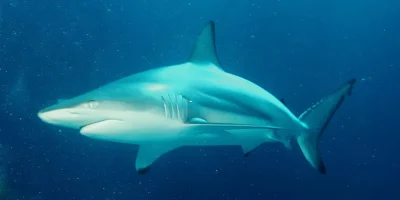
Blacktip sharks (Carcharhinus limbatus) can detect underwater sound from considerable distances and adjust their swimming direction. In a field study off Florida, free-swimming sharks responded to low-frequency test tones by suddenly turning away from the loudspeaker. According to Florida Atlantic University, the greatest observed response distance was 74 metres.
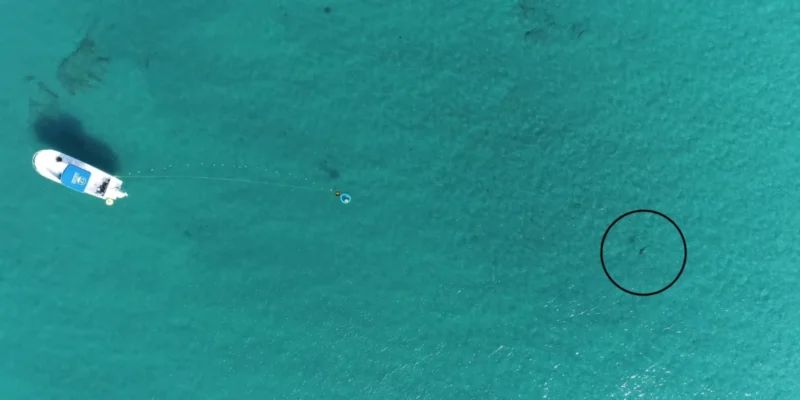
A speaker in the water, a drone above it
The research team studied the sharks in shallow coastal waters off Palm Beach County. An underwater loudspeaker played signals in three frequency ranges: 100 to 200, 200 to 400 and 400 to 800 hertz. A control tone at 10,000 hertz was outside the animals’ known hearing range. The test signals were loud enough to trigger a startle response.
A drone tracked the swimming paths from a height of about 40 to 50 metres. The university’s research video shows the experimental setup and the sharks’ changes of direction.
The sharks turned away from the source of the sound
With the low-frequency signals, the animals changed their direction by about 20 to 160 degrees and swam away quickly. They did not respond to the high-frequency control tone. Of 209 reactions evaluated, 71.6 percent occurred in the acoustic far field. This number denotes reactions, not 209 different sharks.
In the far field, the direct examination of hearing ability is particularly interesting: sharks do not have a gas-filled swim bladder, which contributes to the perception of sound pressure in many bony fish. The results suggest that the sharks also perceive the particle movement associated with sound. The exact mechanism behind this remains to be investigated further.
74 meters is not a general hearing limit
The measured distance depends on the signals used, their volume and the conditions in the experiment. It cannot be transferred to every shark or to every noise. The study shows an evasive response to test tones; it does not prove that sharks can hear prey from exactly this distance or can reliably be attracted.
The study was published in June 2026. The university presented it in September. Its particular contribution lies in combining the reactions of wild sharks with controlled sound measurements and observation from the air.