


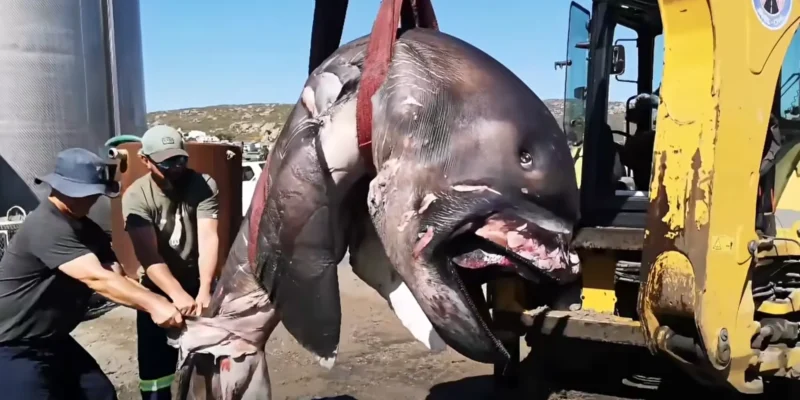
An unusual find is attracting the attention of marine researchers on the west coast of South Africa: according to a report by Weslander, a Megamouth shark washed ashore in the harbour area of St. Helena Bay on Saturday, 22 August 2026. The shark had briefly been seen alive in the harbour before drifting ashore near the Pioneer Fishing fish factory.
Ettienne Swanepoel of the Sandveld Wildlife Rehabilitation Centre reported the find to the newspaper. The carcass was initially placed in the care of the fish factory. On 24 August, DFFE researchers Sarika Singh and Steven McCue travelled from Cape Town, examined the shark and collected samples. These will be analysed in the South African environment ministry’s laboratory, after which the carcass is due to be buried.
Cause of death remains unknown
It is currently unclear why the shark died. The short stay in the harbor and the subsequent washing up alone do not indicate illness, injury, fishing bycatch, lack of oxygen or any other environmental cause. Only the examination of tissue, organs and possible external injuries can provide reliable information.
The site is on the west coast facing the Atlantic. St. Helena Bay is characterized by the cold Benguela Current and nutrient-rich buoyancy and belongs to Atlantic Ocean. The fact that a rarely observed oceanic shark appears in a harbor there is remarkable, but in itself does not prove either a permanent local population or an unusual migration.
Why the carcass is scientifically valuable
The megamouth shark (Megachasma pelagios) is a large, plankton-feeding shark that exploits vast tropical and warm temperate ocean areas. Although the species is distributed worldwide, much knowledge is still based on isolated captures, strandings and few observations of live animals. Any well-documented carcass can therefore provide data on size, sex, nutrition, maturity, health and genetic affiliation.
It is particularly important to properly document the find: exact dimensions, weight, gender, degree of maturity, stomach contents, parasites, injuries and tissue samples. If this information is linked to the location, water temperature and observation time, the South African evidence can later be classified in global distribution and population analyses.
The Weslander gives a body length of up to five meters as a general species information, but has not yet published a reliable measurement of the current animal. The length should therefore not be estimated from photos alone. The test results on the size, gender and condition of the carcass are also awaited.
Third documented megamouth shark record in South Africa
South Africa’s first scientifically verified record dates from 20 April 2002 at Nature’s Valley in the Western Cape. A publication in the South African Journal of Science explicitly identified the shark as the first megamouth recorded from the South African coast and the first preserved specimen from Africa. The immature female was estimated to be 4.66 metres long and to weigh about 260 kilograms; its skeleton, organs and gills were retained under collection number SAM 36030.
The second record followed on 6 November 2009 between Mazeppa Bay and the Qora Estuary on the Wild Coast. The East London Museum documented the heavily decomposed remains, which measured more than three metres, and explicitly described them as the second find on a South African beach.
The shark that washed ashore in St. Helena Bay on 22 August 2026 is therefore South Africa’s third documented record: Nature’s Valley in 2002, the Wild Coast in 2009 and St. Helena Bay in 2026. The description of the current shark as the “second” record in Weslander apparently does not include the museum record from 2009.
What the samples could reveal
A necropsy can first clarify whether there are clear traumas, hook or net marks, internal bleeding, stomach contents or pathological changes. Histological and microbiological analyzes can provide additional information, provided the tissue was still sufficiently well preserved. Even then, the cause of death for stranded marine animals is not always clear.
Genetic samples could also show how the animal relates to finds from the Indian Ocean, the Pacific and other regions. For a species with few documented encounters, a result without a clear cause of death is also valuable: it expands the basis for comparison for later finds and helps to verify historical information.
Until the DFFE publishes its results, the cause of death and the shark’s precise body measurements remain unknown. Its classification as South Africa’s third documented record, however, is supported by the scientific publication on the 2002 specimen and the museum documentation of the second find in 2009. The location, date and sampling of the current shark are also confirmed — making it an exceptional opportunity to study one of the least frequently observed large sharks.