


Megamouth shark - Megachasma pelagios

Body structure, features & anatomy
The basking shark is a large, soft-bodied filter feeder with a noticeably short, broad head. Its terminal mouth extends behind the small eyes and can be extended far forward. Numerous small, hook-shaped teeth line the jaws, but are not designed for cutting up large prey.
There are around 50 rows of teeth in each jaw, only a few of which are functional at the same time. On the inside of the gill arches there are dense rows of finger-shaped gill trap papillae. Together with the highly expandable mouth and throat, they form a specialized filter apparatus.
Identifying features
- Very large, rounded head with a wide terminal mouth.
- Dark gray to black-brown upper side and significantly lighter underside.
- Bright, silvery reflective band on the upper jaw that only becomes visible when the jaw is pushed forward.
- Two low dorsal fins; the second is significantly smaller than the first.
- Soft body without keels on the caudal peduncle and an asymmetrical caudal fin.
- Dense gill trap papillae for retaining small prey from the water.
At 7.09 meters, the largest documented total length comes from a female; many well-known animals measured around four to five and a half meters. The squat head, huge mouth and comparatively soft fins clearly distinguish the species from whale and basking sharks.
Electric sense at the top of the head
A examination of the Lorenzin ampoules counted 225 pores on one head. Around 75 percent were on the upper side, particularly close to the snout area. The authors interpret arrangement and orientation as a possible aid in passively locating plankton-rich water layers; This function has not yet been tested directly in the field.
The white band reflects – it does not glow itself
The popular idea of a glowing mouth was not confirmed by a histological and optical study of tissue from three animals. Neither photophores nor symbiotic luminous bacteria were found. Instead, heavily calcified, densely packed skin teeth cover the white band and reflect incident light particularly strongly.
Whether the reflective band attracts prey, reflects light from bioluminescent plankton or serves intraspecific recognition remains an open question. The reflection is documented; the biological function is so far a hypothesis.
Distribution & habitat
Megamouth sharks have been recorded in tropical and warm-temperate marine areas worldwide. The focus of documented finds is in the western Pacific, especially in front of Taiwan, the Philippines, Japan and Indonesia. This accumulation reflects both habitat and intensive coastal and net fishing, as well as better reporting systems.
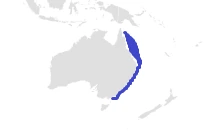
Further evidence comes from the eastern Pacific off the USA and Mexico. In the Indian Ocean, animals were found off Sri Lanka and South Africa, among others. There are significantly fewer reports from Atlantic, including from Senegal and Brazil.
The global evaluation of 261 animals assigned 214 records to the western and 35 to the eastern Pacific; Only six data sets were available from the Atlantic and Indian Oceans. This is a map of known encounters, not an inventory count. Areas with more fishing, observers and reporting requirements inevitably produce more points.

The second map ends in 2010 and is also historical. It shows how few reports were known back then, but is not complete for today’s country lists or inventory statements. Both maps should therefore be read as a chronicle of documented sightings and not as a fixed area boundary.
Multi-month telemetry instead of individual snap points
A satellite telemetry study published in 2024 tagged three animals in the Northwest Pacific for 12, 58 and 244 days. The data sets provided direct evidence for the first time of territorial loyalty east of Taiwan lasting several months and subsequent seasonal migration. During the day, the sharks spent most of their time in the mesopelagic zone, and at night they rose to epipelagic water layers.
Depth and habitat
Documented depths range from the surface to 1,203 meters. Juveniles were recorded more frequently above 200 meters in the data evaluated; larger and more mature animals also used lower and higher latitudes. The megamouth shark is therefore neither exclusively a coastal nor exclusively deep-sea species, but rather an epi- to mesopelagic migrant that occasionally reaches near islands, continental slopes, bays and coasts.
Life history, diet & reproduction
The basking shark is one of three large plankton-eating sharks alive today, along with the whale shark and the basking shark. A morphological study of the feeding apparatus describes an unusually large oral and pharyngeal cavity, elongated jaw cartilages, powerful lifting muscles and elastic skin around the throat. This combination allows the jaw to be pushed forward and the volume of the oral cavity to quickly increase.
No permanently open mouth
Unlike a basking shark, it probably doesn’t swim continuously with its mouth open. The animal opens and expands its oral cavity in phases, takes in water and prey and then closes its mouth. When squeezed across the gill slits, gill trap papillae hold the organisms back. The mechanism combines forward swimming with a suction effect supported by the increase in volume.
Krill swarms as high-energy prey
A stomach content analysis of a 3.67 meter long, 361 kilogram female from the Kuroshio Extension is particularly informative. Based on preserved mouthparts, the researchers estimated at least 18,000 euphausiaceae in the stomach contents; almost all identifiable animals belonged to the species Euphausia pacifica. This suggests targeted feeding in a dense swarm of krill.
Other stomachs examined also contained copepods and jellyfish. Individual small fish can be included, but reliable data primarily speak for concentrated accumulations of krill and other zooplankton.
Daily rhythm and prey search
The daily deep migration corresponds to the movement of many zooplankton species: at night they rise to the upper layers of water and during the day they retreat to depths with less light. The few basking sharks tagged clearly followed this pattern. It is not yet clear whether they actively find individual swarms in the wild using smell, electroreception or visual contrasts.
Reproduction: mother and seven pups documented for the first time
On 14 November 2023, a freshly dead adult female washed ashore at Barangay Ipil in Dipaculao on the Philippine island of Luzon. The mother measured 5.60 metres; the seven pups were 1.65 to 1.835 metres long. One pup was already lying beside the mother and six remained in her womb. Four were female and three were male.

The study published in 2025 describes the find as the first scientifically documented record of a pregnant megamouth shark and a complete litter. Morphological features and mitochondrial DNA confirmed the identity of all eight animals. The authors regard the find as confirmation of ovoviviparity: the eggs hatch inside the mother and the young are born alive. Whether the embryos additionally consume unfertilised eggs remains unproven.
A comparison of 19 body proportions showed that some traits scale isometrically, whereas most display positive or negative allometry. The pups were therefore not simply scaled-down adults. Litter size, gestation period, mating and birthing areas, and reproductive intervals remain unknown despite this exceptional find.
Threats & conservation status
The IUCN Red List lists the megamouth shark as not endangered (Least Concern). This classification is based on the widespread distribution, lack of large-scale target fishing and the reports available at the time. It does not mean that population size, age structure, reproductive rate or long-term trend are known.
Bycatch is the best documented human impact
A large proportion of the documented animals ended up as bycatch in drift, fishing or purse seining nets. Some were released alive, others died in the net or during retrieval. Strandings and accidental captures therefore not only shape the threat, but almost the entire scientific picture of the species.
- Entanglement in large pelagic nets and inshore gillnets.
- Injuries caused by net tension, retrieving, landing and measuring very large animals.
- Unreported or misdetermined catches that make trends invisible.
- Local concentration of bycatch in months and areas of high fishing activity.
Protection in Taiwan
Taiwan banned targeted fishing in 2020, according to the Fisheries Administration. Animals accidentally caught must be released and reported immediately, regardless of their condition; Exceptions are only made for approved teaching or research. This reduces direct use but makes non-lethal sampling, photos and satellite tagging all the more important.
Plausible risks are not yet proven main causes
Ocean warming can shift the location and season of plankton swarms, and filter feeders can ingest microplastics or bound pollutants. However, for the megamouth shark there is a lack of data that can be used to weight these influences against bycatch. Serious risk management should therefore clearly separate documented mortality from plausible but not yet quantified burdens.
Standardized reports with coordinates, date, depth, fishing gear, body length, gender, condition at release and photos are particularly valuable. For a rarely observed, highly migratory species, a lack of evidence is neither proof of absence nor of a population decline.
Megamouth shark & humans
Discovered in 1976, scientifically described in 1983
The first known megamouth shark became entangled in the sea anchor of a U.S. Navy vessel northeast of Oʻahu on November 15, 1976. The 4.46 meter long adult male holotype was later described as a new species, new genus and new family; The type catalog of the California Academy of Sciences documents the location, depth and deposited tissue samples. The formal description did not appear until 1983.
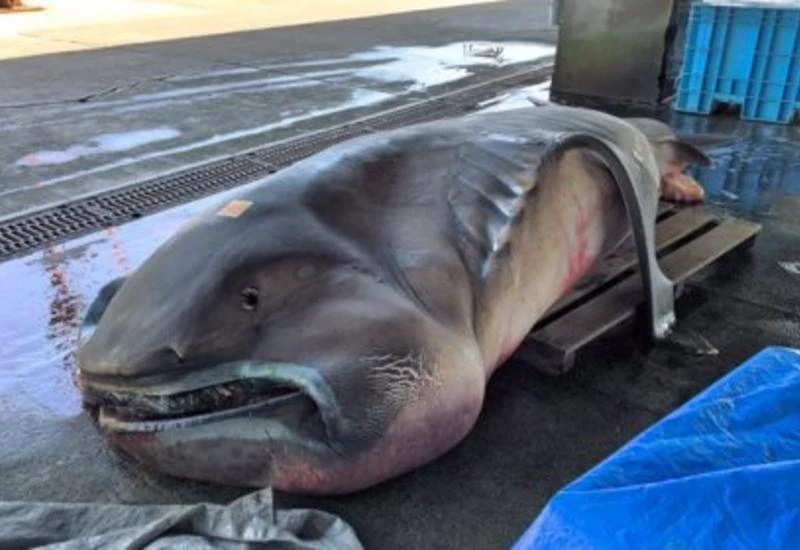
The photo of an animal caught off Japan in 2016 shows why fishermen hardly confuse the species with an ordinary large shark: the head, mouth and soft body are unmistakable. At the same time, the image represents a research problem – many anatomical findings come from animals that came to land dead or seriously injured.
Encounter with a live animal
The following video starts at 2:04 minutes and shows one of the rare underwater encounters. Such recordings are particularly valuable because body position, swimming style and reaction to observers can be documented without being caught.
Not known to be dangerous to humans
The Shark Research Institute describes the species as a plankton-feeding, slow-swimming shark; There are no known confirmed unprovoked attacks on humans. The huge mouth is built for filtering small prey, not for grabbing large animals. However, a shark several meters long can cause unintentional injury due to its mass, tail strike or escape movement.
Behavior when sighted or bycatched
- Keep your distance to the sides, leave the swimming path clear and do not pursue or circle the animal.
- Do not lift or drag for photos and do not place lines through gill gaps or around the head.
- If possible, document it in the water, measure it and release it without delay.
- Record location, time, depth, length, gender, scars and condition when released.
- Report sightings or bycatch to the responsible research or fishing offices.
Photos and videos can make individuals recognizable through scars, pigment patterns and fin injuries. For reliable research, unaltered original files with time and location information are more valuable than highly compressed social media clips. The priority is always to have a calm encounter that is as injury-free as possible.
Profile
- First described:
- Max. size:
- Depth:
- Max. age:
- Max. weight:
- Water type:
- IUCN Status:
Taxonomy
- Kingdom:
- Phylum:
- Subphylum:
- Infraphylum:
- Parvphylum:
- Class:
- Subclass:
- Superorder:
- Order:
- Family:
- Genus:
News
Newsletter
Shark Alert in Your Inbox