


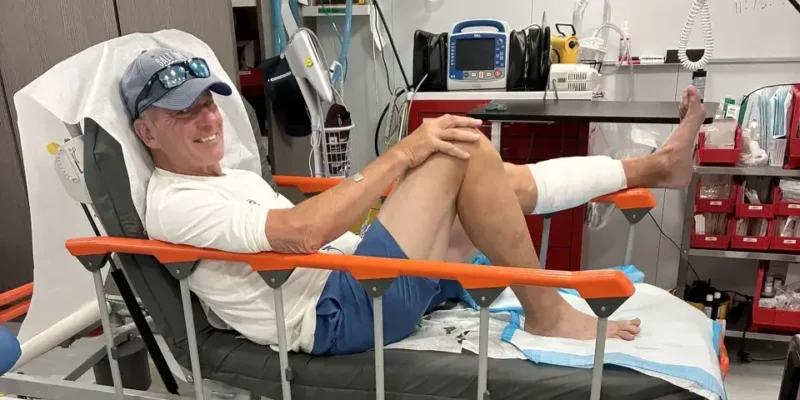
A 69-year-old man from Niantic in the US state of Connecticut was bitten by a shark while snorkeling in the Bahamas on 24 July 2026. John Schweizer survived the incident with a deep wound to his left shin. A doctor aboard his cruise ship later closed the injury with 24 stitches.
CT Insider reports this after speaking with Schweizer and his son Tom. The retired financial adviser was on an adventure cruise with his wife and two adult sons. Before the snorkeling trip, guides instructed guests to jump directly into the water. The stated aim was to scare away any Caribbean reef sharks nearby.
A shark about two meters long rose below him
Tom Schweizer observed the entry from the boat. According to his description, a shark about seven feet long, i.e. a good two meters long, rose directly below his father. John Schweizer felt the bite immediately and was momentarily pulled underwater. He was able to reach the boat under his own power, but was bleeding profusely.
The boat crew wrapped the injured leg and organized a faster boat to return to the cruise ship. There a doctor treated the wound. In Miami, Schweizer received further medical treatment, according to his son. Back in Connecticut, neighbors greeted the vacationer with shark costumes, a humorous homecoming after a serious incident.
A Caribbean reef shark is considered likely, but the identification is unconfirmed
The report names a Caribbean reef shark as the likely species. However, there is no independent confirmation or forensic species identification. The observed size alone is also insufficient for a reliable identification. Several similarly shaped requiem shark species occur in the Bahamas and can be confused at short range.
Only four confirmed unprovoked cases in the ISAF table
The species overview of the International Shark Attack File lists four confirmed unprovoked incidents involving Caribbean reef sharks and humans worldwide. All four were non-fatal. The Florida Museum also notes that the evidence behind individual species identifications is not always conclusive.
Caribbean reef sharks are common around coral reefs in the Bahamas. They can grow to nearly three meters, feed mainly on fish and play an important role in reef ecosystems as large predators. Their regular presence makes encounters more likely for snorkelers and divers, but does not make bites a routine part of such excursions.
The exact location of the incident remains unclear
CT Insider names the Bahamas as the country of the incident, but does not publish an island or a specific diving or snorkeling site. This means that no reliable statement about the conditions on site can be derived from the report. It also remains unclear whether food, schools of fish, strong currents or limited visibility played a role.
According to the guides, the instruction to jump into the water was intended to scare away sharks. However, it is not a universal security standard. The decisive factor is always the specific situation, the type and number of animals, the visibility and a briefing that provides for an orderly entry and exit and a clear end to the snorkeling session.
The crew’s quick response prevented further problems
In this specific case, the rescue chain was short: Schweizer got back on the boat, the crew reacted immediately, faster transport was organized and medical help was available on the ship. The favorable outcome does not change the fact that heavily bleeding bite wounds can become dangerous within a few minutes.
The incident shows two sides of a shark encounter in the Bahamas. Large sharks are of course part of the sea there, and incidents with humans remain rare. At the same time, their power and the possible consequences of a single bite should not be underestimated. Professional processes on board were crucial for Schweizer.