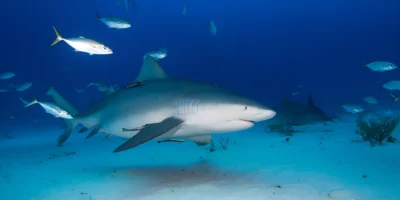
The Mexican state of Quintana Roo wants to protect bull shark diving off the coast of Playa del Carmen as a geographical indication. The Mexican Institute for Intellectual Property Law IMPI published the application on May 29, 2026 in Diario Oficial de la Federación. It is called “Tiburón Toro de Playa del Carmen, Quintana Roo”.
The protection was requested by the government of Quintana Roo. The registration was received on May 25, 2026 at IMPI. It is noteworthy that the name does not refer to a food or a processed product, but to a tourist experience with live bull sharks (Deep Dive Mexico).
@scubadan_ 150 meters from the beach you have big ol bull sharks in playa 🇲🇽 their not your issue tho 😂 the damn trigger fish are 😂
♬ Storm Troopers – Ernesto P. Neto
A clearly defined area off the coast of Playa del Carmen
The requested geographical indication refers to the “Subzona de Uso Público Tiburón Toro” within the Mexican Caribbean Biosphere Reserve. According to the application, the polygon covers 10.337062 hectares off the coast of Playa del Carmen. Approximately 20°36′ to 20°39′ north latitude and 87°04′ to 87°06′ west longitude are given.
The diving community waits there each year for the seasonal arrival of female bull sharks, including many pregnant animals, according to the technical file. Sightings are possible from approximately November to April; The application specifies the period from November 1st to March 31st as the actual season of the protected tourism product.
Observation and controlled attraction
The dossier describes two forms of bull shark diving. When simply observed, the animals spontaneously appear in the designated public use zone. In the second variant, specialized and appropriately equipped divers use a limited amount of bait as an olfactory attractant to attract bull sharks.
This means that the geographical indication would not only cover a name of origin, but also a spatially and seasonally defined tourism offering. The application presents bull shark diving as part of the local identity and as an economic alternative to traditional fishing.
The diving centers Deep Dive Mexico and Maple Leaf Scuba are located directly in Playa del Carmen. Their locations show how closely the local diving infrastructure is connected to the coastal resort. Specific bull shark offers and seasonal conditions should be checked directly with the operator.
No approval yet and no automatic species protection
Publication is a procedural step, not a decision. The IMPI expressly emphasizes that this does not prejudge the admissibility or rejection of the application. Interested third parties can object in writing and submit supporting documents within a non-extendable period of two months after publication.
The legal scope is equally important: a geographical indication primarily protects the name and the association of a product or service with a specific area. It does not automatically replace fishing regulations, protected area law or biological protection status for the bull shark.
Opportunity and obligation for shark tourism
If the designation is later recognized, it could raise Playa del Carmen’s profile as an internationally known area for bull shark encounters. However, the value of such a name depends on whether clear safety, animal welfare and sustainability standards are set and monitored.
Precisely because predominantly female and apparently often pregnant animals are off the coast during the season, economic use must be combined with reliable monitoring. A designation of origin can create a framework for quality. Whether it actually contributes to protecting sharks will depend on the later rules and their implementation.