


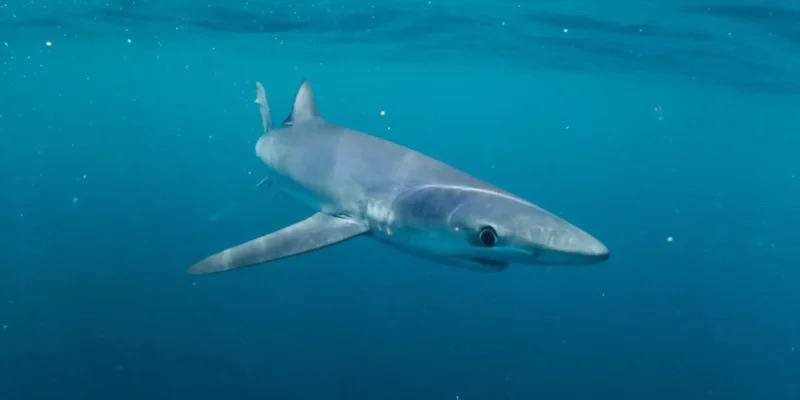
blue sharks (Prionace glauca) are long-distance migratory oceanic sharks. This is precisely why they are suitable as a warning signal for pollutants that do not stop at a single stretch of coast. A new one Open access study in Environmental Science and Pollution Research now shows that blue sharks from the northern tropical eastern Pacific can simultaneously carry anthropogenic microparticles and mercury pollution.
23 blue sharks, two sampling periods
Ten animals came from a research trip in southern Gulf of California in July 2019, another 13 from commercial fishing vessels that landed in January 2021 in Mazatlán, Sinaloa. The Sharks had been caught with pelagic longlines. In the laboratory, the stomach and intestines were examined for anthropogenic microparticles; Liver and muscle provided data on total mercury exposure.
The study separates classic microplastic particles from non-plastic anthropogenic microparticles. The latter include cotton, cellulose and Rayon from processed textiles. It is precisely this distinction that is important because such fibers easily disappear behind the buzzword microplastics in environmental analyzes even though they can also be chemically treated, long-lasting and ecologically relevant.
All animals contained microparticles
The result was clear: the researchers found at least one anthropogenic microparticle in all blue sharks examined. On average there were 32 ± 37 particles per digestive tract. Fibers clearly dominated at 76 percent; most particles were smaller than five millimeters. Among the synthetic polymers, polyethylene and PET were particularly common.
The non-plastic anthropogenic particles were even more conspicuous in number. More than 60 percent of the anthropogenic particles confirmed by FTIR belonged to this group, especially cotton, Rayon and cellulose. Conventional microplastic particles averaged 12 ± 11 particles per digestive tract, non-plastic microparticles 22 ± 27.
Mercury and fibers appeared together
The mean mercury exposure in liver and muscle was 1.08 ± 0.43 mg kg⁻¹. Statistical models identified the abundance of non-plastic anthropogenic microparticles as the strongest predictor of mercury levels. The relationship was not linear and was particularly pronounced in the hot, humid rainy season.
That doesn’t mean that the fibers alone brought the mercury into the sharks. The authors themselves emphasize that the data show a common occurrence, but do not prove direct transfer. Common sources, food, seasonal runoff, currents, and trophic effects can also explain why particles and mercury vary together.
Why textile fibers are important
At first glance, textile fibers made of cotton, cellulose or Rayon seem more harmless than plastic. However, in the environment they can carry or bind dyes, additives and other substances. The study therefore addresses a gap in many monitoring programs: those who only count synthetic plastics may be underestimating a large proportion of man-made particle pollution.
This is particularly relevant for blue sharks because, as highly mobile predators, they integrate many bodies of water and food webs. A single stomach content tells the story not just of a capture location, but of the stress on a larger pelagic system. The Tropical Eastern Pacific is both a fishing area and a transport corridor for floating garbage from the North Pacific.
Risk yes, but not a simple seafood warning
Overall, the calculated stress indices were in the low to moderate range. At the same time, more than half of the animals in the Polymer Hazard Index exceeded the threshold value of 1000. This shows that the pure particle number is not enough to understand risk. Material type and chemical hazard make a big difference.
However, no direct consumption warning can be derived from this for people. The microparticles were counted in the digestive tract, not in edible tissues. Mercury in muscle tissue remains a distinct, well-recognized problem in large predatory fish. Rather, the particle data shows that future food safety and marine monitoring programs should consider multiple contaminant pathways together.
What the study shows for shark protection
blue sharks are commonly caught worldwide and reported as bycatch. If such animals also carry microparticles, textile fibers and mercury pollution, shark protection goes beyond catch quotas. It affects wastewater, textile fibers, waste transport, fishing pressure and the question of which substances enter pelagic food webs.
The study does not provide a definitive causal chain, but does provide an important baseline. It shows that non-plastic anthropogenic microparticles in large oceanic sharks should not be treated as a side issue. If you want to understand the health of sharks and marine ecosystems, you will also have to measure these quiet fibers in the future.
