


Bronze whaler shark - Carcharhinus brachyurus

Body structure, features & anatomy
The bronze whaler shark Carcharhinus brachyurus is a large requiem shark with a classic, powerful shark silhouette. WoRMS leads the species taxonomically within the Carcharhiniformes, the family Carcharhinidae and the genus Carcharhinus. The German name fits the mostly bronze-gray to olive-gray upper surface, which brightens significantly towards the light belly.
Shark References cites the bluntly pointed, broad snout, narrow hook-shaped upper tooth tips and the lack of a pronounced ridge between the two dorsal fins as important identifying features. It is precisely this combination that is important because bronze whaler sharks easily interacts with other large ones in the field Carcharhinus-Species can be confused.
Shape, color and demarcation
- Upper side gray to bronze-colored, underside white, usually without noticeable hard markings.
- First dorsal fin medium sized and triangular; second dorsal fin significantly smaller.
- No prominent interdorsal ridge between first and second dorsal fins.
- Upper teeth in adults narrow, curved and finely serrated.
- Maximum values are around 3.25 m long and a good 300 kg weight.
This makes the species appear less stocky than a bull shark and less high-backed than a sandbar shark. Safe identification still requires good photos of the head, fins, body coloration and teeth, especially in juveniles or in regions with several similar coastal sharks.
Distribution & habitat
The bronze whaler shark is an inshore and shelf shark of warm temperate and subtropical seas. FishBase describes it as a continental margin species that occurs both offshore and further out, occasionally using large bays, estuaries and inshore areas.
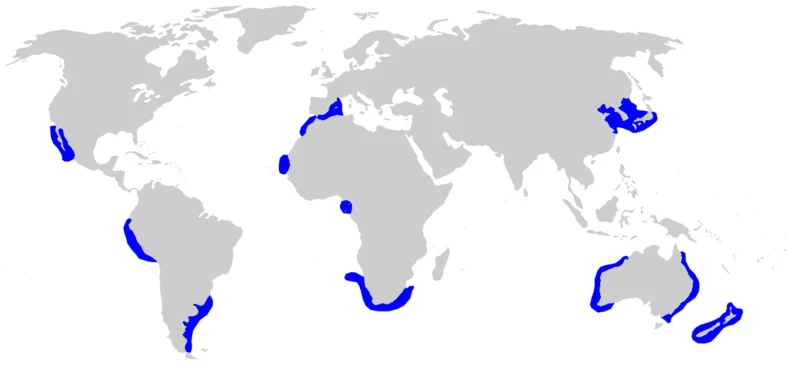
Its distribution is wide but patchy. Shark diving is particularly important Atlantic, the Mediterranean, the Indian Ocean and the Pacific relevant. Well-known focal points include: Australia, South Africa, New Zealand and on parts of the coasts of Mexico as well as South America.
Coasts, shelves and seasonal movements
Typical habitats range from near surf, open bays and harbors to shelf areas and island edges. The depth range of 1 to 145 m stored in the species profile describes the core area relevant for divers and coastal fishing; Depending on the region, greater depths are also mentioned in the literature.
In parts of its range, the bronze whaler shark migrates seasonally. Animals follow temperature, prey, and reproductive spaces; In South African waters, for example, they can be noticed with schools of sardines near the coast, while Australian data show large-scale movement along the southern coast.
Life history, diet & reproduction
bronze whaler sharks are mobile predators of productive coastal seas. The Save Our Seas Foundation describes the species as a shallow coastal shark that may be closely associated with sardine movements in South Africa. The range of prey includes bony fish, cephalopods, smaller sharks and rays.
The animals hunt individually or in loose groups. With large schools of fish, multiple bronze whaler sharks can use the same prey pulse; This looks spectacular for divers, but above all it is a sign of how dependent this species is on seasonally productive coastal ecosystems.
Reproduction
bronze whaler sharks are viviparous with yolk sac placenta. After the early yolk supply, the embryos continue to be nourished in the mother and are born as fully developed young animals. Depending on the source and region, litters contain approximately 7 to 24 young animals; Information is often in the range of a good dozen.
The gestation period is usually given as approximately twelve months, and females do not reproduce annually. In many regions, births take place in flat, sheltered coastal areas. Newborns are about 60 to 70 cm long and use bays, estuaries and food-rich shallow water areas as breeding areas.
growth and maturity
Like many large coastal sharks, the bronze whaler shark grows slowly and reaches sexual maturity late. Females only reach maturity when they are a good two meters long; Age information in the species profile and in regional studies show that populations respond only slowly to strong fishing pressure.
Threats & protection status
The IUCN Red List levels Carcharhinus brachyurus global as endangered a. The reason is not a single local problem, but the combination of wide but patchy distribution, slow life history, and fishing pressure in coastal and shelf fisheries.
Main hazards
- Targeted catch and bycatch in coastal fisheries, particularly with nets and longlines.
- Use of meat, fins and other products at regional markets.
- Recreational fishing and incompletely documented harvests in some coastal regions.
- Loss or disruption of shallow bays and estuaries that may be important as nursery areas.
- Late sexual maturity and reproductive pauses, causing populations to recover slowly.
The report Status of Australian Fish Stocks shows why regional considerations remain important: In Australia, the bronze whaler shark is treated as a single biological stock across much of the south coast, while the global IUCN assessment summarizes the global risks. For conservation work, this means taking local catch data, migration and nurseries separately seriously.
Effective protection therefore requires reliable species identification in catch data, cautious catch limits, observer programs, protection of important nursery areas and international control of trade. Especially for a species that is not common everywhere, seemingly regional losses can quickly become permanent.
Bronze whaler shark & humans
To humans, the bronze whaler shark is not typically a deliberately aggressive shark, but is a large, powerful coastal predator. The Florida Museum lists the species as potentially dangerous because it is large enough to cause serious injury and has historically been implicated in isolated incidents.
The practical risk usually arises in special situations: cloudy water, fish remains, fishing bait, spearfishing, seals or large schools of fish nearby. Anyone who encounters a bronze whaler shark should remain calm, keep their distance, do not harass a caught or fed shark and do not put their hands near the mouth or prey.
Diving and observation
The bronze whaler shark is particularly exciting for divers where productive coastal ecosystems attract large schools of fish. The animals can appear curious, but remain wild animals with strong swimming and hunting behavior. Good observation means a clear group, no feeding without a strict protection and approval concept, no touching and a clean exit if an animal becomes intrusive.
Ecologically, the bronze whaler shark stands for long-lived coastal predators that mediate between open shelf areas, bays and seasonal prey pulses. For shark diving, it is therefore not only a great shark encounter, but also an indication of how closely healthy coastal fish stocks, protection of nurseries and responsible fishing are linked.
Profile
- First described:
- Max. size:
- Depth:
- Max. age:
- Max. weight:
- Water type:
- IUCN Status:
Taxonomy
- Kingdom:
- Phylum:
- Subphylum:
- Infraphylum:
- Parvphylum:
- Class:
- Subclass:
- Superorder:
- Order:
- Family:
- Genus:
News

Plettenberg Bay: Shark Spotters programme suspended
Shark draws nearly 20,000 visitors to Busan waterfront park
Surfer defies shark attack and drives himself to hospital
More Than Remoras: Why a Shark Is Also Habitat for Other Fish
Sharks in an Industrial Harbour: Can Ngqura Show How Artificial Coasts Offer Protection?


Newsletter
Shark Alert in Your Inbox