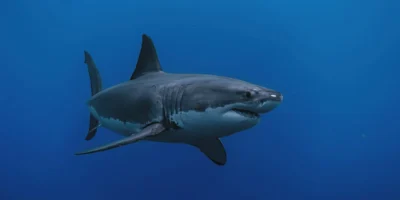
For decades, South Africa was one of the great dream destinations for white sharks. False Bay, Gansbaai and Mossel Bay stood for breaching sharks, cage diving, wildlife films and a form of marine tourism that made living animals economically valuable. Today that story feels cut short at many former hotspots: the sharks have not simply become rarer, they have virtually disappeared from some of the best-known places.
The South African article by 2oceansvibe takes up this development sharply and asks one central question: are the orcas Port and Starboard being used too conveniently as an explanation, while human-made factors such as longline fishing, shark nets and weak enforcement have too few consequences?
This fits the updated valuation approach from Shark Allies. The organization concludes that the former financial value of South Africa’s white sharks has effectively been lost through the collapse of sightings and the tourism industry connected to them. This is not an abstract conservation calculation, but a warning about how expensive it becomes when an apex predator is protected on paper first and then disappears from the sea.
Orcas Do Not Explain the Whole Story
Port and Starboard have strongly shaped South Africa’s shark debate. The two male orcas have been linked to dead white sharks whose livers were removed. Such cases are biologically spectacular and powerful in the media, but several critics argue that they do not explain the timing of the decline.
In a BizNews interview, Chris Fallows, who documented the white sharks of Seal Island for decades, argues that numbers were already falling from around 2007 and that the collapse began before the well-known orca events. Fallows sees the orcas more as additional pressure on an already weakened population, not as the sole cause.
CBS/60 Minutes also describes the dispute more cautiously: some researchers consider a spatial shift caused by orca pressure plausible, while others, including Enrico Gennari and Fallows, point more strongly to fishing, prey depletion and lethal coastal-protection systems. That uncertainty matters. The orca story is real, but it should not stop controllable human causes from being examined and reduced.
The Problem on the Hook
At the center of the criticism is the demersal shark longline fishery. Long mainlines with many hooks are set on or close to the seabed. Target species include soupfin and smoothhound sharks, smaller shark species that can be important prey for white sharks.
When such prey species are heavily fished, the white shark does not only lose food. It can also die as bycatch because the longlines fish where the sharks hunt. A particularly sensitive point is that, according to Fallows, the fishery is regulated through a system of allowable effort: limits on boats and effort do not automatically replace a firm catch limit for threatened species.
Mongabay reported on the case of the Zanette, a fishing vessel where observations by Enrico Gennari raised possible permit violations and further investigative questions. 2oceansvibe uses the case as an example of how weak deterrence can be when sanctions remain small and a vessel keeps fishing.
Protection That Still Kills
A second, older conflict is the shark nets and drumlines of the KwaZulu-Natal Sharks Board. They are intended to protect bathers, but they also kill protected and threatened marine animals. For white sharks, this pressure is especially hard to absorb because they grow slowly, mature late and produce few young.
That is what makes the South African case so bitter: the white shark has been protected there since 1991 and was still caught in systems that accept lethal losses. Legal protection alone is not enough if bycatch, coastal protection and longline fishing are not treated as one connected problem.
The Mongabay background on South African shark fisheries places this weakness in a broader context: threatened shark species are caught between export markets, weak enforcement and management that does not always keep pace with biological risk.
The Lost Value of Living Sharks
Shark Allies describes the decline not only as an ecological loss, but also as an economic failure. The former white-shark tourism industry brought visitors to the coast, supported local operators and made South Africa visible worldwide as a shark destination. The valuation cites earlier figures such as roughly 100,000 shark-related tourists in the Western Cape and a contribution of about one billion rand to the economy.
These figures matter because they make a simple contrast visible: a living white shark could create value for years without being killed. A dead shark, or a destroyed prey-fish community, may bring short-term revenue, but it loses the larger ecological and tourism context.
At the same time, the economic view should not be confused with species protection itself. White sharks are not worth protecting only because people want to see or photograph them. Their value also lies in their role as apex predators, scavengers and part of a coastal system that becomes poorer and less stable without large predators.
What Matters Now
The lesson from the reports is not to erase orcas from the story. The lesson is to take controllable pressures more seriously. That includes real catch limits instead of pure effort logic, consistent enforcement of permit conditions, a review of lethal shark nets and clearer transparency about which sharks end up as supposedly anonymous fish on export markets.
For divers, the development is especially tangible. Many South African operators have had to shift tours to other species such as bronze whalers because white sharks no longer appear reliably at former hotspots. That can still create good encounters, but it does not replace the loss of a unique white-shark system.
South Africa therefore shows an uncomfortable truth about shark conservation: a famous animal can be globally known, nationally protected and economically valuable, and still disappear if everyday rules at sea do not work. That is where it is decided whether protection is more than a nice sign at the edge of an empty ocean.