


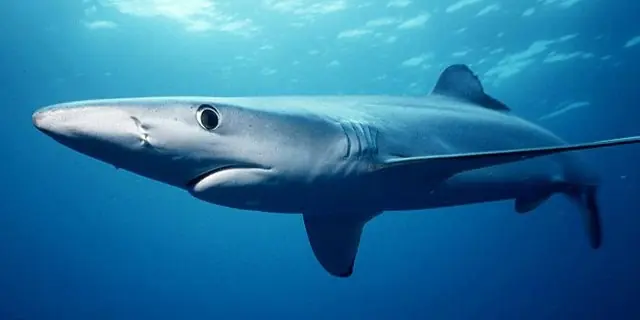
Contrary to its striking name, the blue shark (Prionace glauca) may possess an unexpected ability: it can change its colour. A research team from Hong Kong has identified nanostructures in its skin that resemble those of chameleons and open new perspectives for its adaptation to the marine environment.
This groundbreaking discovery is based on a detailed analysis of the shark’s denticulated scales and reveals a highly developed optical mechanism. The scientists suspect that these structures could respond to the environment, thus providing a previously unknown camouflage advantage among sharks.
A nanometric mechanism
The blue colour of the shark is created by guanine crystals that reflect blue light, combined with melanosomes that absorb other wavelengths. These elements, encapsulated in different cells, act like a selective mirror and an absorbing filter.
The distance between the crystal layers determines the hue: when compressed, they produce blue; when expanded, they shift towards green or yellow. Digital simulations have confirmed this flexibility, although their natural activation still needs to be observed in situ.
“This system resembles that of chameleons but has an evolutionary peculiarity unique to sharks, which diverged from bony fish millions of years ago.”
An adaptation to the environment?
The researchers suspect that water pressure at depth compresses the crystals, thereby darkening the skin to blend better into the abyss. Such an adaptation would be the first proven in a shark, although other species show similar signs.
Possible applications are already inspiring biomimetic technology. Structural colouration, which is less environmentally harmful than chemical pigments, is of particular interest to the shipping and textile industries.
Finally, this study underscores the diversity of animal strategies for producing blue, a colour rare in nature. Sharks thus offer a new model for understanding the evolution of optical mechanisms.
This discovery could fundamentally change our understanding of sharks and once again shows how many secrets the oceans still hold. The fact that these prehistoric predators possess such sophisticated adaptation mechanisms highlights the remarkable complexity of marine ecosystems.
