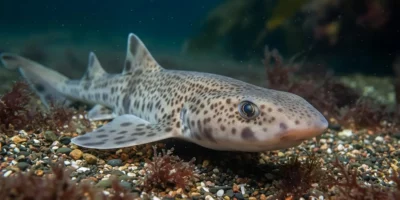
Small-spotted catshark as a bioindicator of marine pollution
The Mediterranean is considered one of the most polluted seas in the world. Tourism, industry, and shipping leave significant traces that, in this semi-enclosed sea, are only slowly broken down. As a result, waste and pollutants, especially plastic, accumulate on uninhabited islands like Alegranza north of Lanzarote in the Archipiélago Chinijo nature reserve.
A recent study by the Institute of Marine Sciences (ICM-CSIC) and the Spanish Institute of Oceanography (IEO-CSIC) now shows alarming mercury levels in the small-spotted catshark (Scyliorhinus canicula), a small deep-sea shark of the Mediterranean and the Cantabrian coast. With a length of 40 to 50 centimetres, up to a maximum of 1 metre, it is considered an indicator species. These species reveal the risks their consumption poses to humans, as they accumulate pollutants in their tissue.
Particularly large specimens and animals near the Catalan coast showed the highest mercury levels. The results confirm earlier studies: the Mediterranean is more polluted than the Atlantic.
Health risks and protective measures
Elena Lloret, a postdoctoral researcher at ICM-CSIC, warns: “Regular consumption of small-spotted catshark could pose health risks, particularly in regions where it is frequently eaten.” Depending on the amount consumed, mercury levels exceed the limits set by authorities.
Joan Giménez, a researcher at the Oceanographic Centre of Málaga, adds that the small-spotted catshark serves as a bioindicator for pollutant levels in deep-sea ecosystems. The pollution not only affects the animals themselves but can also be transferred to humans through the food chain.
Fishing and habitat loss threaten species
The main threat to sharks and rays is trawl fishing, which not only decimates species but also destroys their habitats. Biel Morey, marine biologist and co-founder of Save the Med, emphasises the severe consequences of human interventions, including coastal development, port facilities, and tourism measures such as beach nourishment.
The biological characteristics of sharks – low fertility, slow growth, late sexual maturity, and high longevity – reduce their reproductive potential. In the Balearic Islands, 50% of shark and ray species are already threatened. Some species, such as the smooth-hound (Mustelus mustelus) and the nursehound (Scyliorhinus stellaris), show worrying population trends, with some even considered locally extinct.
Climate change intensifies the threat
Climate change is altering habitats in the Mediterranean: warming, acidification, and oxygen depletion are leading to a biogeochemical transformation of the seas. Raquel Sunyer, coordinator of the Mar Balear report, points out that coastal dwellers like the small-spotted catshark and rays are particularly sensitive. Open-sea species, on the other hand, may retreat to deeper, cooler waters.
The study authors therefore call for specific protective measures, such as releases by fishermen and inclusion in management plans for Natura 2000 areas, to stabilise populations and preserve biodiversity.