


Winghead shark - Eusphyra blochii
Body structure, features & anatomy
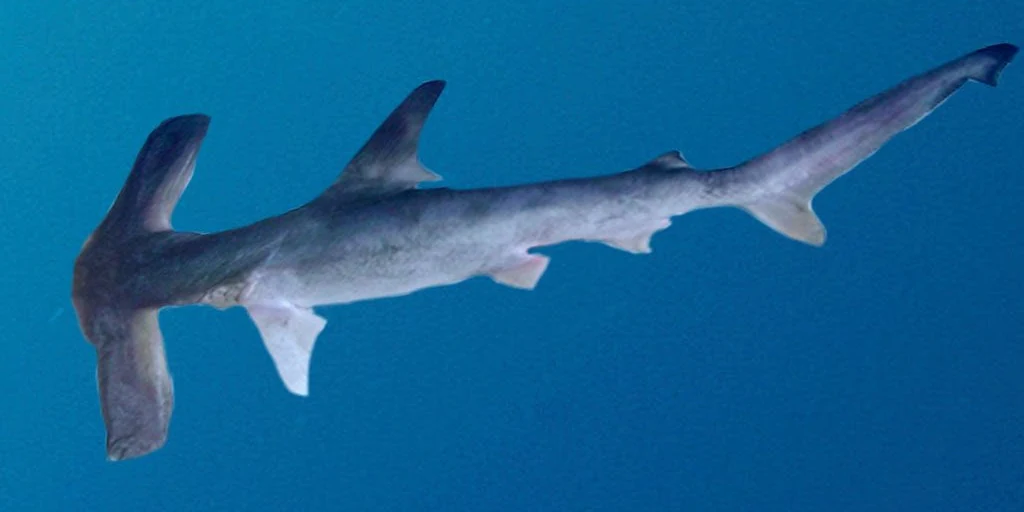
The exceptionally broad, narrow head is the most distinctive feature. Its lateral extensions can span almost half the shark’s total length. The eyes sit at the outer tips, while elongated nostrils run near the front edge. Small bumps in front of the nostrils help distinguish it from other hammerheads.
The Australian Museum describes a particularly large overlapping field of vision. Widely separated olfactory organs and electroreceptors distributed across the underside of the head provide a broad sensory search area.
The body is slender, grey to grey-brown above and paler below. The first dorsal fin is tall and sickle-shaped; the second is much smaller. Short triangular pectoral fins and an asymmetrical tail complete its distinctive outline.
The teeth have smooth cutting edges and an oblique main cusp. At a maximum recorded length of about 1.86 metres, it is smaller than many other hammerheads. The extreme width of the head is a more reliable identification feature than size alone.
Distribution & habitat
Its range spans the tropical Indo-Pacific, from the Indian Ocean to the western Pacific Ocean. Records include India, Sri Lanka, Indonesia, China, the Philippines and northern Australia.
It mainly inhabits shallow continental shelves, bays, estuaries and turbid coastal waters. It tolerates brackish water and generally occurs from the surface to around 40 metres deep. Sandy or muddy bottoms and areas influenced by large rivers appear particularly suitable.
A record published in the Journal of Fish Biology extended its known Australian range roughly 800 kilometres south to Moreton Bay, Queensland. The 1.57-metre male was caught, measured and released alive in 2018.
Whether this individual represents a previously overlooked local population or a climate-related southward shift remains unresolved. Patchy occurrence, poor underwater visibility and misidentification in fisheries complicate range estimates. Repeated, reliably identified records are therefore especially valuable.
Life history, diet & reproduction
The broad head is not a rigid wing. It can tilt up and down during prey pursuit and appears to assist rapid changes of direction. Numerous sensory pores on its underside detect electrical signals from animals, including those concealed near the seabed.
A 2026 observation in Pacific Conservation Biology documented a complete hunting sequence. During a 143-second recording, a shark about 1.5 metres long followed a fish, made tight turns and repeatedly adjusted its head position before catching and eating the prey.
FishBase lists small bony fishes, crustaceans and cephalopods as food. Reproduction is placental viviparity: embryos initially feed on their yolk sacs, after which a connection to the mother supplies nourishment until birth.
Gestation is estimated at eight to eleven months. Litters may contain six to 25 pups, approximately 32–45 centimetres long at birth. Females may reproduce annually. Slow growth, late maturity and a generation length of around 14 years nevertheless limit the recovery of heavily exploited populations.
Threats & conservation status
The 2025 IUCN Red List assessment classifies the species as Critically Endangered. Across much of South and Southeast Asia, its coastal habitat overlaps with intensive fisheries, while reliable long-term monitoring remains scarce.
Gillnets and coastal trawl fisheries are major threats. The exceptionally wide head readily becomes entangled. Sharks are landed for meat, fins and liver oil or retained as bycatch. Juveniles in estuaries are also exposed.
The Australian stock report classifies the population as depleting. Even in this comparatively better monitored part of the range, a decline exceeding 30 per cent is considered possible. Populations connected across national boundaries face additional fishing pressure in neighbouring waters.
Effective conservation requires protection of estuaries and coastal habitats, lower bycatch, prompt release of living sharks and species-specific catch records. A long generation time delays recovery. Missing information should not be mistaken for evidence of a stable population.
Winghead shark & humans
This small hammerhead is generally regarded as harmless to swimmers and divers; no confirmed attacks on people are known. Although it lives in shallow water, its habitat is often turbid and away from conventional dive sites. Population declines further reduce opportunities for sightings.
Most encounters arise through coastal fishing or scientific surveys. Living bycatch should be released promptly and carefully, preferably while supported in the water. Sharks should not be lifted by their heads or kept out of water for photographs.
The FAO species catalogue describes the use of the meat for food, the liver for vitamin oil and other remains for fishmeal. Products are often not identified to species, making fishing pressure difficult to quantify.
Photographs of the head underside and fins, length measurements, location, depth and fishing gear can help research and conservation. Records should be sent to local fisheries authorities or scientific programmes. Documentation should never delay a prompt release.
Profile
- First described:
- Max. size:
- Depth:
- Max. age:
- Max. weight:
- Water type:
- IUCN Status:
Taxonomy
- Kingdom:
- Phylum:
- Subphylum:
- Infraphylum:
- Parvphylum:
- Class:
- Subclass:
- Superorder:
- Order:
- Family:
- Genus:

Newsletter
Shark Alert in Your Inbox