
Whale shark - Rhincodon typus

Body structure, characteristics & anatomy
The whale shark (Rhincodon typus) is considered the gentle giant of the oceans. With a length of up to 18 metres and a weight of several tonnes, it is one of the most impressive representatives of sharks. Despite its enormous size, it feeds mainly on plankton, small fish and crustaceans, which it takes in through its filter system. It is of particular interest to science and nature conservation, as it has developed unique adaptations to life in the open sea.
The impressive body size
The whale shark is the largest known fish on Earth. Its body shape appears massive, yet it is a skilful swimmer. The broad, flattened head has an enormous mouth that can be up to 1.5 metres wide. Through this, it takes in thousands of litres of water daily to filter out food. Despite its size, it moves slowly and glides gently through tropical and subtropical waters.
Anatomical characteristics
Characteristic of the whale shark are its five large gill slits, through which it filters water and food. It has tiny teeth, which are hardly used for feeding. Instead, special lamellae in the gills ensure efficient filtration. Its skeleton, like that of all sharks, consists of flexible cartilage, which combines lightness and stability. This enables it to swim energy-efficiently despite its massive stature.
External features
The most striking feature of the whale shark is its skin pattern. The body is dark grey to bluish in colour and covered with light spots and lines that resemble a mosaic. This pattern is unique to each individual and functions similarly to a fingerprint. Researchers use this pattern to identify individual animals and document their migrations. The whale shark’s skin is extremely thick and provides protection against injuries and parasites.
Differences between males and females
The distinction between male and female whale sharks is not made solely on the basis of body size, but through specific anatomical features. Males have so-called claspers – paired appendages on the pelvic fins that serve reproduction. Females do not possess these structures, which allows for clear identification.
Physical differences
Female whale sharks reach larger average sizes than males. They can grow to lengths of over 14 metres, while males usually remain somewhat smaller. These differences are likely related to reproduction, as female animals require additional space for the development of numerous embryos. Studies suggest that females can produce several hundred offspring during their lifetime.
Distribution & habitat
The whale shark (Rhincodon typus) is found in all tropical and subtropical oceans. As the world’s largest fish, it prefers warm waters rich in plankton and small fish. Its way of life is closely linked to the availability of food and seasonal currents, which is why it undertakes extensive migrations.
Geographical distribution
Whale sharks are found in large parts of the Atlantic, Indian Ocean and Pacific. They are particularly common near the coasts of countries such as Mexico, the Maldives, Mozambique and the Philippines. They are also regularly observed in the Red Sea and along tropical island chains such as the Seychelles and the Galapagos Islands. In temperate zones, whale sharks appear less frequently, as the water temperatures there are too low for their way of life.
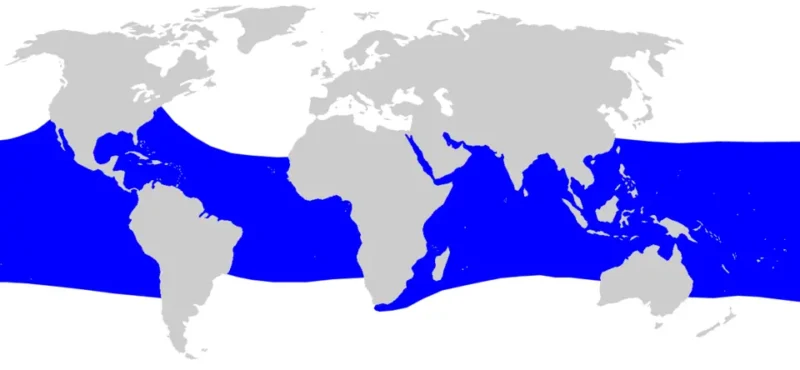
Chris_huh, CC BY-SA 3.0, via Wikimedia Commons
Ocean habitat
The whale shark prefers open sea areas but also often moves in coastal regions. Particularly where plankton blooms occur or large quantities of fish spawn are available, the animals gather in groups. These gatherings, also known as aggregations, are observed especially in certain seasons. Dozens of whale sharks can gather in one place to feed together.
Depth and areas of residence
Whale sharks are mainly found at the ocean surface, where they take in their main food. However, they are capable of diving to depths of more than 1,000 metres. Such dives are likely for foraging or energy conservation. Their ability to move between different water layers makes them flexible inhabitants of the oceans.
Factors influencing distribution
The distribution of the whale shark depends heavily on water temperature, currents and food availability. Seasonal changes, such as the occurrence of plankton blooms or the spawning of certain fish species, influence their migrations. Studies have shown that whale sharks can travel thousands of kilometres to reach suitable feeding grounds or breeding areas.
Lifestyle, diet & reproduction
The whale shark (Rhincodon typus) is one of the most admired marine creatures. Despite its enormous body size, it is considered a peaceful plankton feeder that poses no threat to humans or larger animals. Its lifestyle is largely determined by its search for food and seasonal migrations. There are also fascinating insights into its reproduction, which has so far only been partially researched.
Lifestyle of the whale shark
Whale sharks lead largely solitary lives but gather in larger groups at certain times in rich feeding grounds. These aggregations are often linked to seasonal plankton blooms or the spawning of fish species. Outside of such events, whale sharks usually travel alone through tropical and subtropical oceans. They cover enormous distances and are considered enduring migrants that adapt flexibly to different currents and living conditions.
Diet
The diet of the whale shark is unique. It feeds mainly on plankton, small fish, krill and other tiny organisms. Its huge mouth allows it to take in many thousands of litres of water daily, which it filters through its gills. Whale sharks use two methods: they swim with their mouths open through nutrient-rich waters or they actively suck in water, then press it out through their filter structures. Their tiny teeth play hardly any role, as feeding occurs almost exclusively through the filtration system.
Reproduction
Little is known about the reproduction of the whale shark, as observations in the wild are rare. It is certain that whale sharks are ovoviviparous – meaning the embryos develop in eggs inside the mother’s body and are born live. Females can give birth to several hundred offspring, with the young measuring around 50 to 60 centimetres at birth. Interestingly, fertilisation can occur over extended periods, allowing females to carry offspring for years. Male whale sharks are identifiable by their claspers on the pelvic fins, which are necessary for reproduction.
Interaction with humans
The whale shark is considered the largest fish on Earth. Despite its impressive size of up to 12 metres in length, it is completely harmless to humans. Worldwide, it captivates divers, snorkellers and marine researchers who want to encounter it in the wild. The interaction between humans and whale sharks has gained increasing importance in recent years – both as a tourism factor and for the conservation of this endangered species.
Why the whale shark is fascinating to humans
Even the first glimpse of the huge body with its distinctive white spots and stripes leaves a lasting impression. Unlike other sharks, the whale shark feeds exclusively on plankton, small fish and crustaceans, which it filters through its gigantic mouth. Its peaceful behaviour makes it an ideal ambassador for the underwater world. Many people describe an encounter with a whale shark as deeply moving and unforgettable.
Encounters while diving and snorkelling
Whale sharks often occur in regions where they gather seasonally to take advantage of plankton-rich waters. In places like Mexico, the Maldives or the Philippines, entire ecotourism offerings have developed around this. The animals usually approach the water’s surface slowly, where snorkellers and divers have the opportunity to observe them in their natural habitat. However, swimming with whale sharks requires consideration and strict rules to avoid disturbing the animals.
Rules for responsible interaction
To ensure whale sharks are not endangered by human proximity, many countries have introduced codes of conduct. These include minimum distances of several metres, a ban on touching and restrictions on the number of people in the water at the same time. Boats must also reduce their speed to prevent collisions. Such rules not only protect the animals but also enable people to have a respectful and sustainable encounter.
Tourism, conservation and research
Ecotourism around the whale shark brings economic benefits to many coastal communities. At the same time, part of the revenue is often invested in the conservation of the animals. Researchers also use encounters with whale sharks to document their migrations, behaviour and populations. This data is crucial, as the whale shark is listed as endangered on the IUCN Red List. Every interaction between humans and animals can thus contribute to greater knowledge and protection.
Threat & Conservation Status
Conservation Status of the Whale Shark
The International Union for Conservation of Nature (IUCN) lists the whale shark as endangered on the Red List. This classification means that the species is experiencing a significant decline in population and, without conservation measures, faces a high risk of extinction. The Convention on International Trade in Endangered Species of Wild Fauna and Flora (CITES) also lists the whale shark in Appendix II, which strictly regulates its international trade. Many countries have additionally enacted national protection laws that prohibit catching and marketing them.
Main Threats to the Whale Shark
The greatest threat to whale sharks comes from fishing. Although they are not aggressive, they are often accidentally caught as bycatch in large nets. In some regions, they are also targeted for their meat, fins, or oil. Collisions with boats also pose a significant risk, as whale sharks frequently swim near the water’s surface.
Another factor is environmental pollution. Plastic waste increasingly enters the oceans and can be ingested by whale sharks along with plankton. Climate change is also altering the distribution of plankton, threatening the animals’ food supply. This combination of human influence and ecological changes puts considerable pressure on the whale shark.
The Role of Ecotourism
Tourism can be both a curse and a blessing for the whale shark. On the one hand, it provides economic incentives that can contribute to the protection of the animals. On the other hand, uncontrolled tourism can cause stress and disrupt their natural behaviour. Strict regulations and responsible providers are therefore crucial to ensure that tourism makes a positive long-term contribution.
Research and International Cooperation
Scientific projects and international agreements are essential to better understand the migrations and habits of the whale shark. Satellite telemetry, photo identification, and DNA analysis provide important data that serve as the basis for conservation programmes. Only through close cooperation between coastal states, environmental organisations, and scientists can the decline be halted.
Keeping in Aquariums
The whale shark is the world’s largest fish and exerts an enormous attraction on people. While most encounters take place in the wild, there are a few aquariums worldwide that keep whale sharks. This practice is highly controversial, however, and has sparked an intense debate between supporters and critics for years.
Why Whale Sharks Are Displayed in Aquariums
Some large marine aquariums, particularly in Asia, have housed whale sharks in enormous tanks. Operators argue that visitors develop a stronger awareness of ocean conservation through direct encounters with the animals. Additionally, the sharks serve as a flagship species to attract tourists from around the world. In some cases, research projects are cited where the behaviour and diet of whale sharks can be observed.

Challenges of Keeping Them in Captivity
Whale sharks are ocean wanderers, covering thousands of kilometres in the wild. This lifestyle is nearly impossible to replicate in captivity. Even the largest aquarium tanks offer only a tiny fraction of their natural habitat. Problems such as restricted movement, stress, and injuries from collisions with tank walls have been documented. Feeding also poses challenges, as whale sharks require large quantities of plankton, which is difficult to simulate in controlled environments.
Criticism from Animal Welfare Organisations
Numerous animal welfare organisations strongly criticise the keeping of whale sharks in aquariums. They argue that the animals cannot live species-appropriately in captivity and often have a significantly shortened lifespan. Additionally, there is the ethical question of whether it is justifiable to remove such migratory animals from their natural environment. For many experts, the negative aspects clearly outweigh any potential benefits.
Alternatives to Keeping Them in Aquariums
Instead of displaying whale sharks in captivity, more and more organisations are focusing on education through documentaries, virtual reality technologies, or guided excursions in the wild. These approaches enable impressive experiences without restricting the animals’ freedom. Moreover, they help to combine tourism with marine conservation in a sustainable way.
Profile
- First described:
- Max. size:
- Depth:
- Max. age:
- Max. weight:
- Water type:
- IUCN Status:
Taxonomy
- Kingdom:
- Phylum:
- Subphylum:
- Infraphylum:
- Parvphylum:
- Class:
- Subclass:
- Superorder:
- Order:
- Family:
- Genus:
Dive Centres






News



Newsletter
Shark Alert in Your Inbox


