


Scalloped hammerhead - Sphyrna lewini
Body structure, features & anatomy
External features
Hammerhead (Cephalofoil)
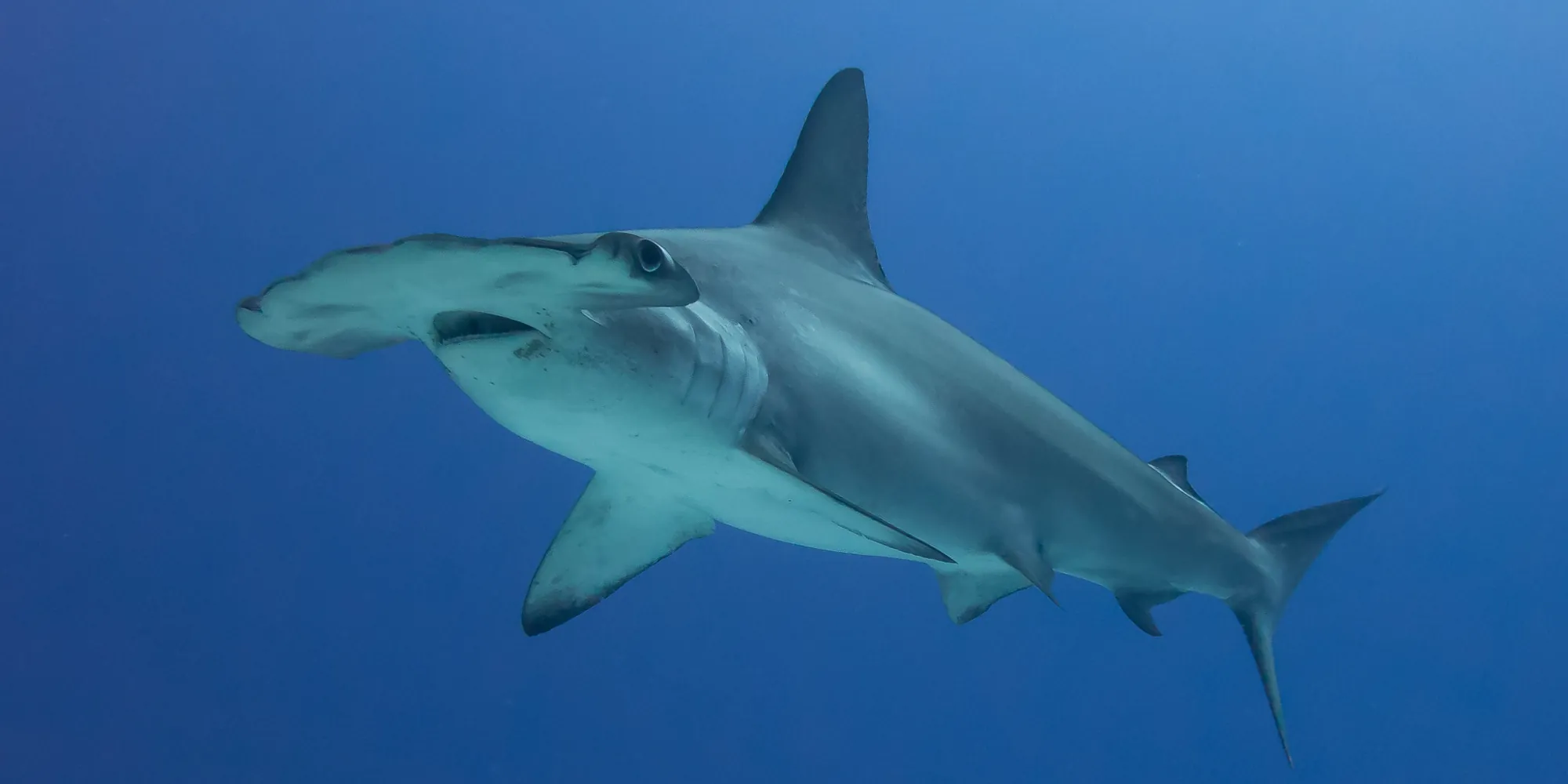
The most striking part of the scalloped hammerhead is its broadened head (“cephalofoil”). The front edge of the head is strongly curved and has a deep notch in the middle that gives the cephalofoil its characteristic ‘scalloped’ profile. The lateral ‘wings’ of the head are narrow and angled backwards, so that the eyes are set far to the sides. This large spacing of the eyes (and nostrils) gives the hammerhead an almost 360° field of view and a particularly acute sense of smell. The mouth of the scalloped hammerhead is wide and forward-facing. The teeth are triangular, strongly serrated towards the back and have smooth or finely serrated edges.
Body shape and fins
The body of Sphyrna lewini is streamlined (fusiform) and relatively slender. Typical of sharks is the absence of a bony swim bladder; instead, a large liver filled with liver oil provides buoyancy. The front part of the body tapers to a cone, and the caudal fin is narrow. The first dorsal fin is large and sickle-shaped, the second dorsal fin considerably smaller (with a concave posterior margin). The pelvic and anal fins are small and low; in particular the pelvic fins (pelvics) have a straight trailing edge. The caudal fin is heterocercal (asymmetrical).
Skin and scales
The skin of the scalloped hammerhead is covered with placoid scales (“denticles”) — small, tooth-like scales made of dentine and enamel. These scales give the skin a textured, sandpaper-like surface and reduce water resistance while swimming. In S. lewini the individual denticles are narrow and curved; juveniles usually have three longitudinal ridges on each scale, adults up to five.
Mouth, teeth and gills
The mouth is located ventrally (on the underside) of the head. As described in the sources, the lower jaw is slightly recessed, so the mouth is ‘subterminal’. The teeth are arranged in the upper and lower jaws and are characterised by their triangular shape and sharply serrated posterior edges. The gill opening consists of five gill slits on each side of the body, which is typical for sharks.
Sensory organs
Sense of smell
The sense of smell of the scalloped hammerhead is exceptionally well developed. Because the nostrils are widely separated on the broad head, the animal can perceive odours separately with each side (‘stereo-olfaction’). The olfactory rosettes (the actual olfactory structures) in the snout are very large: in the scalloped hammerhead they make up about 7 % of the total brain mass, compared with about 3 % in other shark species. This arrangement allows it to detect tiny traces of blood in the water (thresholds in the range of one part blood to 25 million parts water).
Electroreception (ampullae of Lorenzini)
Like all sharks, Sphyrna lewini also possesses Lorenzinian ampullae on the head — specialised sensory cells in gel-filled canals. These ampullae are distributed on both the underside and the upper side of the cephalofoil. Through them the hammerhead detects weak electric fields in the water (e.g. from the muscle currents of hidden prey). This helps it locate prey fish or rays buried in the sand.
Vision
The eyes of the scalloped hammerhead are located at the outer ends of the cephalofoil. This arrangement gives it an exceptionally wide field of view: it can see almost all around without turning its head. Studies also show that the hammerhead has a greatly enlarged binocular field compared with conventionally shaped sharks — in the scalloped hammerhead an overlap angle of both eyes of about 34° has been measured, while typical large sharks only reach about 10°. This gives it improved depth perception and target acquisition when hunting.
Internal anatomy
Cartilaginous skeleton
Sphyrna lewini has, like all cartilaginous fishes (Chondrichthyes), an entirely cartilaginous skeleton. The skull and vertebral column are made of hyaline cartilage, which is surrounded by a connective tissue layer (perichondrium). Many of these cartilaginous areas are additionally covered with small, hexagonal calcified plates (tesserae), which support the skeleton. S. lewini does not develop a true bony skeleton or a swim bladder — its skull and vertebral structure remains flexible and lightweight.
Musculature
The musculature of the hammerhead is similar to that of other fast-swimming sharks. It consists of segmented muscle blocks (myomeres) along the body axis. There are red (aerobic, endurance) and white (fast-twitch) muscle fibres. The red muscles lie mainly along the vertebral column and keep the hammerhead going during prolonged swimming movements, while the white muscles are used for short sprints.
Internal organs
The largest internal organ is the liver: it can make up to 25 % of body weight and is highly enriched with oil. This oily tissue provides buoyancy and energy storage. The digestive system ends in an intestine with a spiral valve, which increases the internal surface area and thus optimises nutrient absorption. The heart has — as in all sharks — only two chambers (an atrium and a ventricle). Behind the intestine is the rectal gland, through which excess salts are excreted (part of the osmoregulation system). The kidneys also contribute to the excretion of urea, with which S. lewini, like other marine fish, adjusts its water and electrolyte balance.
Research findings and special features
Studies support that the unique body plan of the scalloped hammerhead confers significant sensory advantages. For example, one study showed that hammerheads, thanks to their broad head shape, have a markedly larger binocular field of view than typical large sharks. At the same time, the wide arrangement of the eyes and nostrils gives the animal an almost complete 360° field of vision and sense of smell. The literature also highlights that S. lewini has disproportionately developed olfactory organs — the olfactory part of its brain is roughly twice as large as in other sharks. Within the hammerhead family, the species also shows the characteristic notches in the cephalofoil: the ‘scalloped’ margin distinguishes S. lewini from closely related species (the smooth hammerhead, for example, has a completely smooth head margin). Overall, these anatomical features make the scalloped hammerhead a specialised predator with extraordinary sensory capabilities and a hydrodynamic shape.
Distribution & Habitat
The scalloped hammerhead is distributed worldwide in tropical and warm-temperate oceans. Its range includes the Atlantic, the Indian Ocean and the Pacific. In these marine regions the species occurs both in coastal areas and in the open ocean. Records exist from the western and eastern Atlantic, the Red Sea, the western Indian Ocean and large parts of the central and eastern Pacific. The species shows a clear affinity for warm water masses and avoids permanently cool marine areas.

Habitats of juveniles
Juveniles of the scalloped hammerhead preferentially inhabit shallow coastal waters. Typical habitats are bays, lagoons, river mouths and shallow shelf areas. These zones offer comparatively high water temperatures and a reduced presence of large predators. Studies from Central America, Southeast Asia and the western Atlantic indicate that such coastal zones play a central role as nursery areas. The spatial fidelity of juveniles to these habitats can extend over several years.
Adult habitats
Adult scalloped hammerheads use a significantly wider range of marine habitats. They occur regularly over the continental shelf but are also observed far offshore in the open ocean. They are particularly common along seamounts, shelf edges and island slopes. These structures appear to be important for orientation and space use. In some regions adult animals have been recorded at depths of several hundred metres, especially during vertical migrations.
Day-night cycle
The habitat of the scalloped hammerhead is not static but undergoes diurnal changes. During the day many animals prefer to remain at greater depths, while at night they ascend into shallower water layers. This behaviour has been documented in both coastal and oceanic habitats. The vertical use of habitat is likely related to environmental factors such as light, temperature and currents.
Spatial segregation by age groups
Within its range the scalloped hammerhead shows a marked spatial separation between juveniles and adults. While juveniles are strongly tied to specific coastal areas, adults use broad-scale habitats and undertake long-distance movements. This partitioning reduces intraspecific competition and increases the survival chances of young sharks during sensitive developmental stages.
Importance of stable coastal habitats
The long-term use of certain coastal regions as nursery habitat for juveniles makes the scalloped hammerhead particularly dependent on intact shallow-water zones. Changes due to coastal development, pollution or intensive fishing directly affect the availability of suitable habitats. Because many of these areas are used over decades, they have high ecological importance for the conservation of regional populations.
Behaviour, Diet & Reproduction
Habitat and migratory behaviour
Scalloped hammerhead sharks (Sphyrna lewini) are pelagic sharks that occur in tropical and subtropical oceans worldwide. They predominantly live in the open sea but regularly use the continental shelf and move into coastal reefs, bays and shallow marine areas. Their distribution changes significantly over the course of the day. In the morning they migrate from the open ocean into coastal shallow-water zones such as island banks or shallow reefs. During the day, females in particular gather at drop-offs and reef edges. In the evening the animals return to the open water, where they actively search for food.
Seasonal migrations are well documented. In several regions juveniles move to higher latitudes during the warm months. Adult animals are more frequently found in nutrient-rich shelf areas that offer stable feeding conditions.
Social behaviour
Scalloped hammerhead sharks occur singly, in pairs or in schools. Within these schools females usually predominate. Large, sexually mature females take central positions, while smaller females more often swim at the periphery of the group. Juveniles form distinct, dense schools and remain in these groups until they reach sexual maturity.
Males are mostly solitary and usually join female groups only during the breeding season. At isolated oceanic islands very large aggregations of several dozen to several hundred individuals have occasionally been observed.
Diet
Prey spectrum
- Schooling fish such as mackerel-like species and coastal fish
- Cephalopods such as squid and cuttlefish
- Crustaceans such as prawns and other crustaceans
- Occasionally smaller sharks and rays
- In tropical regions, occasionally sea snakes
Scalloped hammerheads are considered opportunistic predators that adjust their prey spectrum to the regional availability of food. Juveniles feed predominantly on bottom-dwelling coastal fishes, while adults preferentially hunt pelagic schooling fish and cephalopods. Studies from the eastern Pacific show that in certain regions squid and schooling fish make up a particularly large proportion of their diet.
Hunting takes place predominantly at night. The sharks accelerate purposefully towards their prey and often swallow them whole. Larger prey are first immobilised with a powerful bite.
Ecological role
As large predators, scalloped hammerheads occupy an important position in the marine food web. By regulating fish and cephalopod populations they contribute to the stability of marine ecosystems and indirectly influence the structure of coral reef communities.
Reproduction
Birth and rearing
Scalloped hammerheads are viviparous. The embryos develop in the uterus via a yolk-sac placenta in both uteri. After a gestation period of about nine to twelve months, a female typically gives birth to between twelve and 38 pups in a litter.
The newborns are about 40 to 50 centimetres long at birth and fully developed. There is no parental care. The juveniles form schools immediately after birth and use shallow coastal areas as sheltered nursery grounds.
Seasonal cycle
Sexual maturity is reached relatively late. Females usually do not become reproductively mature until around 15 to 17 years of age, males considerably earlier. In many regions reproduction is seasonal. Mating often takes place in specific months of the year, depending on regional environmental conditions.
After birth there is usually a period of rest, so females on average produce offspring only about every two years. The low reproductive rate, together with late sexual maturity, characterises the entire life cycle of this species.
Threat & Protection Status
The great hammerhead is a tropical coastal shark that is under severe pressure worldwide. The main causes are overfishing and high levels of bycatch. The species is both targeted and unintentionally caught in trawl nets and on longlines. Scientific surveys show marked population declines in many regions. In the north-west Atlantic declines of over 80 per cent have been documented, and in parts of South Africa of more than 60 per cent. Globally, the population has declined by more than two-thirds within a few decades. The primary factor is the persistently high fishing pressure.
Overfishing and Bycatch
The greatest pressure is intensive fishing. Nearshore aggregations of the great hammerhead are easily accessible and are regularly caught as bycatch. In many fishing grounds there are no effective catch limits or controls. As a result, even populations that are not targeted are being continuously depleted. In several countries the population has declined by more than half since the 1980s. Additionally, many caught animals are not fully landed and therefore do not appear in official statistics, which obscures the true level of removals.
International Shark Fin Trade
A major driver of overfishing is the international trade in shark fins. The large fins of hammerheads fetch high prices on the Asian market. Estimates suggest that hundreds of thousands to over a million hammerhead fins are traded annually. This economic incentive leads to hammerheads being targeted or to fishing bans being circumvented. Despite international trade restrictions, demand remains high and continues to place strong pressure on populations.
Habitat Loss and Pollution
Young winghead sharks use shallow coastal waters as nursery areas. These habitats are particularly vulnerable to human impacts. Coastal development, port facilities, land reclamation and changes to river mouths impair the quality of these areas. In addition, sewage, oil pollution and plastic waste burden coastal ecosystems. Even though the direct effects of individual pollutants are not yet fully researched, deteriorating water quality is considered a risk factor for the development of juveniles.
Climate Change
Climate change indirectly affects the habitats of the winghead shark. Rising sea temperatures and altered rainfall patterns influence coastal ecosystems, salinity and nutrient availability. As a result, fish stocks and nursery areas can shift or deteriorate. Although the species’ wide distribution offers some scope for relocation, large-scale changes in the ocean reduce the long-term recovery potential of populations.
Protection status according to IUCN, CITES and CMS
The winghead shark is considered globally Endangered. The International Union for Conservation of Nature (IUCN) has listed the species as Critically Endangered since 2019. This assessment is based on an estimated global population decline of 70 to 95 per cent within three generations. Several regional populations have at times been classified as Endangered or Critically Endangered.
Under the Convention on International Trade in Endangered Species of Wild Fauna and Flora (CITES), Sphyrna lewini is listed in Appendix II. International trade is therefore subject to permits and strict conditions. Within the European Union, implementation is carried out through the EU Species Protection Regulation. Expert committees and conservation organisations have for years called for an uplisting to Appendix I in order to ban commercial trade entirely. In addition, the species is listed in Appendix II of the Convention on Migratory Species, which obliges the Parties to take coordinated conservation measures.
International and Regional Conservation Initiatives
Several international agreements seek to curb the species’ decline. In the Caribbean region there are special protection measures that restrict the trade and use of hammerhead sharks. At the level of regional fisheries organisations, regulations exist that prohibit the retention and marketing of hammerhead sharks. However, implementation varies regionally and is often inadequately enforced. In some high-seas areas comprehensive fishing bans have so far not been enforced.
Individual countries have taken further measures. In the USA several populations are protected under national species protection laws. The European Union prohibits the retention of hammerhead sharks in certain fishing areas and has banned finning across Europe. Such regulations reduce the economic incentives but on their own are not sufficient to halt the global decline.
Case Studies and Conservation Projects
A notable example of national protection is Costa Rica. There a comprehensive fishing and trade ban for hammerhead sharks has been introduced. Previously, certain bays had already been designated as protected nursery areas. Despite these measures, the country’s populations had previously declined sharply. Other countries such as Mexico, Honduras and the Maldives have also established large-scale shark protection areas.
In South America and Africa, international management approaches exist that aim for improved catch monitoring, satellite surveillance and reduction of bycatch. Early successes show that protective measures, consistently implemented at the local level, can contribute to stabilisation. However, in the long term, globally coordinated regulation of fisheries and trade is considered crucial to secure the survival of the great hammerhead shark.
Profile
- First described:
- Max. size:
- Depth:
- Max. age:
- Max. weight:
- Water type:
- IUCN Status:
Taxonomy
- Kingdom:
- Phylum:
- Subphylum:
- Infraphylum:
- Parvphylum:
- Class:
- Subclass:
- Superorder:
- Order:
- Family:
- Genus:
News

Newsletter
Shark Alert in Your Inbox