


Port Jackson shark - Heterodontus portusjacksoni
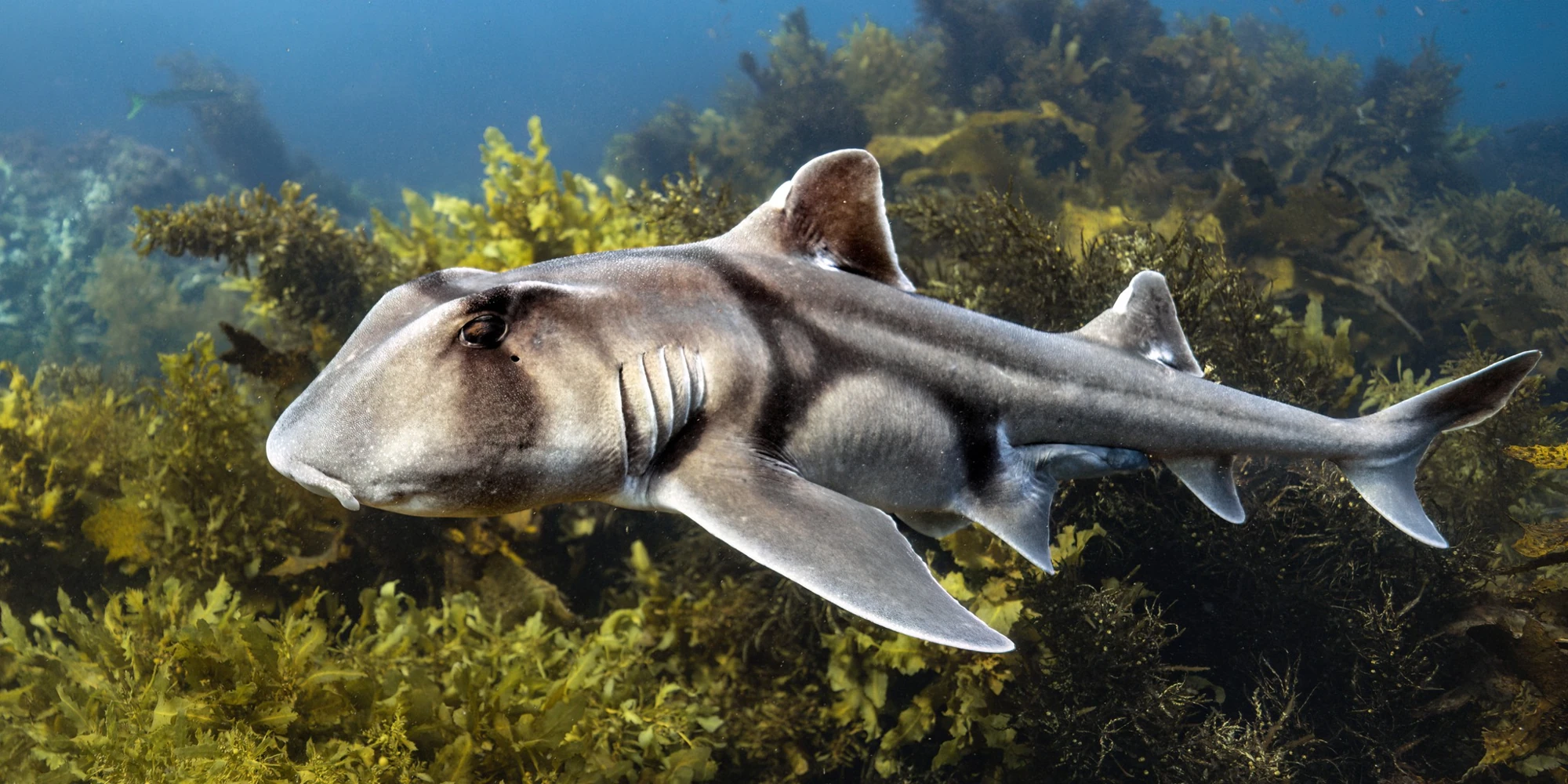
Body structure, features & anatomy
The Port Jackson shark Heterodontus portusjacksoni is a compact, robust bullhead shark with a blunt head, prominent brow ridges and dark harness-like markings that cross the eyes, back and flanks. This pattern is one of the quickest ways to identify the species underwater.
According to the Australian Museum, the species can reach about 1.65 metres, although males are often around 75 centimetres and females usually between 80 and 95 centimetres. Like other bullhead sharks, it has no anal fin and carries a spine in front of each dorsal fin.
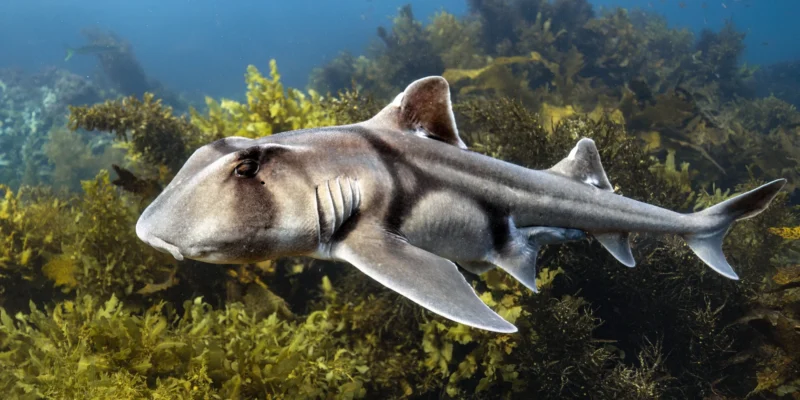
Teeth, head and resting posture
The name Heterodontus points to its different tooth types: FishBase describes pointed front teeth for gripping prey and broad rear teeth for crushing hard-shelled animals. The shark can pump water over its gills while resting, so it can lie on the bottom for long periods instead of swimming continuously.
Distribution & habitat
The Port Jackson shark is endemic to southern Australian coastal waters. Its main range follows the temperate continental shelf from New South Wales through Victoria, Tasmania and South Australia to Western Australia.
The Australian Museum lists southern Queensland to Tasmania and west to central Western Australia, while the fish.gov.au Shark Report summarises the common range from Byron Bay to Houtman Abrolhos and treats some northern records as doubtful. A single New Zealand record is considered exceptional rather than a regular range.
Coastal bottom habitats
FishBase describes the species as marine, demersal and oceanodromous, with records from 0 to 275 metres. It uses rocky reefs, caves, gutters, ledges, sandy or muddy bottom and seagrass areas, resting by day and foraging mostly at night.
Life history, diet & reproduction
Port Jackson sharks are mainly nocturnal bottom predators. During the day they often rest in caves, under ledges or in protected gutters; after dusk they move over reef, sand and seagrass in search of prey.
The Australian Museum lists sea urchins, molluscs, crustaceans and fishes as food, with black sea urchins often taken. Frontiers in Marine Science also discusses Heterodontus sharks as possible co-predators of barrens-forming sea urchins in south-eastern Australia.
Eggs and reproduction
The species is oviparous. Breeding usually peaks from late winter into spring, and females lay dark brown spiral egg cases. The Australian Museum gives an egg-case size of roughly 7-8 centimetres wide and 15 centimetres long; young hatch after about nine to twelve months.
The fish.gov.au Shark Report gives an estimated longevity of about 35 years. Males and females mature at different sizes and ages, which is why even common coastal sharks benefit from careful monitoring.
Threats & protection status
The Port Jackson shark is listed as Least Concern by the IUCN Red List. FishBase carries the same global category, and the Australian Shark Report assesses the species as sustainable.
Why the outlook is comparatively good
The fish.gov.au Shark Report describes the species as abundant and frequently taken as bycatch, but most individuals are released alive. Studies indicate high post-release survival after contact with gillnet, trawl and longline gear.
- Bycatch: it is caught in commercial and recreational fisheries, but flesh and fins are generally of low value.
- Regional changes: a historic decline in Bass Strait has been documented, although recent assessments suggest that trend has not continued.
- Slow life history: late maturity and limited egg production still make local populations worth tracking.
Port Jackson sharks & humans
Port Jackson sharks are considered harmless to people. The Australian Museum notes that the teeth are not large or sharp, but a provoked animal can still give a painful bite. The right diving behaviour is simple: observe, keep space and do not handle the shark.
For divers and underwater photographers, this is one of the most approachable sharks of temperate Australia. Resting animals are often visible on the bottom, in caves or under overhangs, and the harness pattern photographs well.
Fisheries, aquariums and education
FishBase lists minor commercial fisheries and public aquariums as human uses. Because the species is distinctive, hardy and egg-laying, it is also useful for explaining shark diversity beyond large open-ocean predators.
Profile
- First described:
- Max. size:
- Depth:
- Max. age:
- Max. weight:
- Water type:
- IUCN Status:
Taxonomy
- Kingdom:
- Phylum:
- Subphylum:
- Infraphylum:
- Parvphylum:
- Class:
- Subclass:
- Superorder:
- Order:
- Family:
- Genus:

Newsletter
Shark Alert in Your Inbox