


Pacific bonnethead - Sphyrna vespertina
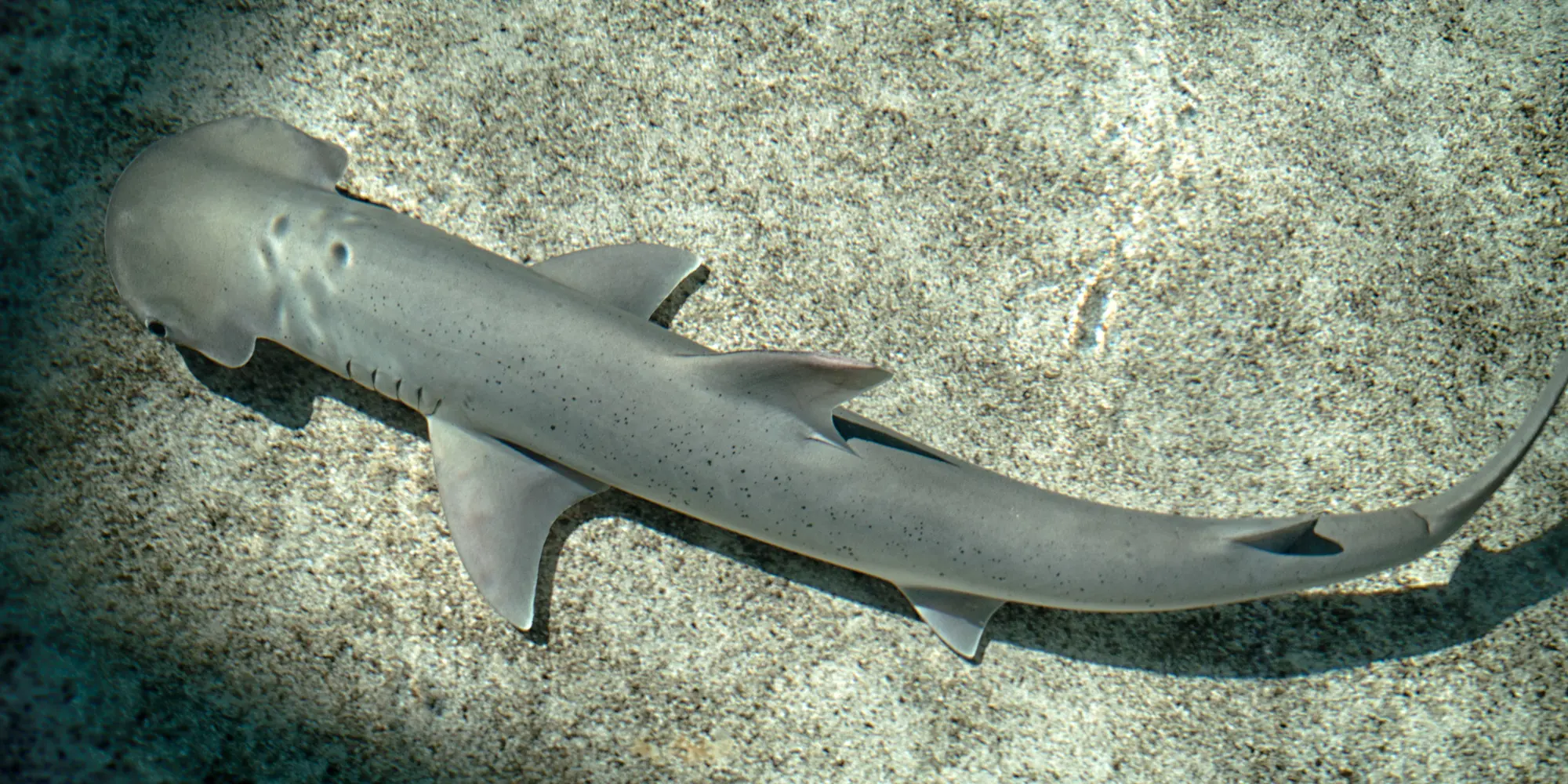
Body structure, features & anatomy
The Pacific bonnethead Sphyrna vespertina is a small hammerhead of the eastern Pacific. WoRMS lists the name as accepted; on Haitauchen it is placed within Selachii, Galeomorphi, Carcharhiniformes, Sphyrnidae and the genus Sphyrna.
Shark-References gives Pacific bonnethead as the English name and records Stewart Springer’s 1940 description. The head is flattened and spade-shaped, with no clear notch on the front margin before the nostrils.
Body structure, features & anatomy
Compared with the western Atlantic bonnethead, the Pacific form has a broader and shorter head, a higher first dorsal fin, shorter pectoral fins and a more compressed body. Location in the eastern Pacific, head outline and body proportions should be read together.
Distribution & habitat
NOAA Repository treats Sphyrna vespertina as the eastern Pacific member of the bonnethead complex. On Haitauchen it is linked with Pacific Ocean and with USA, Mexico, Guatemala, El Salvador, Honduras, Nicaragua, Costa Rica, Panama, Colombia, Ecuador and Peru.
FishBase summarizes the range as the eastern Pacific from southern California to Paita in northern Peru, including the Gulf of California. This is a coastal shark of the tropical to warm-temperate eastern Pacific, not an Atlantic species.
Distribution & habitat
Typical habitats are shallow bays, estuaries, soft sand and mud bottoms, mangrove or seagrass edges and reef areas. A text range is used here instead of a map, because the recent taxonomic split makes older bonnethead maps easy to misread.
Life history, diet & reproduction
Shorefishes of the Eastern Pacific describes Sphyrna vespertina as a common inshore hammerhead that can enter shallow estuaries. The listed depth range runs from the intertidal zone to at least 80 m.
Diet fits a small bottom-searching coastal shark: mobile crustaceans such as shrimps and crabs, small bony fishes, squid and other cephalopods, and plant material such as macroalgae or seagrass can all be involved.
Life history, diet & reproduction
The species is live-bearing. Young are born as small, free-swimming sharks rather than pelagic larvae. Because juveniles use coastal habitats, estuaries, shallow bays and soft-bottom areas are especially important.
Threats & conservation status
The Catalog of Fishes currently lists Sphyrna vespertina as valid and notes that IUCN 2025 has it as not assessed. Haitauchen therefore treats the species as not evaluated, not extinct and not formally least concern.
That status should not be read as proof of no risk. Small coastal sharks can be affected by gillnets, trawls, local fisheries, estuary degradation and poor species separation in catch data.
Threats & conservation status
Good conservation starts with naming the animal correctly. If Pacific bonnetheads remain merged with Atlantic bonnetheads or other small hammerheads, range, catch and protection needs stay blurred.
Pacific bonnethead & humans
FishBase lists Sphyrna vespertina as harmless to humans. Its size and feeding ecology fit a small coastal shark that focuses on invertebrates, small fishes and bottom-associated food.
Divers should observe quietly from the side, leave an escape route and avoid touching, chasing or lifting the animal for photographs. Shallow estuary, mangrove and seagrass habitats deserve especially passive behavior.
Pacific bonnethead & humans
Sightings with date, place, habitat and photographs are useful, because this eastern Pacific species is still much less visible in public data than the better-known western Atlantic bonnethead.
Profile
- First described:
- Max. size:
- Depth:
- Max. age:
- Max. weight:
- Water type:
- IUCN Status:
Taxonomy
- Kingdom:
- Phylum:
- Subphylum:
- Infraphylum:
- Parvphylum:
- Class:
- Subclass:
- Superorder:
- Order:
- Family:
- Genus:
Newsletter
Shark Alert in Your Inbox