


Lemon shark - Negaprion brevirostris
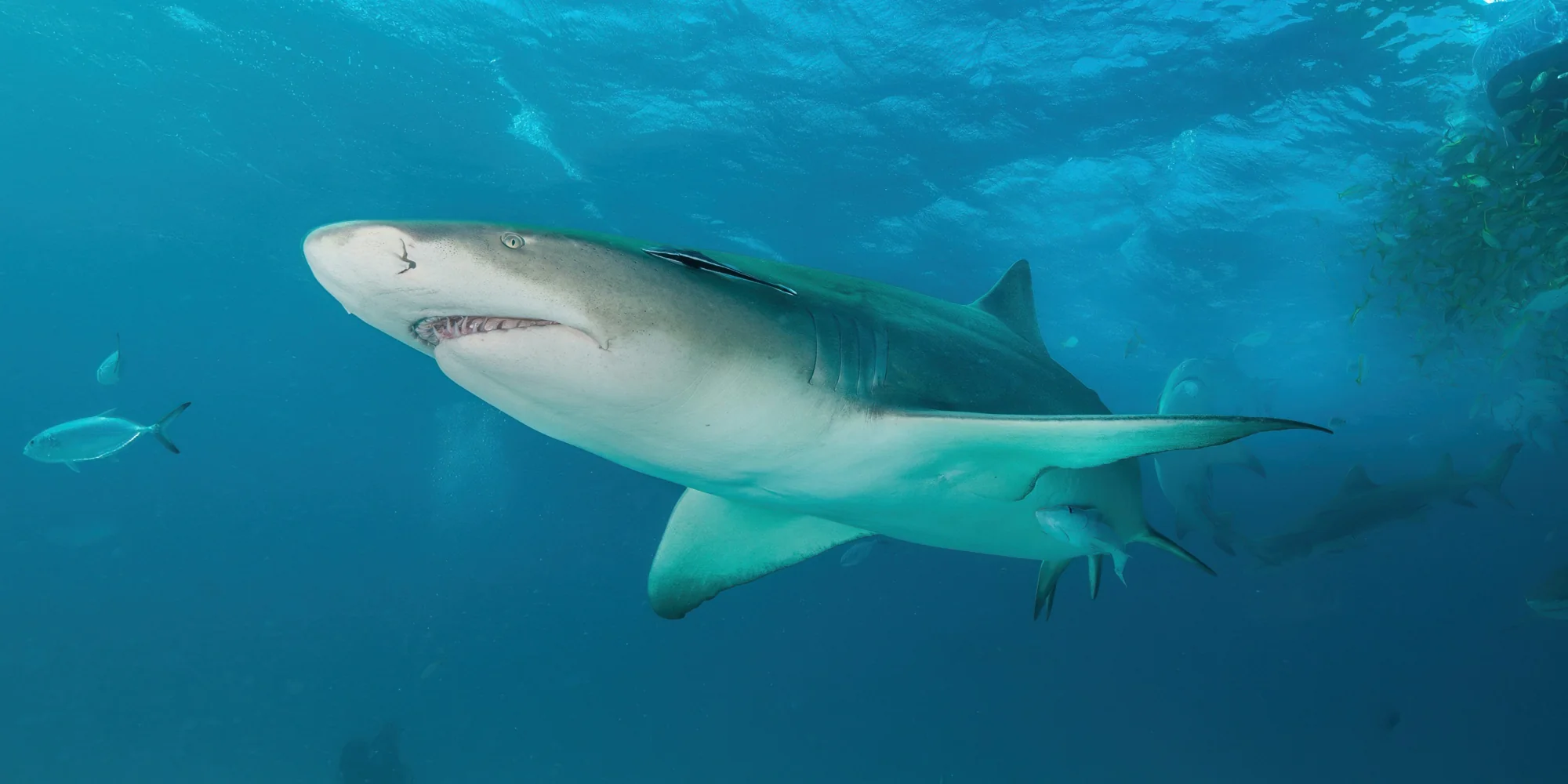
Body structure, features & anatomy
The lemon shark is a large shark species in the requiem shark family. Its body shape is clearly adapted to life in shallow coastal waters. The combination of a robust build, a specialised fin arrangement and well-developed sensory organs makes it an effective swimmer and hunter in turbid water.
Basic body structure
The lemon shark’s body is powerful, stocky and muscular. Adults usually reach a length of 250 to 300 centimetres; individual specimens can grow slightly larger. Body weight is usually between 150 and 250 kilograms. Females are, on average, larger and heavier than males.
The trunk appears compact and broad, without a pronounced dorsal longitudinal ridge. This body shape provides stability when swimming slowly near the seabed and in shallow areas.
Head and snout
The lemon shark’s head is broad and flattened. The snout is short, blunt and rounded. Its length is less than the width of the mouth. This head shape distinguishes the lemon shark from many other requiem sharks with a more pointed snout.
The nostrils are located close to the tip of the snout. A spiracle is generally absent, but in rare cases it occurs in some individuals.
Dentition and teeth
The mouth is broad and powerfully built. The upper jaw has about 15 teeth on each side, and the lower jaw 13 to 14 teeth. In the front region there are also an additional one to three smaller teeth.
The tooth shape is functionally differentiated:
- Upper jaw teeth are broad, triangular and finely serrated at the base.
- Lower jaw teeth are narrower, pointed and have smooth cutting edges.
This combination allows prey to be held securely and then pieces of flesh to be cut out.
Fin arrangement
A key identifying feature of the lemon shark is its two dorsal fins that are almost the same size. The first dorsal fin sits clearly behind the pectoral fins. The second dorsal fin is similarly sized and is located in front of the anal fin.
Other fin characteristics:
- Pectoral fins broad and powerful, slightly sickle-shaped
- Pelvic fins also slightly curved
- Anal fin relatively small and inconspicuous
- Caudal fin asymmetrical with an elongated upper lobe
This fin arrangement supports controlled gliding and precise movements close to the seabed.
Skin and colouring
The upper side of the body is yellowish-brown to olive-grey in colour. The flanks often show a yellowish or olive-green tone. The underside is noticeably lighter, ranging from pale yellow to white.
This colouring serves as camouflage over sandy or muddy substrate. Striking patterns or markings are completely absent.
Dermal denticles
The skin is covered with large, densely overlapping dermal denticles. These have three to five longitudinal ridges. The central ridge is particularly high and sharply defined. The structure reduces water resistance and protects the skin from injury.
Gills and respiration
The lemon shark has five gill slits on each side of the head. Breathing occurs mainly through continuous swimming, with water being directed over the gills. During resting phases, the shark can actively pump water over the gills.
Skeleton and internal anatomy
Like all sharks, the lemon shark has a complete cartilaginous skeleton. This is lighter and more flexible than a bony skeleton. The spine consists of numerous cartilaginous vertebrae, which allow a high degree of mobility.
The liver is large and rich in oil. It serves both buoyancy control and energy storage.
Sensory organs
The lemon shark has very well-developed sensory capabilities, which are closely linked to its anatomy.
- Eyes with a horizontal visual zone for good perception in shallow water
- Well-developed sense of smell for locating prey
- Lateral line organ for sensing pressure waves
- Ampullae of Lorenzini in the head region for sensing electrical fields
These electroreceptors make it possible to locate prey even in poor visibility or in the dark.
Sexual characteristics
Male lemon sharks have paired copulatory organs on the pelvic fins, known as claspers. Females are on average larger and more heavily built. Apart from that, the sexes differ only slightly in appearance.
Distribution & habitat
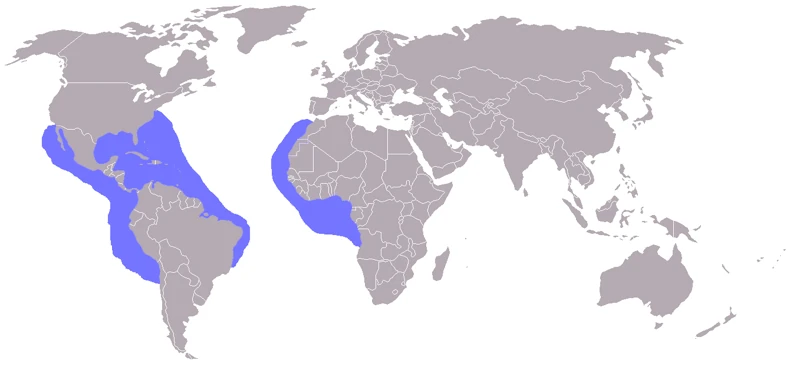
The Lemon Shark is a warmth-loving coastal shark species that is distributed on both sides of the Atlantic and in the eastern Pacific. Its distribution varies regionally and is strongly tied to the availability of shallow, tropical waters.
Global distribution
In the western Atlantic, its range extends from the US state of New Jersey to the south of Brazil, including the Gulf of Mexico, the Bahamas and the Caribbean. In the eastern Atlantic, the species occurs along the coasts of West Africa, for example off Senegal, the Ivory Coast and Cape Verde. In the eastern Pacific, Lemon Sharks can be found from southern Baja California to Ecuador.
| Region | Bereich |
|---|---|
| Western Atlantic | New Jersey to southern Brazil, including the Gulf of Mexico, the Bahamas, the Antilles and the Atlantic coasts |
| Eastern Atlantic | Coasts of West Africa with a focus on Senegal, Côte d’Ivoire and Cape Verde |
| Eastern Pacific | Southern Baja California to Ecuador |
Regional focal areas
The highest density of lemon sharks is found in the warm regions of the Atlantic. Off Florida and around the Antilles they are present year-round, while further north they appear only as summer visitors. Along the coasts of West Africa and in the Amazon delta, lemon sharks appear occasionally; they can tolerate brackish water and fresh water for short periods, but they rarely penetrate far into river courses.
Coastal habitats
Lemon sharks prefer shallow, tropical coastal waters. Typical habitats include mangroves, shallow bays, lagoons, estuaries and coral reefs. The sharks often stay over sandy or rocky ground, where they can easily find prey and camouflage well. In mangroves and shallow coastal areas, their young also find protected nursery grounds, as there is plenty of prey there and larger sharks have difficulty reaching these shallow areas.
- Mangroves and river mouths – shallow nursery areas with many fish and few predators.
- Coral reefs – offer hiding places and hunting opportunities in warm, clear water.
- Bays and lagoons – calm, shallow areas with warm water and a sandy bottom.
River and brackish-water areas
Occasionally, lemon sharks swim up estuaries and remain in brackish water. In doing so, they tolerate fluctuating salinity levels and low oxygen values. However, their presence in the Amazon delta and other large estuarine areas is sporadic; they rarely migrate far upstream.
Water depth and migration
The species prefers depths of up to about 90 metres. During seasonal migrations, lemon sharks can cross the open sea, but then return to coastal waters. As a rule, they remain along continental shelves and island coasts. In the open ocean, they are mainly encountered during migration.
Special habitat use
Lemon sharks repeatedly use certain coastal areas as nursery grounds. Females return to these sites to give birth, and young sharks remain there for several years. These places offer protection from predators and a stable food supply. Adult sharks adapt to low oxygen levels and can rest on the seabed. They are often seen near jetties and harbour facilities, where they feed on fish and other marine life.
Lifestyle, diet & reproduction
The lemon shark is a large coastal shark that lives in tropical shallow waters of the Atlantic and the eastern Pacific. Owing to its stocky build and yellowish-brown colouring, it is well camouflaged against the sandy seabed. Its way of life, feeding behaviour and reproductive cycle are closely interlinked and contribute to its success in mangroves, bays and lagoons.
Lifestyle and behaviour
When young, lemon sharks lead a largely site-attached life in mangroves and shallow bays. Adult animals occupy defined home ranges, which cover only a few square kilometres in juveniles and reach several hundred square kilometres in larger animals. They are active both during the day and at night, but show increased hunting activity at dusk. Their behaviour is characterised by a certain social flexibility: most of the time the sharks travel alone, but they form groups in which animals of similar size gather together. These aggregations facilitate communication, courtship, cooperative hunting and protection from predators.
Thanks to their relatively large brains, lemon sharks can learn from other sharks and form stable social bonds. The animals occasionally rest on the seabed and actively pump water over their gills, allowing them to breathe even when the current is weak. Because of their specialised sensory organs—a keen sense of smell, sensitive lateral line organs and the ampullae of Lorenzini—they can perceive electrical signals and the slightest movements. These abilities help them to locate and track prey even in murky water or in the dark.
- Young remain for several years in shallow coastal areas, using them as protected nurseries.
- Adults often form loose groups, especially when food is available or during the mating season.
- The species is adapted to low oxygen levels and can survive in mangroves and brackish-water areas.
- Activity peaks are usually in the evening and early morning hours.
Diet and hunting behaviour
As a predator, the Lemon Shark feeds mainly on fish, crustaceans and molluscs. In doing so, it mainly patrols sandy or muddy bottoms, where it tracks down its prey. Thanks to its keen sense of smell and its electroreceptors, it can detect injured or buried animals even when the water is murky. It often hunts at dusk or at night, but will generally feed whenever prey is available.
Its diet is varied. Larger individuals feed primarily on bony fish such as mullet, jacks, porcupinefish, cowfish, croakers and rays. Crustaceans such as crabs, crayfish and spiny lobsters are also on the menu. In addition, molluscs such as octopuses, seabirds and smaller sharks—including younger Lemon Sharks—are occasionally taken. The sharks eat until their stomach is full. The rate of digestion depends on the amount of food consumed.
- Main prey: bony fishes (including mullets, jacks, sea bass), stingrays and guitarfishes.
- Crustacean and shellfish prey: crabs, crayfish, spiny lobsters and shrimps.
- Additional prey: Molluscs such as octopuses, seabirds and smaller sharks.
- Hunting strategy: Combination of sense of smell, vision and electroreceptive detection in murky water.
Reproduction and life cycle
The Lemon Shark’s reproduction is viviparous: the embryos develop in the uterus and are supplied with nutrients via a yolk-sac placenta. Mating takes place in shallow coastal waters during the spring and summer months. Males hold the female in place by biting her pectoral fins and insert a clasper into the cloaca. Females are polyandrous, store sperm from multiple copulations and mate with different males out of “convenience” to placate persistent suitors. The animals have a two-year reproductive cycle: after a gestation period of ten to twelve months, there is usually a year in which no offspring are carried.
After completing the gestation period, females give birth to between four and seventeen pups, which are 50 to 65 cm long at birth. Births preferably take place in mangrove-rich coastal areas, which serve as nurseries and protect the young from predators. These “nurseries” are visited repeatedly by females over many years (natal philopatry). The young remain in these shallow-water areas for two to three years before migrating into deeper water. Lemon sharks grow slowly and do not reach sexual maturity until around six to sixteen years of age. Their total lifespan is estimated at three decades.
| Reproduktionsmerkmal | Typische Werte |
|---|---|
| Reproductive mode | Viviparous, yolk-sac placenta |
| Gestation period | 10 – 12 months |
| Litter size | 4 – 17 pups |
| Size at birth | 50 – 65 cm |
| Sexual maturity | Around 6 – 16 years |
| Reproductive interval | Biennial (one year gestation, one year off) |
Threats & Conservation status
The Lemon Shark is a characteristic inhabitant of many coastal regions, but its population has declined sharply over recent decades. As a large coastal shark species with slow growth and a low reproductive rate, it is particularly sensitive to human impacts. The following sections highlight the main threats as well as the current conservation status of this species.
Current classification and population trends
The International Union for Conservation of Nature (IUCN) has classified the Lemon Shark globally as Vulnerable since 2021. Earlier assessments listed the species as “Near Threatened”; the downlisting to “Vulnerable” is based on ongoing population declines. Estimates suggest that the global population has shrunk by 30–79 percent over recent decades. Coastal regions in the western Atlantic and the eastern Pacific are particularly affected, where intensive fishing and habitat loss are accelerating the decline.
Targeted fishing and bycatch in fisheries
The greatest threat to the lemon shark is targeted and incidental fishing. Worldwide, these sharks are caught in commercial and artisanal longline and gillnet fisheries. In addition to targeted catches for their meat, the highly sought-after fins and the tough skin, lemon sharks often end up as bycatch. In the USA and the Caribbean, they are also caught recreationally with rod-and-line fishing. Because of their slow reproduction, populations cannot compensate for the high fishing pressure. Particularly problematic are poorly regulated coastal fisheries in Central and South America as well as West Africa, where lemon sharks are scarcely protected by catch quotas or closed seasons.
Habitat loss and environmental changes
Alongside fishing, habitat loss is also taking its toll on lemon sharks. Coastal mangroves, seagrass meadows and lagoons serve as nursery grounds for juveniles. In many regions, mangroves are cleared for tourism or shrimp aquaculture projects, and river mouths are polluted or filled in. In Bimini (Bahamas), for example, large areas of mangroves have been destroyed, resulting in the loss of feeding habitats and shelter. Coastal development leads to increased sedimentation, reduced oxygen levels and heavy-metal contamination; studies on juveniles showed traces of zinc, manganese, selenium, cadmium and lead in their tissue. Added to this are global environmental changes such as rising water temperatures, sea-level rise and acidification, which alter shallow nursery areas and impair the sharks’ metabolism.
Conservation measures and legal regulations
The lemon shark is only partially subject to effective protection measures. Some US states, such as Florida, prohibit the commercial or recreational capture of this species in their territorial waters; under federal law, lemon sharks are managed within the group of “large coastal sharks” and are subject to catch quotas and seasonal closures. The Bahamas banned the use of longlines in 1993 and established a nationwide shark sanctuary in 2011, which prohibits commercial shark fishing as well as trade in shark products. Nevertheless, lemon sharks can still be caught in US federal waters and internationally, as there are no global bans on catching them. International trade is regulated by the Convention on International Trade in Endangered Species of Wild Fauna and Flora (CITES Appendix II), which means export licences are required, but illegal catches and inadequate controls reduce the effectiveness of this regulation.
Summary and outlook
Overfishing, bycatch, and the loss of mangrove and coral habitats have significantly reduced lemon shark populations. The IUCN now lists the species as Vulnerable, and robust studies document population declines of well over half within just a few generations. Regional protected areas such as the Bahamas Shark Sanctuary show that effective measures can have an impact. To conserve the lemon shark in the long term, coastal habitats must be protected, sustainable fishing practices established, and illegal shark fishing consistently prosecuted. Closer international cooperation—covering trade restrictions as well as habitat and stock management—is crucial for the survival of this charismatic species.
| Aspekt | Information |
|---|---|
| Population trend | Decreasing; decline of an estimated 30–79 % over the past 50 years |
| Main threats | Intensive fishing (targeted and bycatch), loss of mangroves and coastal habitats, pollution, climate change |
| Key conservation measures | Fishing bans in some US states (e.g. Florida), Bahamas national shark sanctuary, CITES Appendix II listing, local marine reserves |
Profile
- First described:
- Max. size:
- Depth:
- Max. age:
- Max. weight:
- Water type:
- IUCN Status:
Taxonomy
- Kingdom:
- Phylum:
- Subphylum:
- Infraphylum:
- Parvphylum:
- Class:
- Subclass:
- Superorder:
- Order:
- Family:
- Genus:
Dive Centres


News

Newsletter
Shark Alert in Your Inbox