


Great White Shark - Carcharodon carcharias

Body structure, characteristics & anatomy
The great white shark (Carcharodon carcharias) is one of the largest sharks and impresses with its robust, torpedo-shaped body structure and unique anatomical features. This article describes the most striking external and internal characteristics of this species and explains the physical differences between males and females.
Few marine creatures are as feared and yet as fascinating as the great white shark. But what is this apex predator of the oceans actually built like? Below, we take a closer look at the body structure and special anatomical features of the great white shark – from its distinctive teeth to the differences between males and females.
Size and body shape
The great white shark, with an average length of about 4 metres and a maximum length of over 7 metres, is one of the largest shark species. Adult females are significantly larger than males; while male sharks usually reach a maximum of around 5 metres, females can grow to over 6 metres in length. The weight also reaches extraordinary dimensions: a large great white shark can weigh up to three tonnes.
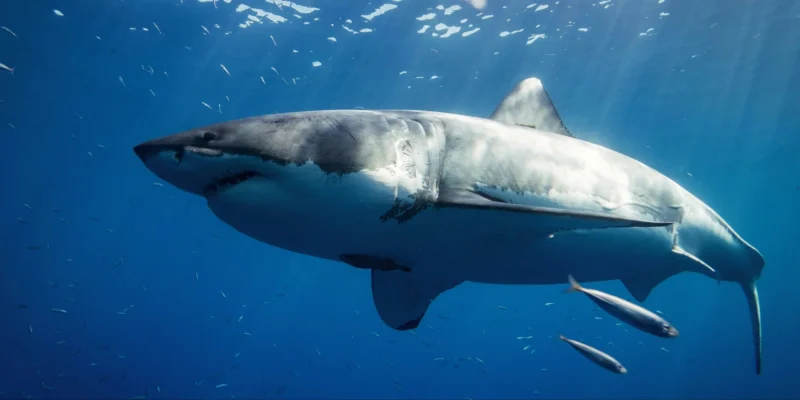
The body shape of these sharks is compact and spindle-shaped (torpedo-shaped) with a conically tapering, blunt snout. This streamlined body structure enables both endurance swimming and rapid sprints when hunting. In fact, the muscular bodies of great white sharks are designed to generate sudden bursts of acceleration. The eyes are positioned laterally on the head, are relatively small, and completely black (the pupil is not visible). Notably, great white sharks lack a nictitating membrane; to protect their eyes during attacks, they roll them backwards.
As a cartilaginous fish (Chondrichthyes), the great white shark does not have a bony skeleton but instead a lightweight skeleton made of cartilage. This lighter, flexible skeletal structure and a large, oil-filled liver provide buoyancy, as they lack a swim bladder like bony fish. Constant movement is important for respiration: like most large sharks, it must swim continuously to pump water through its mouth and the five large gill slits to absorb oxygen.
Skin and colouration
The great white shark displays a dorsal colouration typical of predatory fish: the upper side is coloured in shades of light grey to brown, occasionally bluish or almost black, often with a bronze shimmer. The underside, in contrast, is a brilliant white and sharply demarcated from the darker flanks. This so-called countershading helps the shark to be less conspicuous in the water: from above, its dark back blends with the deep water, while from below, the light underside matches the bright light from above. A notable feature is a usually dark spot at the base of the pectoral fins (behind their attachment) and black tips on the underside of the pectoral fins. The individual spot and colouration pattern in the gill area is unique to each shark, allowing researchers to even recognise individual great white sharks.
The skin of the great white shark is exceptionally tough and resembles sandpaper. It is covered with millions of tiny, placoid scales – small, tooth-like structures known as dermal denticles. These skin denticles are oriented backwards, reducing drag and allowing the shark to swim more efficiently and quietly. At the same time, the rough skin protects against injuries and infestation by parasites. If you stroke a shark from head to tail, the skin feels smooth, but in the opposite direction, you could scrape your hand. The unique structure of shark skin has even inspired engineers: high-tech applications such as special swimsuits or antiseptic surfaces mimic the grooved structure of shark skin.
Fins and locomotion
All fins of the great white shark are formed without fin spines. The first dorsal fin is large, triangular, and slightly sickle-shaped; it begins roughly at the level of the rear end of the pectoral fins. A second, significantly smaller dorsal fin is located further back and begins just before the anal fin. The pectoral fins themselves are long and powerful, serving as rudders and lift surfaces. On the caudal peduncle (the tail root), there is a distinct keel on each side, which increases stability during rapid swimming manoeuvres. The caudal fin is large, crescent-shaped, and nearly symmetrical – the lower fin lobe is almost as large as the upper one. This homocercal (symmetrical) tail shape, combined with the powerful trunk musculature, provides strong propulsion. Great white sharks primarily swim with powerful strokes of the tail (thunniform swimming pattern) and move the trunk very little laterally. They can accelerate very strongly from a standstill and even leap completely out of the water, for example, when hunting seals. However, most of the time, they move rather leisurely at cruising speeds of around 3 km/h but can cover distances of 70–80 km daily.
The powerful trunk musculature of the great white shark is supported by a special thermoregulatory system. Unlike most fish, this shark is partially warm-blooded: special networks of fine blood vessels (the rete mirabile) act like a heat exchanger and retain the heat generated by muscle activity within the body. This keeps vital organs such as the brain, eyes, and swimming muscles at a higher temperature. The core body temperature of a great white shark is thus several degrees Celsius above the ambient temperature – literature often cites a difference of around 10 °C. This adaptation increases performance, particularly when hunting in cooler waters, as muscles and senses work more efficiently when warm.
Jaws and teeth
The dentition of the great white shark is one of its most distinctive features. The broad, arched mouth measures nearly a metre in diameter in large specimens and houses several rows of teeth. In the front, active row of teeth, there are about 23 to 28 triangular teeth in the upper jaw and about 20 to 26 in the lower jaw. These teeth are broad, flat, and sharply serrated at the edges (saw-like) – perfect weapons for tearing apart prey. Like all sharks, worn or lost teeth are continuously replaced by new ones from the rows behind; a great white shark can lose and regenerate several thousand teeth in its lifetime. The arrangement is known as a ‘conveyor belt’ dentition. The teeth in a row form a continuous cutting edge, with the largest teeth positioned at the front of the snout. When biting, the upper and lower jaws fit together perfectly: the pointed lower teeth hold the prey, while the large, serrated upper teeth tear out chunks of flesh. The bite force of a large great white shark is enormous and can easily crush bones.
Interestingly, the great white shark – unlike, for example, tiger sharks – lacks a nictitating membrane to protect its eyes. Therefore, it rolls its eyeballs backwards during the final bite into prey to protect them from injury – which gives it a ‘white eye’ during the attack, possibly the origin of its German name.
Sensory organs
As a highly developed predator, the great white shark is equipped with remarkable sensory abilities. Its sense of smell is legendary: sharks can detect the slightest traces of blood in the water. Hearing also picks up low-frequency vibrations and sounds over long distances. Along the sides of the body runs the so-called lateral line, a sensory canal that allows the shark to sense pressure waves and movements in the water.
The great white shark possesses special organs for detecting electrical fields: in small, jelly-filled pits in the snout region, known as the ampullae of Lorenzini, it registers the bioelectricity of other creatures – such as the heartbeat of hidden prey. Its vision is also better than previously thought: although great white sharks have relatively small, uniformly black eyes, they can discern contrasts and movements well and even see colours. When hunting prey, it protects its eyes by rolling them backwards, as mentioned above, due to the lack of eyelids. The interplay of these senses makes the great white shark an efficient hunter. It can scent prey over long distances, track it with hearing and the lateral line, and precisely locate it in the final sprint using vision and its electrical sense.
Differences between males and females
Great white sharks exhibit pronounced sexual dimorphism in terms of body size: females significantly surpass males in length and mass. While male sharks average around 3.5 to 4 metres in length, females reach average lengths of 4.5 to 5 metres. The largest known specimens – such as the famous female ‘Deep Blue’ – were even over 6 metres long. Female sharks are generally more robustly built and have a broader head, which may be related to their role in reproduction (carrying embryos).
A clear distinguishing feature between the sexes is found on the underside of the body: male sharks possess a pair of visible copulatory organs called claspers on their pelvic fins. These are modified fins and can be up to 50 cm long in sexually mature males (about 10% of their body length). Females do not have claspers.
During mating, males often bite females on the fins or back to hold on. Female sharks therefore frequently bear scars from these ‘love bites’. To better withstand such injuries, the skin of females is noticeably thicker than that of males – in some shark species, up to three times as thick. Apart from size and the aforementioned features, male and female great white sharks differ little morphologically. Both sexes have the same colouration and essentially identical body shapes.
Habitat & distribution
The great white shark (Carcharodon carcharias) is a globally distributed predatory fish found both in coastal areas and the open ocean. It prefers water temperatures between 12 and 24 degrees Celsius and inhabits areas where it can find sufficient food. Its habitat ranges from the coasts of the Atlantic to the Pacific and Indian Oceans, as well as the Mediterranean Sea.
Global distribution
In the Atlantic, the distribution area extends from Canada and the United States through the Caribbean to South America. In the eastern Atlantic, great white sharks are found from Europe to the African coast and throughout the Mediterranean. In the Pacific, they inhabit the coasts of North America, Japan, Australia, New Zealand, and South America. In the Indian Ocean, they occur off South Africa, the Seychelles, and in the Red Sea, among other places. Particularly well-known hotspots include South Africa, California, and southern Australia, where the sharks regularly gather near seal colonies.

Coastal and open ocean habitat
Great white sharks use various habitats: coastal waters with rocky reefs or sandy beaches as well as the vast open ocean. Juveniles primarily stay in shallower and warmer regions that offer them protection. Adults, on the other hand, move between coastal hunting grounds and pelagic zones, where they search for food at depths of up to 1,300 metres. Their ability to maintain body temperature above the ambient level enables them to survive in a wide range of temperatures.
Nursery areas
Certain nursery areas exist for juveniles. Off California and the US East Coast, particularly between New Jersey and Massachusetts, young great white sharks have been repeatedly observed. The Mediterranean, especially the Adriatic and the Sicilian Channel, is also considered an important nursery area. These regions offer abundant food and relatively safe conditions.
Migration routes of the great white shark
The great white shark is known for its extensive migrations. These can be seasonal along coasts or cover great distances through the open ocean.
Seasonal coastal migrations
On the US East Coast, great white sharks follow a fixed pattern: in summer, they migrate north to Newfoundland, and in winter, they travel south to the Caribbean. Similar movements can be observed in South Africa and Australia, where the sharks return to seal colonies.
The White Shark Café
A unique phenomenon is the so-called White Shark Café, a region in the middle of the Pacific between California and Hawaii. Many sharks from the northeastern Pacific spend the winter months there. They regularly dive to great depths and apparently utilise the rich food supply in the open ocean.
Transoceanic migrations
Some individuals cover enormous distances. A famous example is a female that swam nearly 20,000 kilometres from South Africa to Australia and back. Such journeys show that populations in different oceans may be more closely connected than previously assumed.
Lifestyle, Diet & Reproduction
As the ocean’s apex predator, the great white shark exhibits remarkable characteristics in its lifestyle, diet, and reproduction.
Lifestyle of the Great White Shark
Great white sharks primarily live as solitary creatures. However, they are occasionally observed in pairs or small groups, particularly in coastal areas rich in prey. In such cases, a certain hierarchy can be observed: larger or more experienced animals assert themselves over smaller ones. Their communication occurs mainly through body language. Researchers have described parallel swimming, mutual circling, and even forceful tail slaps on the water’s surface. Such behaviours are likely used to signal dominance and territorial claims to other members of the species. The great white shark is also known for its curiosity: it often circles boats or lifts its head out of the water to explore its surroundings.
The great white shark’s habitat spans vast areas of the world’s oceans. It prefers temperate coastal waters but also traverses open oceans and ventures into tropical zones. Thanks to a special network of blood vessels, this shark can maintain its body temperature up to 10 to 15 °C above the water temperature. This physiological adaptation allows it to inhabit colder waters and grants it the ability for sudden bursts of speed.
Great white sharks are also enduring long-distance swimmers. Individual tagged specimens have covered distances of over 10,000 kilometres and dived to depths of more than 1,000 metres. Throughout the day, they often move just below the water’s surface or at moderate depths of up to about 500 metres but can explore extreme depths when necessary. Overall, this flexible lifestyle helps the great white shark thrive in many marine regions, from the coasts of California to the waters off Australia and South Africa.
Diet of the Great White Shark
As carnivores, great white sharks adapt their diet to the available prey and their own body size. Young sharks primarily hunt smaller fish, squid, and crustaceans. As they grow, they expand their prey spectrum to include larger fish such as tuna, as well as other sharks and rays. From a length of about three metres, marine mammals also feature on their menu. In regions with seal or sea lion colonies, these mammals make up a large part of their prey, while in the absence of such prey, they also consume large bony fish.
Great white sharks also display opportunistic behaviour: they feed on carrion, such as the carcasses of large whales, whose fatty flesh is highly energy-rich. Generally, adult great white sharks prefer fatty prey, as it most efficiently meets their energy needs. Humans, however, are not part of their prey schema—the human body has a low fat content in water and does not fit their hunting pattern. The very rare attacks on humans are likely due to mistaken identity (such as with seals or sea turtles) or territorial defence in most cases.
When hunting, the great white shark relies on surprise and powerful attacks. It often shoots up from the depths and attacks prey from below at high speed. Particularly in seal hunting off South Africa, adult sharks have been observed striking with such force that they completely breach the water’s surface. Once a great white shark has seized a large prey animal, it usually bites once and then retreats to avoid injury from a counterattack. The severely wounded victim weakens quickly, and the shark waits before returning for the final feed. Smaller animals, however, are often swallowed whole directly.
The serrated, triangular teeth and enormous jaw strength allow the great white shark to overpower even formidable prey. Estimates suggest its bite force is among the highest in the entire animal kingdom. After a substantial meal, the shark can go weeks without further food. A large seal, for example, provides enough calories to meet the predator’s energy needs for up to a month.
Reproduction of the Great White Shark
The reproductive biology of the great white shark is extraordinary in many ways and remains not fully understood. It is certain that this species reaches sexual maturity very late: males at around 26 years and females at about 33 years. Little is known about mating behaviour in the wild. Scars on the pectoral fins of some females suggest that males hold their partners with a bite grip during mating, as is known from other sharks.
Great white sharks are ovoviviparous: the fertilised eggs remain in the mother’s womb, and the embryos hatch from the egg membrane before birth. The young are thus born fully developed and alive. During embryonic development, the unborn sharks initially feed on the yolk of their eggs and later on so-called nurse eggs—unfertilised eggs produced by the mother in the uterus to nourish the young. The exact gestation period is unknown, but estimates suggest at least twelve months. A female typically gives birth to only a few offspring per litter, usually between two and ten young.
The newborn pups (juvenile sharks) are already remarkably large, measuring about 120 to 150 centimetres in length and weighing 25 to 30 kilograms. Nevertheless, they lose some weight in the first few weeks as they learn to hunt independently. Young great white sharks prefer to stay in coastal nursery areas, where they prey on smaller fish and squid and are relatively safe from large predators. As they grow, they gradually shift their range to deeper waters and tackle increasingly larger prey until they eventually reach the hunting spectrum of adult sharks.
The great white shark is one of the longest-lived fish species. Individual findings suggest that some specimens can live over 70 years. The combination of high life expectancy, late onset of reproduction, and low offspring numbers means that populations grow very slowly. Over a long lifetime, a female produces only a few litters, which is highly unusual for fish. With its unique characteristics in lifestyle, diet, and reproduction, the great white shark embodies a unique apex predator of the seas. At the same time, it symbolises the enduring fascination that the oceans and their great hunters hold.
The Great White Shark and Humans
The great white shark (Carcharodon carcharias) is one of the world’s most well-known predatory fish. Few other species evoke as many emotions, stories, and headlines. It is often portrayed as a merciless hunter, but the reality is more complex. Modern research shows that its encounters with humans usually unfold differently than popular films suggest.
Myths and Reality
In public perception, the great white shark is often seen as an aggressive threat. In reality, attacks are rare. Scientists suspect that many incidents are due to mistaken identity: surfers or swimmers can resemble a seal from the shark’s perspective, which is its preferred prey. In most documented cases, the shark releases the human after an initial bite, as they do not match its dietary preferences.
Why Do Attacks Occur?
The reasons for interactions with humans are varied. Some researchers view attacks as exploratory behaviour. Great white sharks are curious and use their teeth to investigate unknown objects. Other incidents are linked to typical hunting behaviour in regions with seal colonies. Nevertheless, the risk to swimmers or divers remains extremely low.
Statistics and Research Findings
Worldwide, only a few dozen encounters between humans and great white sharks are reported each year. A fraction of these end fatally. By comparison, many other everyday risks are far more dangerous. Research also shows that most interactions are not characterised by aggressive behaviour but by caution and curiosity.
Geographical Foci
Most incidents occur in regions with a high presence of great white sharks, such as South Africa, Australia, or California. There, the habitats of the animals overlap with popular beaches and surf areas. It is crucial that such encounters remain rare, even though millions of people visit the coasts each year.
Tourism and Encounters Under Controlled Conditions
Great white sharks are not only feared but also attract adventurers. In some countries, safe cage dives are offered. These experiences allow people to get close to the animals and observe them in their natural behaviour. They also contribute to education and raise awareness for the protection of this endangered species.
Conservation Status and Measures
The great white shark (Carcharodon carcharias) is one of the most well-known shark species and is also highly endangered. Overfishing, bycatch, and the demand for fins have significantly reduced populations worldwide. For this reason, it is strictly protected in many regions. The IUCN Red List classifies the great white shark as vulnerable.
International Regulations
At the global level, the great white shark is protected under the Convention on International Trade in Endangered Species of Wild Fauna and Flora (CITES). International trade in parts of the shark is strictly controlled. Additionally, numerous countries prohibit targeted fishing, trophy hunting, and the trade in jaws or teeth. The great white shark is also explicitly considered in many marine protected areas.
Regional Conservation Measures
Protection of the great white shark varies regionally. Some countries have implemented comprehensive protection programmes, while others still have catching up to do.
Australia
Australia is considered one of the hotspots for great white sharks. Here, the species has been fully protected since the 1990s. Research, monitoring, and the establishment of marine protected areas are among the most important measures. Nevertheless, incidents involving swimmers or surfers regularly spark discussions about safety nets and targeted culling, which remain highly controversial.
South Africa
South Africa has recognised the importance of the great white shark for both the ecosystem and tourism. Fishing has been banned since the 1990s. At the same time, the country is known for cage diving, which is scientifically supervised and subject to strict regulations. Protected areas such as the Table Mountain National Park include important hunting and migration areas for the sharks.
USA (California)
In the United States, great white sharks enjoy legal protection in several states. California placed the species under protection as early as the 1990s. Fishing and trade are prohibited, and there are large-scale research projects on the migration and behaviour of these animals.
Mexico
Mexico has also introduced protective measures for the great white shark. Since the early 2000s, fishing and trade have been banned. Important habitats, particularly around Guadalupe Island, are under special protection and are strictly monitored. The island has also become a renowned destination for cage diving, which benefits both research and ecotourism.
Europe and the Mediterranean
In the Mediterranean, the great white shark has declined sharply. Sightings are now extremely rare. Nevertheless, it is also protected here. The European Union prohibits targeted fishing and trade, but bycatch remains a problem. Experts call for stricter controls and more protected areas to secure the remaining populations in the long term.
New Zealand
New Zealand has fully protected the great white shark since 2007. The country prohibits both fishing and the possession of parts of the animals. Important habitats around the Chatham Islands and Stewart Island are regularly monitored by researchers.
Challenges in Conservation
Despite international efforts, numerous challenges remain. Bycatch in commercial fisheries, illegal hunting, and climate change continue to threaten the species. Additionally, conservation measures often conflict with the safety interests of coastal regions where shark attacks make headlines.
Profile
- First described:
- Max. size:
- Depth:
- Max. age:
- Max. weight:
- Water type:
- IUCN Status:
Taxonomy
- Kingdom:
- Phylum:
- Subphylum:
- Infraphylum:
- Parvphylum:
- Class:
- Subclass:
- Superorder:
- Order:
- Family:
- Genus:


News

How White Sharks on Guadalupe Island Reveal Their Social Secrets
Shark alert off Catalina Island: Long-distance swimmer injured during night-time ocean swim
New study explains increasing shark attacks in New England
Great White Sharks Conquer the North: More Sightings off New England and Canada
From Gansbaai to Indonesia: The 38,000 km Odyssey of a Misidentified Great White Shark
Great white sharks barely survived the Ice Age – and pose a mystery
World’s Largest Great White Shark Likely Heading to Nova Scotia
Rare Catch: Great White Shark in the Adriatic off Montenegro Caught and Released

Shark scare at Cabarita Beach: Surfer survives attack with broken board half





Newsletter
Shark Alert in Your Inbox