


Great hammerhead - Sphyrna mokarran
Body structure, characteristics & anatomy
General body structure
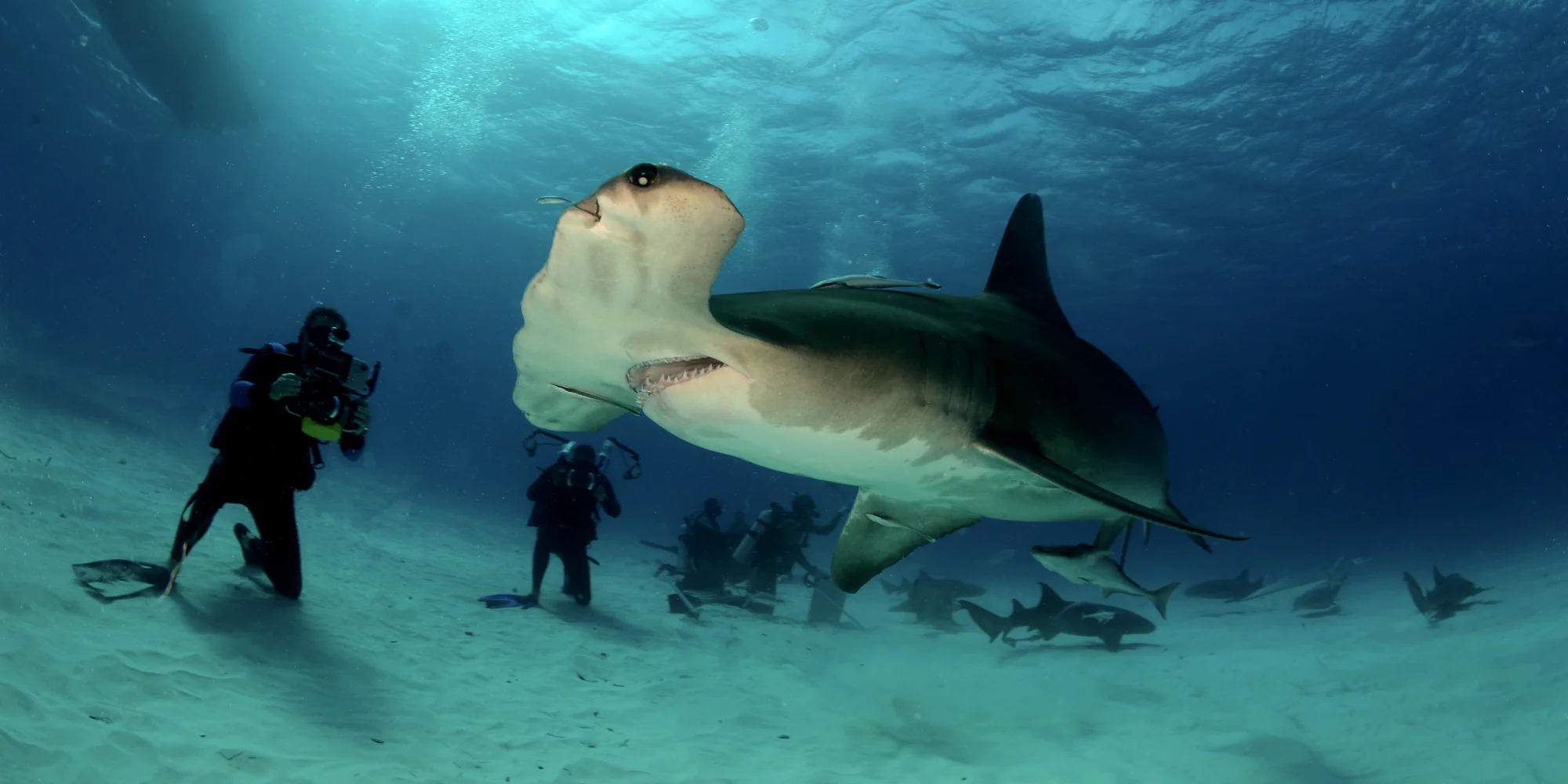
The Great hammerhead is a powerfully built, streamlined shark. It typically reaches total lengths of 3 to 4 metres; individual specimens can exceed 5 metres. The body is broad and muscular, and the overall shape is adapted for efficient swimming. The dorsal colouring ranges from dark brown to olive-grey, the flanks are lighter and the underside is noticeably paler. Like all hammerheads, the Great hammerhead has five gill slits on each side. A spiracle is not developed. The combination of a robust body and a slender silhouette gives the species its high swimming performance and endurance.
Cephalofoil (hammerhead)
The eponymous hammer-shaped head, the so-called cephalofoil, is particularly broad in the Great hammerhead. Its width corresponds to about 23 to 27 per cent of the total body length, exceeding that of all other hammerhead species. The front edge of the cephalofoil runs almost straight and has a shallow indentation in the middle. The rear edge is slightly concave. This construction significantly increases the surface area beneath the head.
The cephalofoil provides hydrodynamic stabilisation and generates additional lift while swimming. It improves the animal’s positioning in the water and contributes to precise manoeuvring. The eyes are situated at the lateral ends of the hammerhead, creating a very wide field of view. This arrangement allows for an almost complete panoramic view without significant head movements.
On the underside of the cephalofoil there are numerous ampullae of Lorenzini. These electroreceptive sensory organs respond to electric fields in the water. The large surface area of the hammerhead allows a particularly high density of these sensors. As a result, the great hammerhead can detect even weak bioelectric signals, for example from animals buried in the sand.
Sensory organs
The great hammerhead has a highly developed sensory system that is closely linked to its body structure.
- Eyes: The lateral position at the end of the cephalofoil allows a very wide field of view with minimal blind spots.
- Ampullae of Lorenzini: Gel-filled pores on the underside of the head that detect electrical stimuli. The broad head shape significantly increases their number.
- Lateral line organ: Running along the flanks of the body. It senses pressure changes and water movements and complements the visual and electrical sensory systems.
Fins and locomotion
The fins of the great hammerhead are clearly designed for stability, speed and manoeuvrability.
- First dorsal fin: Very tall and sickle-shaped, with a distinctly backward-curved tip.
- Second dorsal fin and anal fin: Significantly smaller than the first dorsal fin, each with a pronounced posterior notch.
- Pectoral fins: Large, broad and sickle-shaped. They generate lift and enable precise steering manoeuvres.
- Pelvic fins: Also sickle-shaped with a concave trailing edge. They stabilise the body during locomotion.
- Caudal fin: Strongly asymmetrical in structure. The upper lobe is noticeably longer than the lower one. This shape produces thrust and provides slight lift to the body.
Propulsion is mainly achieved through powerful lateral tail movements. The fins act as stabilising elements, enabling changes of direction and controlled acceleration.
Skin and scale structure
The skin of the great hammerhead is covered with densely packed placoid scales. These small, tooth-like skin structures are diamond-shaped and have several fine longitudinal ridges. They increase the skin’s mechanical resistance while simultaneously reducing water resistance. As a result, the shark glides efficiently through the water. In addition, the skin provides protection against external injuries and prevents the attachment of organisms.
Cartilaginous skeleton and musculature
The great hammerhead has a skeleton composed entirely of cartilage. This is lighter and more flexible than a bony skeleton. In combination with a large, oil-rich liver, the cartilaginous structure provides sufficient buoyancy despite the absence of a swim bladder.
The musculature is particularly well developed along the back and in the caudal peduncle. It enables powerful acceleration and sustained swimming over long distances. The entire anatomical structure is geared towards efficiency, stability and high performance in the water.
Distribution & Habitat
The great hammerhead has a wide but patchy distribution in warm marine regions. The species is primarily present in tropical and subtropical oceans and prefers waters with stable temperature conditions.
Global distribution
Records of the great hammerhead come from the Atlantic, the Indian Ocean and the Pacific. In the Atlantic the occurrence ranges from the east coast of North America through the Caribbean to Brazil and along the west African coast. Populations in the Indian Ocean have been documented, among others, in the Red Sea, in the Arabian Gulf and along the East African coast. In the Pacific the species has been recorded from Mexico to Peru as well as in the western Pacific region including Australia and Southeast Asia.
Overall, the distribution is considered fragmented. Regional populations are often isolated, which limits genetic exchange and increases vulnerability to local fishing pressure.
Preferred habitats
The great hammerhead is predominantly coastal. Typical habitats include continental shelves, outer reefs, lagoons and shallower areas around islands. The species is particularly common near coral reefs, steep reef slopes and over sandy or muddy seabeds.
Juveniles tend to remain in sheltered coastal zones. Shallow bays, mangrove areas and shallow shelf waters serve as important nursery grounds. These habitats provide protection from larger predatory fish and experience reduced wave action.
Depth distribution and habitat use
The great hammerhead occupies a wide depth range. Most sightings occur at depths of a few metres up to about 80 metres. However, individual animals have been recorded considerably deeper. Nearshore shallow-water zones play a central role in daily habitat use, while offshore waters are visited less often.
Movement patterns show flexible habitat use. Individuals move between reef structures, open shelf areas and deeper water, depending on environmental conditions and the local availability of suitable habitats.
Behaviour, Diet & Reproduction
Behaviour
The great hammerhead is mostly solitary. It traverses large areas with steady, powerful movements and often covers several dozen kilometres each day. Telemetry studies show pronounced diurnal and seasonal activity patterns. During the day many individuals remain in deeper water layers or along reef edges. At dusk and during the night activity shifts to shallower zones, where hunting takes place. The species is very mobile and shows only low site fidelity. Females in particular migrate over long distances and regularly move between coastal and pelagic habitats.
Juveniles use sheltered coastal areas as nurseries. In Biscayne Bay off Florida stable nursery areas have been documented. There, juveniles initially feed mainly on rays and bottom-dwelling bony fishes. As body size increases and at around two years of age they gradually move into coastal habitats outside the bays. Subadults show a much wider range of prey and adjust their diet seasonally to local availability. This close association with certain coastal habitats makes the species particularly vulnerable to human disturbance.
Diet
The great hammerhead is a highly specialised apex predator. Rays make up the main part of its diet. Studies show that in many individuals remains of rays constitute the majority of stomach contents. In addition, the species also consumes other cartilaginous fishes, including smaller sharks, as well as bony fishes, cephalopods and crustaceans. In rare cases seabirds or marine mammals have also been recorded as prey.
The hunting strategy is closely linked to its distinctive head shape. Using its electroreceptors the shark locates rays hidden in the sand. It then pins the prey to the seabed with its broad head plate and delivers targeted bites, often to the pectoral fins, to immobilise the ray. Juveniles initially feed on smaller batoids and teleosts and expand their dietary range as they grow. The species is generally considered opportunistic and adjusts its prey according to local availability.
Reproduction
The great hammerhead is viviparous. Fertilisation occurs internally via the males’ claspers. The embryos first develop from the yolk sac and are later nourished through a yolk-sac placenta. Mating occurs both near the seabed and close to the water surface. The reproductive system is polygynandrous, so both males and females mate with multiple partners.
Gestation lasts about seven to twelve months, averaging around eleven months. Each litter comprises six to fifty pups, though usually twenty to forty. Newborns measure approximately 50 to 70 centimetres and are independent immediately after birth. There is no parental care. Females reproduce only about every two years and reach sexual maturity at around 15 years of age. Males reach sexual maturity much earlier, typically at about six years. Mating and birthing times vary regionally. In northern parts of the range they mostly occur in late spring and summer, while off Australia they take place in December and January.
Lifespan and Growth
Great hammerheads grow slowly and can live to a considerable age. The average lifespan is between 20 and 40 years. The oldest documented age to date is 44 years. Adults typically reach lengths of about three metres and weights of around 400 kilograms. The combination of slow growth, late sexual maturity and a low reproductive rate shapes the species’ population dynamics.
Ecological Role
As an apex predator, the great hammerhead plays a key role in tropical and subtropical coastal ecosystems. By regulating rays, bony fishes, cephalopods and crustaceans, it indirectly influences the structure of entire food webs. Pilot fish live in close association with it and use its protection while picking off parasites and feeding on scraps. Remoras, as well as various tapeworms and copepods, occur as commensals or parasites. The great hammerhead has few natural predators. Occasionally injured or juvenile individuals are preyed upon by orcas or large sharks.
Threats & Conservation status
IUCN Red List
The great hammerhead is considered globally “Critically Endangered” (Critically Endangered). The current assessment (2019) is based on massive population declines: the IUCN estimates global population losses of about 50–62% (median) over three generations, with a probability of >80% decline. Significant declines occurred particularly in the Indian Ocean (median ~99.3% since the 2000s) and in the Mediterranean (~99.99% since the 19th century). Only rare indications suggest a slight recovery in the northwestern Atlantic. Overall, the survival of the species is considered to be highly threatened.
Causes of endangerment
The main threat is overfishing. The great hammerhead is targeted and caught worldwide as well as taken as bycatch in pelagic and coastal fisheries. Because of its large, valuable fins it is a particular target of the shark fin trade. These fish have an extraordinarily high bycatch mortality — over 90% of animals hooked during capture die. In addition, finning is often practised: when caught as bycatch, fish have their fins cut off and the carcass discarded. Added to this is the very slow reproduction (late sexual maturity, long gestation, only a few young every two years) — the species therefore recovers very poorly from removals. Finally, habitat loss exacerbates the threat: coastal development, the laying of undersea cables and especially the loss/decline of coral reefs (important habitat) further impact hammerheads. In summary: “Overexploitation (fisheries for fins, meat, liver oil), bycatch, habitat degradation and inadequate regulations [make] life difficult for the great hammerhead.”
- Targeted fishing & finning: The great hammerhead is hunted for its valuable fins (Shark-Soup), and its meat, skin and liver oil are also utilised.
- Bycatch: It is frequently caught as bycatch in gillnet, longline and trawl fisheries – with >90 % mortality rate of hook-/net-caught individuals.
- Reproductive biology: Late sexual maturity, infrequent birth of large litters (6–42 pups) and a long generation time make the population particularly vulnerable.
- Habitat loss: Coastal pollution, coral reef die-off (up to 70 % loss projected) and other coastal developments deprive important feeding and nursery areas.
International protection measures
To curb global trade and fishing, the great hammerhead has been listed on CITES Appendix II since 2013. This requires non-detriment findings for exports from all Parties. In 2014 the species was also added to Annex II of the Bonn Convention (CMS) — migratory species in unfavourable conservation status — and it is included in the CMS Sharks Memorandum (Annex I). Regionally, fisheries management organisations have introduced catch restrictions: since 2010 the IOTC/ICCAT recommendation prohibits the landing, sale and transfer of hammerheads of the family Sphyrnidae (exception: S. tiburo). An obligation to retrieve any caught individuals and their prompt release is foreseen. The EU and the USA implemented this measure: since 2010/2011 they have prohibited the landing of hammerheads on Atlantic fishing vessels and have in principle a strict shark finning ban in force. In addition, there are marine protected areas and national catch bans (e.g. Bahamian shark sanctuary 2011, protected zones in Florida, among others) that also indirectly relieve pressure on hammerheads. Overall, the great hammerhead is now listed on multiple protection lists (CITES, CMS, EU and RFMO regulations) and benefits from increasing trade bans and catch restrictions.
Population trends
Today only some monitoring series (e.g. northwest Atlantic) show slight stabilisation trends under protection measures. For the Pacific and other areas reliable data are lacking but indicate similarly marked declines. Overall the trend remains negative:
“The dramatic declines worldwide demonstrate the existential risk posed to this species by overfishing.”
Without consistent protection and a reduction in fishing pressure, further recovery of the population is unlikely.
Profile
- First described:
- Max. size:
- Depth:
- Max. age:
- Max. weight:
- Water type:
- IUCN Status:
Taxonomy
- Kingdom:
- Phylum:
- Subphylum:
- Infraphylum:
- Parvphylum:
- Class:
- Subclass:
- Superorder:
- Order:
- Family:
- Genus:
News

Newsletter
Shark Alert in Your Inbox