
Blacktip Reef Shark - Carcharhinus melanopterus

Body structure, features & anatomy
Body shape and proportions
The blacktip reef shark has the typical streamlined body shape of the grey reef sharks. The body is powerful but not bulky, and overall clearly spindle-shaped. This shape reduces water resistance and allows rapid changes of direction in shallow, structurally complex reef terrain. The dorsal line runs evenly without a pronounced hump, and an interdorsal ridge between the first and second dorsal fin is completely absent.
Adult animals usually reach a total length of about 140 to 160 centimetres. In exceptional cases, lengths of just under 180 centimetres can be reached. Females are on average slightly larger and more robustly built than males, which is particularly evident in the trunk area.
Head, snout and mouth
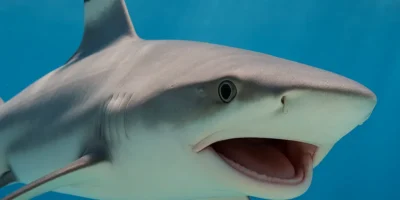
The head is relatively short and broad. The snout appears bluntly rounded and is clearly shorter than in many other Carcharhinus species. This head shape is well adapted to hunting in tight reef structures, where precise manoeuvring is more important than high top speed.
The mouth is on the underside and curved in an arc. The jaws are made entirely of cartilage, which is typical of cartilaginous fishes. The teeth are narrow, upright to slightly inclined, and have fine cutting edges. In the upper jaw they are more serrated than in the lower jaw. As with all sharks, the teeth are continuously replaced.
Eyes and sensory organs
The eyes are relatively large and horizontally oval in shape. The blacktip reef shark has a nictitating membrane, which protects the eye during hunting or when in close contact with the surroundings. This protective membrane is drawn reflexively over the eye without completely blocking vision.
In addition to the eyes, the ampullae of Lorenzini are well developed. These sensory organs are located mainly at the tip of the snout and enable the detection of very fine electrical fields. They play an important role in locating prey in murky water or among coral structures.
Fin arrangement and fin shape
The first dorsal fin is relatively tall, triangular, and begins roughly above the rear insertion of the pectoral fins. Its most striking feature is the deep-black tip, which stands out clearly from the lighter base of the fin. Directly below this black tip there is usually a narrow pale edge, which further enhances the contrast.
The second dorsal fin is significantly smaller and is set far back on the body. The pectoral fins are narrow, sickle-shaped, and taper to a point towards the rear. They enable precise steering movements and contribute to the shark’s high manoeuvrability. The pelvic fins and the anal fin also show dark tips, though these are less pronounced than on the first dorsal fin.
The caudal fin is asymmetrical in structure. The upper lobe of the tail is noticeably longer than the lower. Along the upper lobe runs a dark marking that often extends to the tip. This fin shape supports rapid acceleration over short distances.
Skin and surface structure
The skin of the blacktip reef shark is covered with tiny placoid scales. These act like fine sandpaper and reduce turbulence along the body surface. At the same time, they protect the shark from mechanical injuries caused by corals or other hard structures in the reef.
The upper side of the body is usually light brown to grey-brown in colour, while the underside is distinctly lighter to white. This contrasting colouration serves as camouflage. Viewed from above, the shark blends with the darker seabed below; from below, with the bright surface light.
Internal anatomy and buoyancy
Like all sharks, the blacktip reef shark has no swim bladder. Instead, buoyancy is generated by a large, oil-rich liver. This liver can make up a significant proportion of the body weight and is crucial for balance in the water.
The gills consist of five lateral gill slits on each side of the body. The shark relies on a continuous flow of water through the gills, but can also lie still for a short time without having to swim actively. The internal musculature is designed for fast, powerful movements and supports the typical jerky swimming of this species.
Summary of anatomical features
The blacktip reef shark combines a compact, robust body with high manoeuvrability. The short snout, the striking black fin tips and the lack of an interdorsal ridge are key identifying features. Its anatomy is clearly adapted to life in shallow, structured reef habitats, where quick reactions and precise movements are crucial.
Distribution & Habitat
The blacktip reef shark is a typical shark species of tropical coastal regions. Its range lies almost exclusively in the warm Indo-Pacific. The species is closely tied to shallow, structurally rich marine environments and only rarely leaves them. Long migrations across open sea play no relevant role for this shark.

Geographical distribution
The blacktip reef shark occurs throughout the tropical Indian Ocean as well as the western and central Pacific. Records exist from the Red Sea, the Persian Gulf and along the East African coast. From there, its range extends across South Asia and South-East Asia as far as Indonesia, Papua New Guinea and Northern Australia. Many Pacific island groups such as the Maldives, Seychelles or Hawaii also form part of its natural habitat.
In the Atlantic, the species is completely absent. Individual sightings outside the core range are considered exceptional occurrences and have no ecological significance for the overall distribution.
Preferred habitats
The habitat of the Blacktip Reef Shark is mostly in very shallow coastal waters. It is particularly often observed in lagoons, on reef flats, and along the inner and outer edges of coral reefs. Water depths of less than two metres are used regularly. In such areas, the dorsal fin not infrequently protrudes from the water.
Typical are firm substrates with coral structures, sandy areas between reefs, and calm bays. The species largely avoids open water. Strong currents are also rarely sought out.
Environmental conditions in the habitat
The Blacktip Reef Shark lives in warm seawater with stable temperatures, mostly between 24 and 30 degrees Celsius. Clear visibility is important for the species, as it is strongly visually oriented. Salinity corresponds to the normal marine range. Unlike some other coastal sharks, it scarcely enters freshwater.
Shallow coastal zones with low wave energy offer both protection and suitable hunting conditions. Particularly sheltered lagoons play a central role in this.
Site fidelity
Blacktip Reef Sharks show pronounced site fidelity. Individual animals often use the same limited coastal area for years. Within this area, fixed core-use zones can be identified, which are regularly visited for resting or hunting.
Juveniles prefer very shallow, sheltered lagoons. These areas serve as natural nursery grounds and provide protection from larger predators. As they grow, the home range gradually shifts into more open reef areas.
Lifestyle, diet & reproduction
The movements of the blacktip reef shark follow the tides; it often patrols familiar territories of less than one square kilometre. These sharks are both solitary and social animals. Adults often stay in small groups and show cooperative hunting strategies. During the day they rest in deeper areas, while becoming more active at dusk. With the help of their electroreceptive sensory organs, the ampullae of Lorenzini, they can detect prey even in murky water.
Diet
As carnivorous predators, bony fish are the main items on the blacktip reef shark’s menu. It pursues schools of mullet, perch, mackerel or surgeonfish, using its speed and agile body shape to isolate individual animals. In addition, cephalopods such as squid and octopus, as well as crustaceans such as crabs and prawns, are part of its diet. Occasionally it eats small sharks, rays or sea snakes. Observations show that, hunting in groups, these sharks drive schools of fish into shallower water to ambush them. Thanks to their well-developed electroreception organ, they can detect prey even when it buries itself in the sand or hides in coral shelters.
Reproduction
The blacktip reef shark is viviparous. Fertilisation takes place internally, with the male transferring sperm via a specialised reproductive appendage. During a gestation period that lasts between seven and sixteen months depending on the region, the embryos initially develop from a yolk sac and are later nourished via a placenta. Females typically give birth to two to five pups. In some areas, litters can be larger. The newborns are around half a metre long and are independent from the outset. Birthing sites are shallow, sheltered areas in mangroves or lagoons. There, the young spend their first months of life before venturing into deeper reef sections. Males reach sexual maturity after about four years; females often take twice as long.
Current research and conservation
Recent studies have shown that the increase in shark tourism can have unexpected effects. In blacktip reef sharks that were regularly fed by visitors, altered blood values and hormone levels were found. Lower haematocrit values and reduced insulin levels indicate poorer condition, which could impair reproductive capacity in the long term. These findings underline the need for a responsible approach to dealing with these animals. As the blacktip reef shark grows slowly and has only a few pups per litter, the species is particularly vulnerable to overfishing and habitat loss. Protecting mangroves, lagoons and undisturbed reef areas is therefore crucial to secure the continued survival of this remarkable shark species.
Threat & protection status
The Blacktip Reef Shark is considered a threatened shark species worldwide. The International Union for Conservation of Nature currently classifies it as endangered. The main reason for this classification is the ongoing fishing pressure in coastal habitats that are intensively used by humans.
The species prefers shallow reef zones, lagoons and coastal coral reefs. These areas overlap heavily with artisanal and industrial fisheries. Blacktip Reef Sharks are targeted or killed as bycatch in set nets, gillnets and longlines. Due to their site fidelity, local populations can decline sharply even under moderate fishing pressure.
In addition, the international trade in shark fins has a negative impact on populations. Even though the Blacktip Reef Shark is not among the largest species in the fin trade, the high number of animals taken leads to regional overexploitation. In many coastal states, reliable catch statistics are lacking, which is why the true extent of removals was underestimated for a long time.
Population trend
Global analyses of population trends show a significant decline in Blacktip Reef Shark populations. Studies from various regions of the Indo-Pacific document decreases of more than fifty percent within just a few decades. Particularly affected are densely populated coastal areas with intensive fishing.
A key biological factor is the species’ low reproductive rate. Females give birth to only a few pups, and the growth rate is relatively slow. These traits make a rapid recovery of populations after declines considerably more difficult.
Regional differences are clearly evident. In remote island regions with low levels of human use, stocks are considered stable or slightly declining. In South East Asia, parts of the Indian Ocean and heavily used reef systems, however, populations have in many places been greatly reduced or have disappeared locally.
Impact of habitat loss
The population trend of the blacktip reef shark is also influenced by the loss of suitable habitats. Coastal development, tourism, port construction and the destruction of mangroves reduce important nursery and refuge areas. Coral bleaching and deteriorating water quality indirectly affect population density, as structurally complex reefs play a central role in hunting and orientation.
Conservation measures
Since 2023, the blacktip reef shark has been listed in Appendix II of the Washington Convention on International Trade in Endangered Species. This regulation obliges the contracting states to control international trade and ensure that removals do not endanger wild populations. However, its effectiveness depends heavily on national implementation and enforcement.
At regional level, marine protected areas are considered one of the most effective measures. Long-term studies from strictly protected reef systems show stable or even increasing stocks. Particularly effective are protected areas in which fishing bans are consistently enforced and coastal habitats are preserved.
Further conservation approaches focus on reducing bycatch, regulating coastal fisheries and protecting mangroves and coral reefs. Sustainable dive tourism can also have a positive effect, as live sharks in many regions have a higher economic value than captured animals.
The long-term safeguarding of blacktip reef shark populations requires a combination of international species conservation, regional fisheries management and the preservation of intact coastal ecosystems. Without these measures, further population declines are to be expected in many parts of its range.
Profile
- First described:
- Max. size:
- Depth:
- Max. age:
- Max. weight:
- Water type:
- IUCN Status:
Taxonomy
- Kingdom:
- Phylum:
- Subphylum:
- Infraphylum:
- Parvphylum:
- Class:
- Subclass:
- Superorder:
- Order:
- Family:
- Genus:
Dive Centres


News

Newsletter
Shark Alert in Your Inbox


