


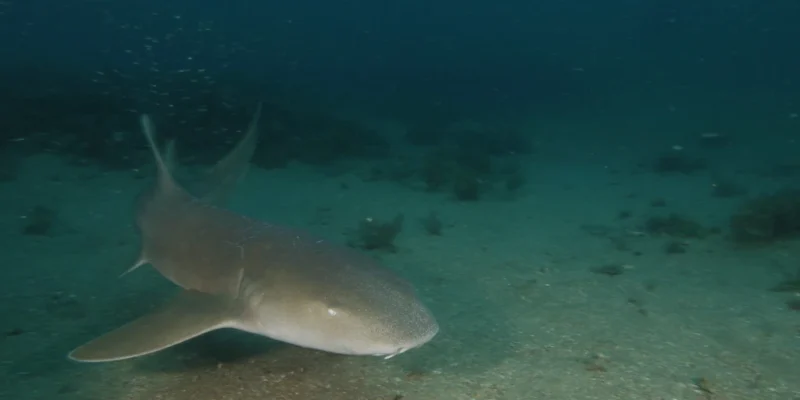
Silky sharks and sandbar sharks use the reefs and underwater banks off Texas in different ways. A new study in Frontiers in Marine Science traces their movements in the northwestern Gulf of Mexico and shows that protected areas, neighboring banks, and artificial reefs together form a connected habitat.
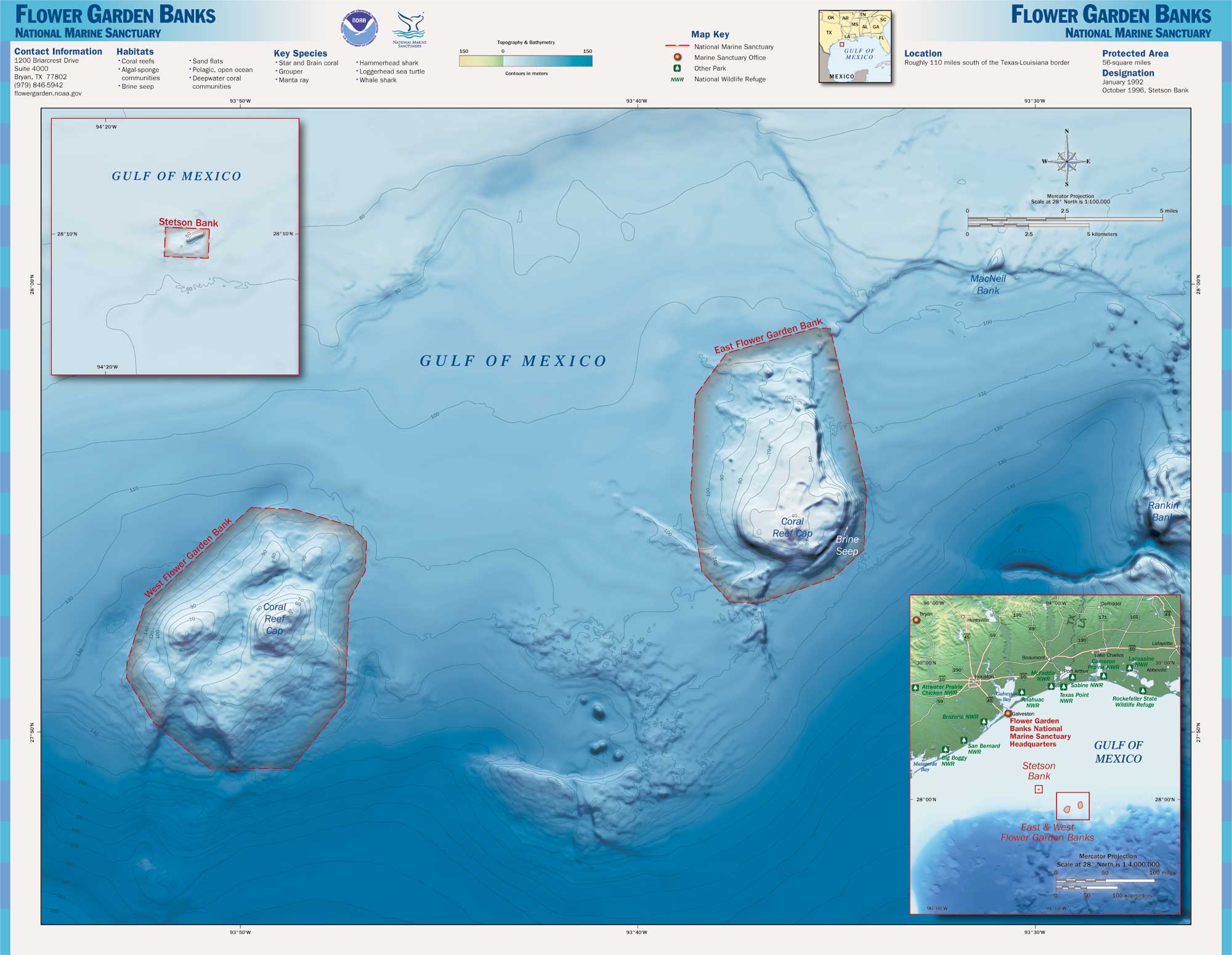
The team fitted 23 silky sharks (Carcharhinus falciformis) and 22 sandbar sharks (Carcharhinus plumbeus) with acoustic transmitters. The data cover the period from August 2022 to October 2025. Receivers were evaluated at 17 banks within the Flower Garden Banks National Marine Sanctuary, four banks outside the protected area, and 14 artificial reefs.
How acoustic telemetry reveals shark movements
An acoustic transmitter transmits an individual ID. If a tagged shark swims within range of a receiver, the contact is recorded. This allows repeated visits and connections between locations to be detected. However, the method does not show every position of an animal: a phase without detection can also mean that the shark was out of the receiver’s range.
You are currently viewing a placeholder content from Facebook. To access the actual content, click the button below. Please note that doing so will share data with third-party providers.
More InformationThe NOAA webinar on the telemetry project from 2024 explains the underwater acoustic network used and the question of how fish use the reefs and banks of the protected area on large and small spatial scales.
Silky sharks shift their focus seasonally
A variable connectivity of the sites was observed in the silky sharks. Natural banks were particularly preferred in winter and spring. At the same time, the receivers showed use of artificial reefs, with a clear pattern in summer and observations that were not limited to a single season.
This complements the well-known image of a strongly pelagic species. Although silky sharks live mainly in the open warm sea, they can make targeted use of structures such as island slopes, banks and artificial reefs. The study does not describe a simple year-round residence on a single reef, but a spatially and temporally changing network.
Sandbar sharks were detected year-round
Sandbar sharks were, on the other hand, recorded throughout the entire year both at natural banks and at artificial habitats. Their movements also extended beyond the local receiver network more frequently: 46 percent of the detected sandbar sharks were also recorded outside the protected area’s acoustic network. For the detected silky sharks, it was nine percent.
This comparison concerns exclusively the marked and actually recorded animals. It does not mean that 46 percent of the entire sandbar shark population leave the protected area, nor does it allow a direct conclusion about population size or population development. However, it shows that the recorded sandbar sharks were spatially more strongly associated with areas beyond the local network during the study period.
A protected area is part of a larger network
For management, the interplay of the locations is especially important. The banks within the protected area, natural banks outside its boundaries, and artificial reefs do not function independently of each other. Mobile sharks connect these habitats and can cross administrative and protection boundaries multiple times.
Thus, the work does not provide a justification against marine protected areas. Rather, it makes visible which additions spatial protection requires: coordinated fisheries management outside the boundaries, the preservation of important corridors, and the monitoring of artificial structures, which can also serve as habitat.
The full paper is not yet available
Frontiers lists the work as accepted on August 21, 2026. At the time of this reporting, the fully formatted final version is not yet available. Therefore, details such as the age and size distribution of the tagged animals, individual observation duration, range differences of the receivers, or the statistical modeling cannot yet be independently verified from the methods and results sections.
The results published in the abstract are still clear: Both species use a habitat mosaic, but not in the same pattern. Precisely these species-specific differences are crucial if protection is not only to designate areas but also to take into account the actual movements of mobile marine animals.