


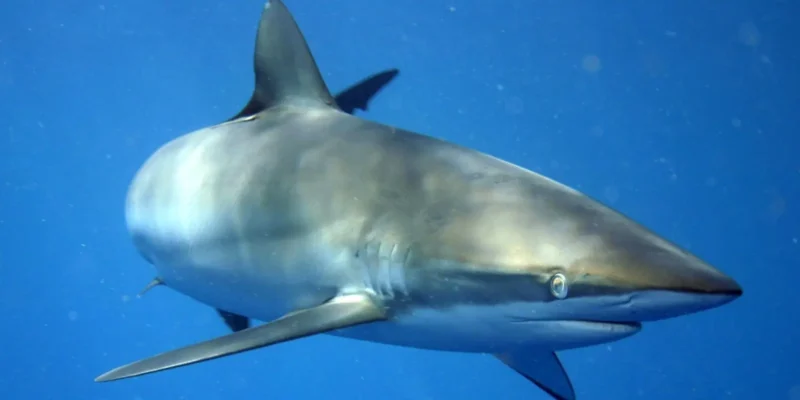
One new study in Reviews in Fish Biology and Fisheries investigates how much different fisheries impact silky sharks in the Atlantic and which management measures could most effectively reduce bycatch.
Leire Lopetegui-Eguren and her team published the paper on July 20, 2026. It evaluates 28 alternative conservation and management measures for the large fisheries served by ICCAT.
Why classic inventory analyzes hardly work
The silky shark, Carcharhinus falciformis, lives pelagically and is often caught as bycatch of tuna and swordfish fisheries worldwide. For the Atlantic However, a lot of data that a classic inventory analysis would require is missing. Fishing effort, gear selectivity and actual fishing efficiency are only partially known spatially and between fleets.
The researchers therefore used EASI-Fish, the Ecological Assessment of Sustainable Impacts of Fisheries. This approach links the spatial distribution of a species with fishing effort, catch probability, biology and mortality. In this way, several fisheries can be viewed together, even if the data basis is incomplete.
Longlines create the greatest cumulative pressure
In the model, industrial longline fisheries were the largest contributors to cumulative fishing mortality. What was crucial was their large spatial overlap with the distribution area of the silky shark. Purse seining, gillnets and handlines had smaller but still relevant contributions.
A single, apparently dominant fishing method does not fully explain the risk. The value of the study lies in the shared balance: many fleets and devices impact the same population at the same time, while individual data sets only show a section.
From increasingly endangered to highly endangered
The assessment depends heavily on how uncertainty is treated. Under assumptions that explicitly reflect areas of uncertainty, the status ranged up to “increasingly at risk.” Under precautionary assumptions, it fell into the highest risk category of the procedure used.
This is not a contradiction, but an important result. The range shows that missing data itself represents a management risk. If only the most optimistic values are used, the pressure can be underestimated; A precautionary assessment makes it clear how unfavorable the situation could be.
Temporal closures have the strongest effect in the model
Among the 28 options examined, avoidance measures achieved the largest reductions in modeled hazard. These included static temporal closures of areas where fishing and silky sharks overlap particularly heavily. Such measures prevent contact before an animal even comes into contact with fishing gear.
Measures to reduce the consequences of previous contact were more moderate. These include a ban on steel leaders in longline fishing and better handling and release practices on purse seiners. Combined, they further improved the result.
A hierarchy instead of an individual measure
The authors are in favor of a graduated strategy: avoid encounters with fishing gear as much as possible, reduce unavoidable catches and improve the chance of survival of caught animals. No single measure solves the problem for all fleets, areas and fishing methods.
It is precisely this combined approach that is relevant for ICCAT. The organization regulates tuna and related fisheries in the Atlantic, whose fishing areas extend far beyond national borders. Protective measures must therefore be tailored to the spatial distribution of sharks and fishing effort.
Where new data makes the biggest difference
The analysis identifies three particularly critical gaps: actual fishing effort, efficiency of different devices and their selectivity. Targeted research in these areas would narrow the scope of assessment and show which measures provide the most protection per intervention under real-world conditions.
The study therefore does not provide a seemingly exact inventory figure. Instead, it provides a framework against which decisions can be compared despite uncertainty. For the silky shark in the Atlantic, the key message is: avoid spatial overlap first, use technical and practical improvements in addition and close the largest data gaps in a targeted manner.
