


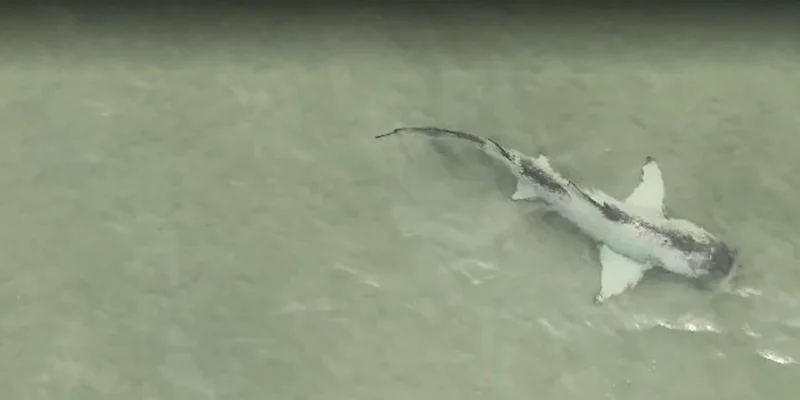
Off Anna Maria Island on Florida’s Gulf Coast, an unusually piebald lemon shark has been filmed. The video, recorded on August 22, 2026, by Jacob Merrifield, shows large light patches on the otherwise yellowish-brown body. The sighting was reported by Storyful on Yahoo News.
Merrifield told the video service that he had never seen such a shark before. The published report does not provide any information on its length, sex, a marking, or the exact location of the recording. A genetic sample was also not mentioned. Therefore, the animal can be described based on the video, but not individually identified.
Piebald is not the same as albino
A scientific overview in Ecology and Evolution defines piebaldism as locally limited loss of pigment: irregular white or very light spots appear on an otherwise normally colored body, while the eyes remain pigmented. The terms piebaldism and partial leucism are used synonymously in this context. Albinism, on the other hand, refers to a different disorder and should not be used as a collective term for any light coloration.
piebaldism can have a genetic basis. However, for this individual animal, a specific mutation has not been proven. The researchers point out that skin changes can also be influenced by diseases, nutrition, or environmental stressors. Only an examination of the animal could confirm the cause of the striking pattern.
Only 25 wild cases in the review
The 2025 study collected 25 verifiable reports of piebald sharks from 17 species and eleven families. Among them was already a lemon shark from Florida, which became known in 2023 through social media and media reports. The number describes the documented cases, not the actual frequency in nature. Animals that went unnoticed or were never reported are necessarily missing.
Furthermore, a piebald lemon shark was already publicly known at Captiva Island earlier. The Miami Herald reported on an animal more than two meters long, tagged, which was caught while fishing and released again. The new video contains too few comparable features to claim that the same individual is visible at Anna Maria Island.
Consequences for the shark remain unknown
A striking coloration could theoretically influence camouflage, hunting success, or encounters with conspecifics. For sharks, this has not yet been proven. In the videos analyzed in the overview, the animals showed no unusual movements or visible malformations. Several records of adult animals also argue against the idea that piebald coloration drastically reduces survival in all affected species.
This is not an all-clear for every single animal. Long-term observations, age data, and genetic studies are missing. Precisely because animals with potential disadvantages may be observed less frequently until adulthood, only limited conclusions can be drawn from the known sightings about the invisible cases.
Scientifically, the video is primarily a new dataset
The researchers emphasize the value of well-documented observations by divers, fishers, and other marine users. Photos and videos are particularly useful when the date, location, depth, size, and possible markings are recorded. For the new finding, sharper comparison images and information on body features would be crucial if the animal appears again.
Anna Maria Island is located in the Gulf of Mexico, where lemon sharks use shallow coastal habitats. The sighting is an unusual biological record, not an indication of increased danger to humans. Rather, it adds to the still very small dataset on pigment disorders in sharks in the USA.