


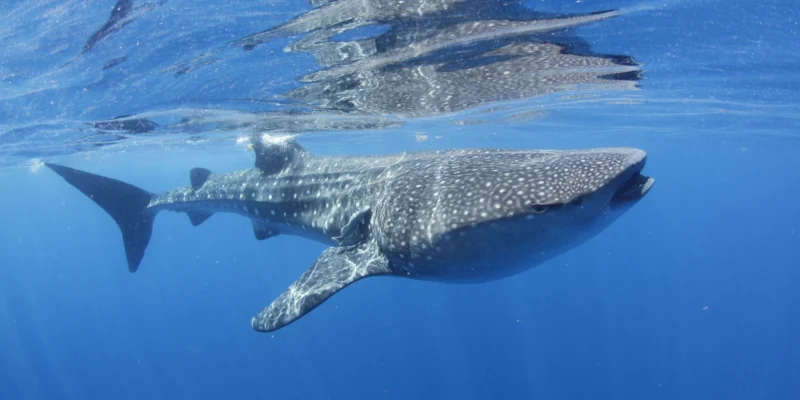
Qatar’s Environment Ministry MECC reports an exceptionally large concentration of whale sharks in the country’s waters. As the Qatar News Agency reported on International Whale Shark Day, an aerial census recorded around 700 animals in a single day.
The number is remarkable, but must be read carefully. The notification dated August 30, 2026 does not specify the date of the flight, the exact route, the recording conditions or the procedure to avoid double counting. It therefore does not indicate a population of exactly 700 animals and is not automatically a new count from August 2026.
Research since 2010, new catalog for individual whale sharks
According to the ministry, whale shark research has been ongoing in Qatar since 2010. The team studies the population structure and identifies individual animals based on their individual spot patterns. The work led to the first national whale shark catalog, which is intended to document returning animals and possible connections with other parts of the Arabian Gulf.
The Environmental Status Report of the MECC for 2025 provides additional context. Between 2022 and 2025, at least 400 whale sharks gathered seasonally at the Al-Shaheen field. From 2022 to 2024, 96 animals were tracked via satellite, according to the report. The data showed strong site fidelity within the field, but also movements across the Gulf and individual migrations into the northern Indian Ocean.
Fish eggs attract whale sharks to Al Shaheen
The aggregation site is at the Al-Shaheen oil field north of Qatar. Whale sharks appear there mainly between May and September. Previous plankton analyzes identified large quantities of eggs from the kawakawa Euthynnus affinis. These energy-rich eggs drift near the surface, allowing the filter-feeding sharks to concentrate on feeding.
A telemetry study in Frontiers in Marine Science evaluated 117 acoustically tracked whale sharks from 2012 to 2016. Around 105,000 detections showed a clear seasonal connection to the small area; 27 percent of the animals were recorded in at least two seasons. The longest continuous detection of a single animal lasted 77 days.
Platforms alone do not explain the aggregation
The whale sharks are often seen near oil and gas platforms. However, the telemetry data does not show that the structures themselves are the key attraction. Distance to the center of the feeding site and time of year explained the distribution similarly well; currents and the spawning of fish are likely to concentrate the animals at a particularly productive point.
The figure of 700 therefore describes an extraordinary snapshot of a seasonal feeding ground. Repeated, methodologically comparable counts would be necessary for a population trend. The catalog, photo identification, satellite and acoustic data complement each other: They can show which animals return, how long they stay and where they go after leaving the Gulf.