
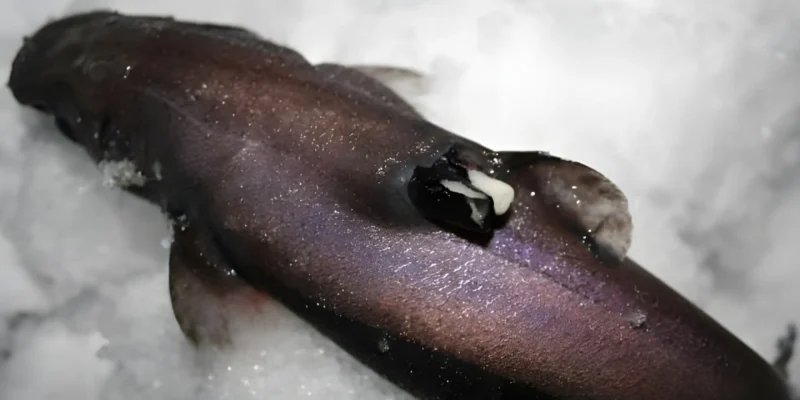
In the dark depths of the Norwegian Sognefjord, researchers have made a remarkable discovery: a species of barnacle normally found near the coast has completely evolved from a filter feeder into a parasite and now infests living deep-sea sharks. The species Anelasma squalicola penetrates deeply into the tissue of its hosts with a specialised stalk and extracts nutrients from them directly.
From filter feeder to parasite
Barnacles are normally harmless filter feeders. As larvae they attach to hard substrates such as rocks or ships and feed using fan-shaped feeding appendages (cirri), with which they filter plankton from the water.
However, in Anelasma squalicola this mechanism has become non-functional. Although the species still possesses the typical cirri, they no longer serve for feeding. Instead, its stalk grows into the skin of sharks like a root. There, the tissue branches inside the host and absorbs nutrients directly from the blood and surrounding tissue.
Studies show that the barnacle’s digestive tract is still present but is mostly empty. A clear indication of the complete abandonment of a filter-feeding lifestyle.
Evolutionary turning point
A phylogenetic analysis from 2014 confirmed that Anelasma squalicola does not descend from already parasitic ancestors. Instead, it evolved from ordinary, free-living stalked barnacles.
The closest living relative is considered to be Capitulum mitella, a rock-dwelling species that is even consumed as food in East Asia. This species therefore documents a rarely directly observable evolutionary transition from a free-living to a parasitic lifestyle.
Hotspot in the Sognefjord
Particularly affected are lantern sharks such as Etmopterus spinax, which live at depths of roughly 100 to 1,000 metres. In these low-light zones a striking number of individuals were found with the yellowish, stalked barnacles. Some of the sharks carry several parasites at once, often around the dorsal fins.
Because these deep-sea sharks are rarely observed, the extent of the infestation remained undiscovered for a long time. The concentration in the Sognefjord suggests that local environmental conditions favour the spread.
Effects on sharks
The embedded stalks cause tissue damage and drain energy from the sharks. Even though the animals apparently can tolerate several parasites, the infestation is likely to impair growth and reproduction.
Sharks have existed for around 400 million years and have survived numerous ecological changes. That they are now being infested by an evolutionarily newly arisen parasitic barnacle represents an unusual and comparatively recent development.
What happens next?
Researchers see two possible scenarios: either Anelasma squalicola remains a locally limited phenomenon in the Sognefjord and eventually disappears again, or the species establishes itself successfully and spreads to other ocean regions.
Regardless of the outcome, this discovery provides a rare insight into an evolutionary upheaval — a moment in which an ordinary marine species is developing into a completely new ecological role.


