


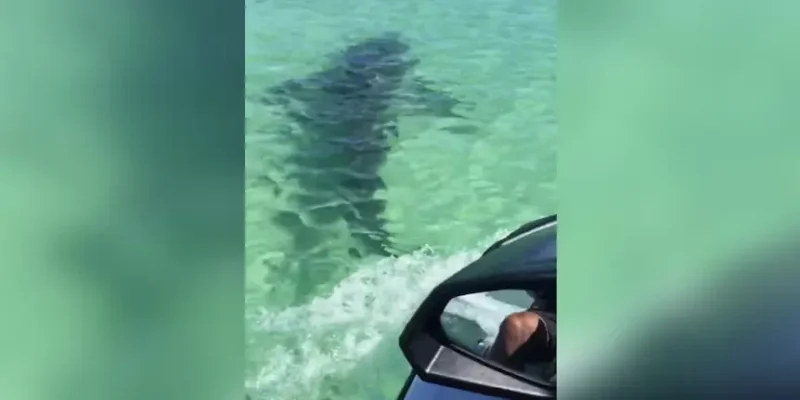
Shark bites are often told as mysterious attacks. A new one Mini review in Frontiers in Conservation Science draws attention to a more sober explanation: Some bites may be a defensive reaction when a shark perceives a person or vehicle as a threat.
The authors Eric E. G. Clua and Carl Meyer take up the concept of antipredator motivation. This does not mean hunting behavior, but rather a defensive reaction. A shark doesn’t bite because a human is prey, but because it feels harassed and wants to keep a potential danger away.
You are currently viewing a placeholder content from Facebook. To access the actual content, click the button below. Please note that doing so will share data with third-party providers.
More InformationWarning behavior is part of the message
The order is important. After the review show Sharks In such situations, agonistic warning behavior often occurs before a bite occurs. This can include abrupt changes in direction, clear evasion, tense posture or other signals include things that are easily overlooked or misread in practice.
This is a crucial difference for people near the water. Anyone who only sees an animal as a danger asks above all how to keep sharks away. Anyone who understands the situation as conflict behavior also asks what people do to trigger or exacerbate the conflict in the first place.
Why jet skis can be problematic
The review identifies one modern practice particularly clearly: the rapid pursuit of sharks using jet skis. A jet ski can repeatedly catch, cut, harass and pursue an animal over long distances. From a human perspective, this might seem like a quick observation or a spectacular video. From the shark’s perspective, it can seem like a constant attack from behind or from the side.
According to the authors, it is precisely this combination of speed, proximity and pursuit that can fulfill behavioral triggers that are consistent with defensive bites. The key point is not that jet skis inherently make sharks aggressive. The point is that active harassment can create a dangerous situation that would not have arisen without persecution.
Provoked does not mean harmless
A provoked bite is no less serious. For the person affected, the injury can be serious, and for the shark the result can be even worse: public fear, blame, fishing pressure, or demands for lethal measures. This is precisely why the classification is important.
If the cause is not a hunting shark but human harassment, prevention must start elsewhere. Then warning signs and panic messages are not enough. What is needed are clear distance rules, good information for water sports enthusiasts and, in cases of doubt, legal limits for the targeted pursuit of sharks.
Better rules protect people and sharks
The authors call for more awareness and, where necessary, adapted regulation. This can look very different locally: minimum distances, bans on targeted tracking, rules for commercial tours, specifications for Drones– and jet ski use or sanctions against intentional harassment of marine animals.
Such rules would not provide special treatment for sharks. For whales, dolphins, seals and sea turtles, distance and approach rules have long been normal in many regions. With sharks, the same logic is often slower to be accepted because their image is more dominated by fear and sensation.
What this means for divers and water sports enthusiasts
For divers, snorkelers, surfers and jet ski riders, the practical lesson is simple: do not pursue, do not circle, do not approach an animal and give space to an evasive shark. A good encounter is one in which the shark can decide for itself whether to stay or go.
Especially with large or visibly stressed animals, distance should be more important than the best photo. If a shark repeatedly avoids, changes direction, or avoids contact, that is not a signal to move closer. It is the moment to end the situation.
A sober look at shark bites
The mini-review does not replace an individual case analysis. Shark bites can have various causes, and not every event can be explained with certainty from a distance. Its value lies in clearly identifying an avoidable risk factor: humans can harass sharks in a way that makes defensive bites more likely.
This is almost inconvenient but helpful news for shark protection. It shifts responsibility back to human behavior. Those who do not hunt sharks, do not pursue them in a hunt-like manner and take warning signals seriously are not only protecting themselves. They are also preventing individual conflicts from further distorting the image of sharks as dangerous animals.