


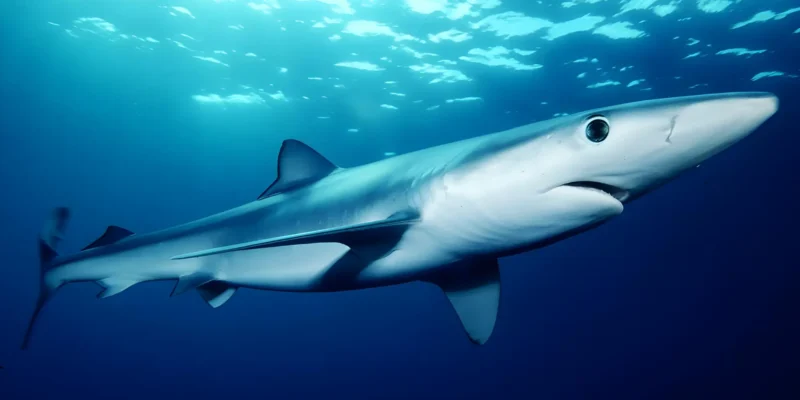
The vast expanses of the oceans may seem infinite, but they are not immune to human influences. Millions of tonnes of plastic and synthetic fibres enter the seas each year, where they break down into tiny particles, drift with currents, accumulate in sediments, and infiltrate marine food webs. A recent study now shows that one of the ocean’s most iconic predators plays an unexpected role in this cycle: the blue shark.
New research findings confirm that the guts of blue sharks act like temporary collection containers, holding onto fibres long enough to accumulate significant quantities. Their epic migrations mean they can spread these particles across entire ocean basins, far from their original source. And it’s not just plastic we need to worry about.
Migratory Waste Distributors of the Seas
Blue sharks (Prionace glauca) are among the most common shark species in temperate and tropical waters and are often caught as bycatch in tuna longline fisheries. Their diet is varied—they eat fish, cephalopods, and crustaceans—and they travel hundreds or even thousands of kilometres each year.
A research team led by Chenxuan Du from Shanghai Ocean University in China analysed the guts of blue sharks and found both plastic and non-plastic particles in every section of the spiral-shaped organ. The highest concentration was in the posterior region. On average, a single gut contained about 11 plastic fibres and 48 non-plastic fibres.
Fibres dominated the mixture found, making up more than 95 per cent of the identified particles. Among the plastics, polyester and polyethylene terephthalate were most common, while the non-plastics included rayon and cotton. These are materials known to be released during washing and flushed into our oceans via river systems.
Complex Impacts on the Marine Ecosystem
The size of these fibres ranged from about 0.1 millimetres to over 8 millimetres. They are small enough to be ingested by other organisms but also large enough to survive digestion intact. Sharks can excrete these particles kilometres away from their original ingestion site, becoming unexpected couriers of pollution.
These findings highlight how deeply marine pollution is woven into ocean ecosystems. The guts of blue sharks essentially act as temporary storage units for waste, holding onto both plastic and non-plastic fibres long enough for researchers to measure significant accumulations.
“The sharks are not just passive victims of pollution; they are active participants in its spread,” explains marine biologist Melissa Cristina Márquez.
As blue sharks migrate thousands of kilometres across entire ocean basins, these new insights add another layer of complexity to the already challenging task of tracking marine pollution. Moreover, the discussion extends beyond plastics: non-plastic fibres like rayon and cotton are often seen as less harmful since they degrade more quickly, but many are treated with dyes, flame retardants, or other chemical additives that can be toxic.
If one of the ocean’s most mobile predators can accumulate and redistribute particles, other pelagic species, including other sharks, tuna, and swordfish, are likely playing similar roles. This means tackling marine pollution has just become a lot more complicated.
Every fibre in the guts of the blue sharks studied reflects an intertwined web of human activity, ocean currents, and biological systems. Each fragment is evidence that our waste does not disappear—it travels, lingers, and embeds itself in the very creatures we admire. The ocean is not too vast to escape our reach, nor are its creatures.
The selected folder has no items.
