


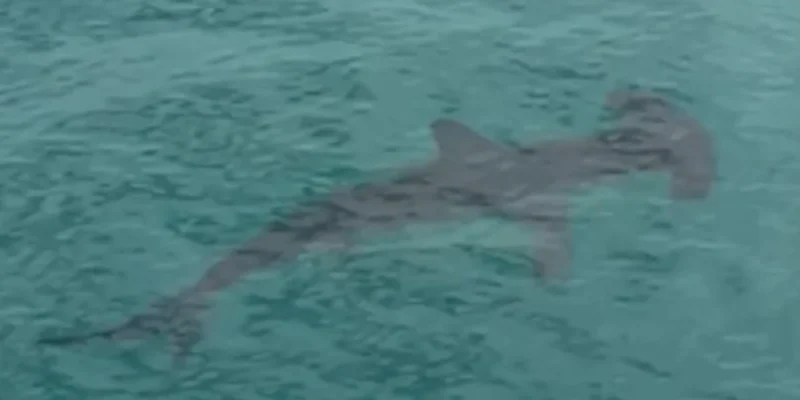
Right next to Malibu Pier in California, a large hammerhead shark appeared on Thursday morning, August 13, 2026. Images show the animal close to the surface; the dorsal and caudal fins temporarily protruded from the water. The sport fisherman Ari Kohanchi filmed the encounter. ABC7 Los Angeles published the video and eyewitness accounts on the night of August 15th.
You are currently viewing a placeholder content from Facebook. To access the actual content, click the button below. Please note that doing so will share data with third-party providers.
More InformationWhile the shark was swimming along the pier, it was briefly hooked by another angler. The animal broke away again and swam away. The scene is spectacular, but its timing is scientifically more interesting: there are exceptionally warm waters off Southern California, and El Niño is strengthening in the tropical Pacific Ocean. It is precisely under such conditions that warm water-loving species can follow their food supply further north.
Why warm water lets hammerhead sharks move north
Nate Jaros, vice president of animal care at Aquarium of the Pacific, told ABC7 that surface temperatures of more than 70 degrees Fahrenheit – a good 21 degrees Celsius – during a El-Niño event create the conditions for such migrations. The sharks move with the warm water and hunt the prey there, which in turn shifts their distribution area.
Also FOX 11 Los Angeles classified the recording as a rare sighting that can occur during warm water events off Southern California. This does not mean that Sphyrna are usually completely absent from the region. Individual species range into warm temperate areas. However, frequency, length of stay and proximity to the coast can change significantly in unusual temperatures.
NOAA had already described the northward shift in June
The sighting is strikingly consistent with an analysis that NOAA Fisheries published on June 12th. In it, the US Oceanic Administration looked back on the combination of the major marine heat wave “The Blob” and the strong El Niño of 2015/2016. At that time, hammerhead sharks and even Whale shark appeared unusually far north of Southern California. Other species shifted even further: A skipjack tuna was caught off Alaska, and albacore tuna came unusually close to shore off Washington.
NOAA already named an early biological signal for the summer of 2026. Anglers off Southern California were catching dorado and yellowfin tuna significantly earlier in the year than usual. The authority interpreted this as an indication that the expected northward shifts may have begun. The hammerhead shark on Malibu Pier is now a particularly visible example of exactly this pattern – but no evidence that NOAA predicted the visit of this individual animal or this specific location.
El Niño is not the only factor warming the West Coast
The cause cannot be reduced to a single climate phenomenon. NOAA tracked two marine heat waves on the west coast in June that were not directly caused by El Niño and had already kept the water warmer than average for months. El-Niño-related warming has a different effect: it comes more strongly from the south and from deeper water layers. According to the forecast at the time, their influence should increase towards autumn.
In front of Malibu, several processes overlap: an existing marine heat wave, the intensifying El Niño, local currents and the distribution of prey fish. The hammerhead shark sighting is consistent with this development. However, it cannot be determined from a single video which factor ultimately led the animal to the pier.
One sighting does not mean a new population
A hammerhead shark in Malibu therefore does not mean that a new population has established itself off California. Sharks are highly mobile animals. When a corridor of warm water and suitable prey emerges, individuals can quickly expand their seasonal range. If the water cools down again or the prey moves back, the shift can reverse just as quickly.
For long-term spread, repeated evidence over several years, data on length of stay and migration routes as well as evidence of regular use or reproduction would be necessary. Such data are not available for the current observation. It is also unclear how long hammerhead sharks will stay in the unusually northern waters this summer.
Which hammerhead species was it?
Some follow-up reports suggest a Smooth hammerhead shark is likely. This would be biogeographically plausible, as this species occurs in both subtropical and temperate seas and is known from Californian waters. However, the reliable local reports from ABC7 and FOX 11 do not determine one type based on the recordings.
For a reliable identification, features such as the shape of the edge of the head and the fins would have to be clearly visible. Therefore, the cautious designation “hammerhead shark” remains the technically sound choice. A probable species may be mentioned as a possibility, but should not appear as a confirmed identification in heading or metadata.
Update: Second hammerhead filmed farther northwest off Gaviota
Only three days after the Malibu Pier footage, Juan Morales of Sky Angel Drones filmed another hammerhead off Gaviota Beach in Santa Barbara County on Sunday, 16 August 2026. KEYT published the drone video on 18 August and explicitly linked it to the Malibu sighting. The local report did not identify the Gaviota shark to species either.
The second sighting considerably farther northwest fits the expected expansion of warm-water species during the current warm-water phase. Two videos within a few days, however, do not demonstrate a permanent range shift or population increase. That would require repeated, standardised evidence over a longer period.