From Ice Age survival to genetic diversity
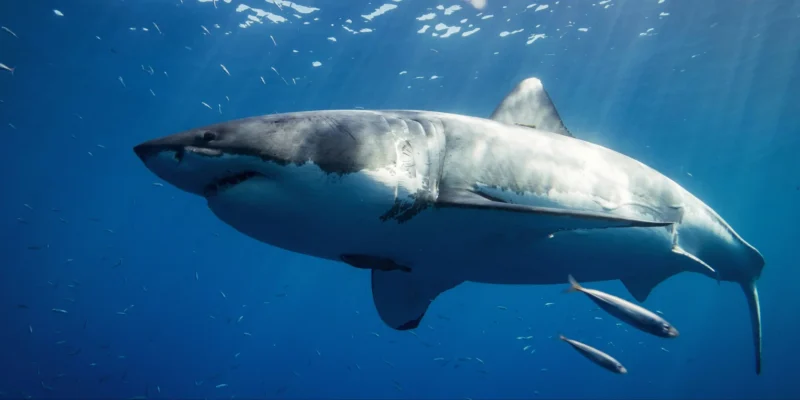
Great white sharks (Carcharodon carcharias) were on the brink of extinction during the last Ice Age. At that time, sea levels were around 40 metres lower than today, drastically reducing their habitat. With the end of the Ice Age about 10,000 years ago, temperatures rose, glaciers melted and the seas expanded – a comeback for great white sharks began.
According to a recent study in the Proceedings of the National Academy of Sciences, the animals initially survived only as a single, well-mixed population in the southern Indo-Pacific. Only about 7,000 years ago did the genetic divergence into several isolated groups begin. Today, there are three genetically distinct populations: in the South Pacific (Australia/South Africa), in the North Atlantic and in the North Pacific.
Yet the total number remains low. “Globally, there are probably only around 20,000 individuals,” explains study co-author Gavin Naylor from the Florida Museum of Natural History. “In any city, there are more fruit flies than great white sharks in the entire world.”
Mysterious DNA patterns and a theory that wobbles
As early as 2001, researchers found anomalies in the DNA of great white sharks from Australia, New Zealand and South Africa: while the nuclear DNA in the cell nucleus was almost identical, the mitochondria – which are inherited only maternally – showed significant differences. This pointed to so-called philopatry: female sharks travel long distances to hunt but return to the same place to reproduce.
This theory held for two decades. But when Naylor and his team analysed 150 mitochondrial genomes and additional nuclear DNA samples, they found that the differences in mitochondrial DNA cannot be explained by philopatry. Other theories, such as an imbalance in the sex ratio or reproductive dominance of individual females, could also not be confirmed.
If not migration, then what?
The only remaining hypothesis: natural selection. But this also seems unlikely – especially given the small populations. For differences to manifest only in mitochondrial DNA, the selection would have to be extremely strong. Naylor remains sceptical: “The selection pressure would have to be brutally lethal.”
The genetic secrets of great white sharks thus remain unsolved for now. One thing is certain: reaching the top of the food chain does not necessarily protect against threats. The survival struggle of these fascinating animals continues – and science remains on the case.