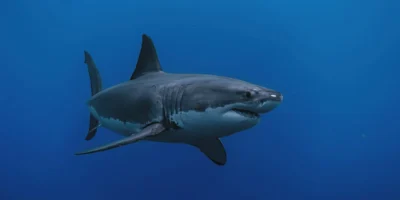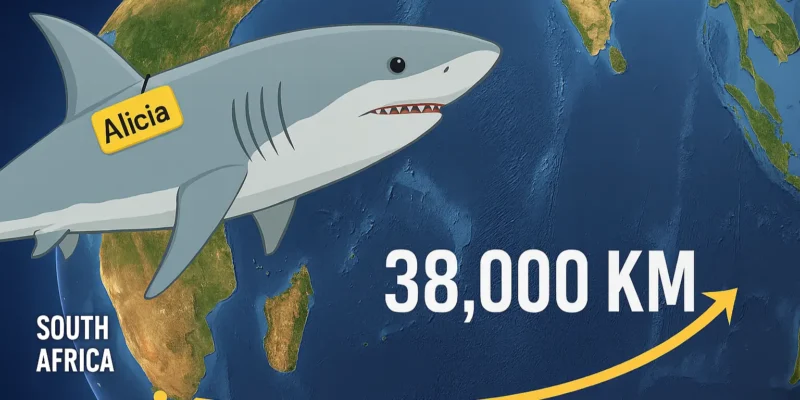
Some scientific discoveries emerge from the depths only by chance. This was the case with “Alicia”, a female Great White Shark that was tagged with a satellite transmitter in 2012 off Gansbaai (Western Cape, South Africa) – and years later unexpectedly “reappeared” in the Indonesian fisheries sector.
The researchers initially tracked Alicia’s route until April 2014, when her transmitter last signalled about 1,000 kilometres southeast of Madagascar. After that, radio silence. It wasn’t until 2016 that the transmitter was recovered from a caught shark in Indonesia. By matching the serial number and database, it was conclusively determined: it was the same tag that had been attached to a roughly 3.9-metre-long subadult female Great White Shark in 2012. The animal had been misidentified as a longfin mako shark when landed in Indonesia.
Record-breaking journey across oceans – and a lucky coincidence
The telemetry data reveal an extraordinary movement pattern: from 2013, Alicia covered a distance of about 38,000 kilometres in 395 days – an average of around 56 kilometres per day. She traversed waters with surface temperatures ranging from 3.8 to 29 °C, passing, among other places, the uThukela Banks Marine Protected Area on South Africa’s east coast and eventually reaching Southeast Asia. This is the longest documented migration of this species and the first evidence of a Great White Shark from South African waters in Southeast Asia.
That the story did not fade into obscurity is thanks to collaboration with local fishermen: an Indonesian conservation project offered rewards for found transmitters. This is how the tag ended up in researchers’ hands and was unambiguously identified by the manufacturer – a rare stroke of luck that made the journey historically reconstructable.
Misidentification as a warning sign
The case highlights a well-known problem: sharks are sometimes misidentified in catch statistics. When Great White Sharks are recorded as other species – or vice versa – statistics may underestimate bycatch and mortality rates of endangered species. Particularly alarming: the shark caught in Indonesia was “well-hooked”, making a gentle release practically impossible.
“Our data suggest that misidentifications occur in the records. This can distort population estimates and hinder protection efforts,” says study author Dylan Irion (UCT).
Extreme adaptability – and open questions
Alicia’s route underscores the enormous ecological range of the Great White Shark – from cold kelp forests to tropical coral regions. At the same time, the odyssey provides new pieces to another puzzle: why have Great White Sharks partially disappeared from former hotspots like Gansbaai? Research points to shifts eastward – a possible motive: orcas in the region that target shark livers.
“I’m impressed by how adaptable these sharks are – they thrive in an astonishing variety of habitats,” says co-author Dr. Alison Kock (SANParks).
Lessons for research and management
The case of Alicia demonstrates how valuable telemetry, local cooperation, and clear identification keys are. Better training for recorders, standardised identification guides, incentives for reporting tags, and robust controls of catch statistics could close gaps. For the protection of endangered shark species, precise data are indispensable – not only to understand migration corridors but also to design effective protected areas and fisheries regulations.