


A new study in Science shows how diverse shark communities on the two sides of a single country were even before heavy human exploitation. Several millennia ago, around 20 times more sharks lived in the reefs examined in Gulf of Panama than on the reefs only about a hundred kilometers away Caribbean coast.
The comparison is crucial for shark protection: an apparently natural reference value from one sea can be wrong by an entire order of magnitude for another sea. Conservation programs must therefore not only ask how heavily a population has been exploited, but also how much energy the respective ecosystem can offer large predators.
3,497 tiny traces from 157 sediment samples
Sharks do not wear normal fish scales. Your skin is covered with dermal denticles – tiny, tooth-like structures that are continually shed. They sink into reef sediments and can remain there for thousands of years. The shape and frequency of these denticles provide clues to the composition and relative abundance of ancient shark communities.
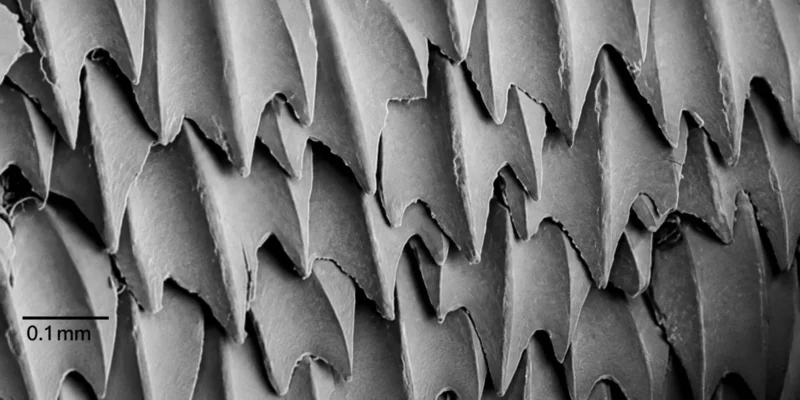
According to the Smithsonian Tropical Research Institute the research team isolated 3,497 denticles from 157 samples. Deposits from the middle Holocene – around 7,000 to 3,000 years old – were compared with sediments from the last century. Differences in sample quantity, dating and sedimentation rate were taken into account in the models.
20 to 1 became about 100 to 1
Before intensive fishing, the reconstructed shark abundance was at the Pacific reefs around a factor of 20 above the Caribbean baseline. Since then, denticule accumulation in the Caribbean has declined by approximately 75 percent, particularly in forms associated with fast-swimming pelagic sharks. On the Pacific side, modern levels were not statistically different from prehistoric levels.
This means that modern Pacific reefs provide around 100 times more denticles than comparable Caribbean reefs. That doesn’t mean that exactly a hundred times as many individual animals were counted there. Denticles are an ecological proxy: rejection rates, sediment transport, preservation and the different lifestyles of the species must be taken into account when interpreting.
Why the more productive Pacific can support more large predators
The Gulf of Panama is fed by seasonal upwelling. Cold, nutrient-rich deep water comes to the surface, promotes plankton and prey fish, and thus provides more energy for large predators. The clearer Caribbean waters are comparatively poorer in nutrients and therefore had a lower natural carrying capacity for sharks even before human use.
What is noteworthy is that more than 98 percent of the fishery Panama take place on the Pacific side. However, the study does not see the stability there as proof that fishing has no consequences. A productive sea may be able to better absorb stress, but at the same time overfishing and changing environmental conditions can push it into a state that did not occur in the millennia examined.
No uniform target for every coral reef
The results warn against blanket reconstruction goals. If a Caribbean reef is measured against the historical shark density of the more nutrient-rich Pacific, the goal would be ecologically unrealistic. Conversely, a naturally lower initial value should not serve to overlook an additional, human-caused decline.
Fossil denticles extend the short period of modern censuses by several millennia. They make it clear that protection does not only have to measure the present: only the ecological history of a place shows what recovery is possible there – and how far a current shark community is from its own starting point.