


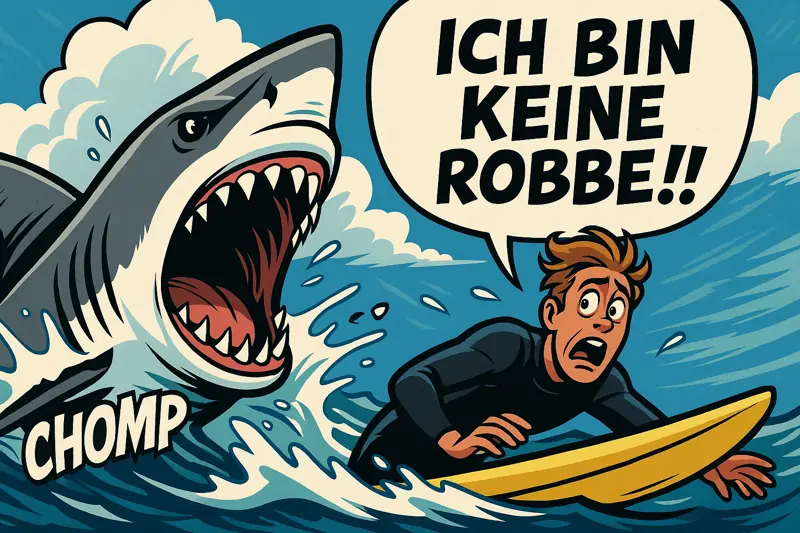
You often hear: Sharks mistake us for seals. This one-sentence explanation is too simplistic. Some studies support the idea that the silhouettes and movement patterns of surfers and seals can appear similar to young great white sharks. Other experts argue that many bites are more likely curious explorations, and sharks use multiple senses, not just rough outlines. Realistically, while mistaken identity can occur depending on the situation, it is far from the only or most important explanation.
Where does the mistaken identity idea come from?
From the underwater backlight perspective, shapes blend more easily. Experiments with silhouettes and videos suggest that, particularly juvenile great white sharks, may struggle to distinguish between surfers and small seals at certain angles. This makes mistaken identity plausible, but not a general rule.
The opposing view: Exploratory bite rather than mistaken identity
Other researchers criticise the mistaken identity narrative as too anthropocentric. Many incidents are better explained as exploration: sharks often test unknown objects with a quick bite and then retreat. This contradicts the idea that humans are regularly mistaken for target prey.
Brief interlude: Warning signs before bites
Many shark species send clear warning or defensive signals before escalating, such as slightly raising the head, lowering the pectoral fins, arching the back, stiff S-shaped curves, or short zigzag approaches. These are context-dependent de-escalation attempts; such warnings are often absent in predatory ambush attacks.
What do observations at sea show?
In coastal zones with seal colonies, juvenile great white sharks often swim near humans without biting. This suggests that, as a rule, we are not target prey, and context—such as visibility, prey presence, and behaviour—makes the difference.
What does this mean for divers and surfers?
Context matters: visibility, nearby prey, currents, and your own behaviour. Staying calm, not rushing, staying in groups, avoiding twilight hours and schools of prey, and not carrying speared fish on your body are practical basic rules that further reduce the risk.
Conclusion
The statement that sharks mistake us for seals falls short. Mistaken identity is possible in certain situations, but many bites are more about exploration than hunting. Most encounters are peaceful, and those who recognise warning signs and choose smart behaviour reduce the already low risk even further.