


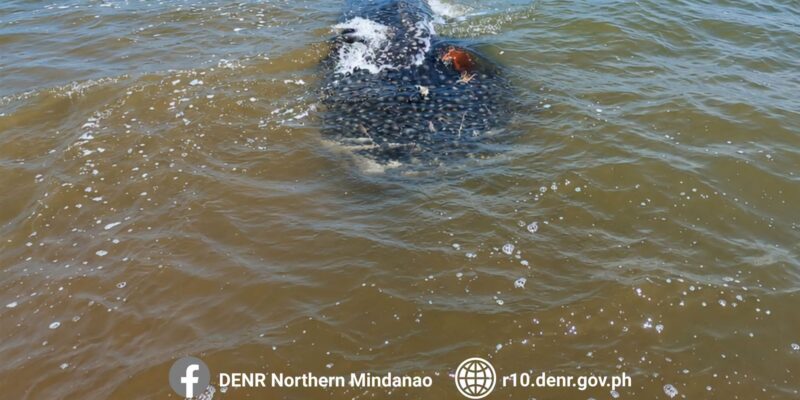
A whale shark measuring roughly 16 feet, or about 4.9 metres, was found dead in shallow coastal water off Barangay Bolisong in Kinoguitan on 29 August 2026. NewsLine Philippines published its report on 31 August. In the Philippines, the whale shark is also known locally as “Taluki”.
According to authorities, residents reported the animal. The Department of Environment and Natural Resources in Northern Mindanao (DENR-10) then deployed personnel to the site along with the Community Environment and Natural Resources Office in Gingoog City, the Philippine Coast Guard and Kinoguitan Municipality.
Deep wound near the head, but no cause of death yet
The initial examination documented a wound near the head that was about seven inches, or just under 18 centimetres, deep. Daily Tribune also reported the finding, citing DENR Region X. However, the exact nature of the injury and whether it caused the animal’s death have not yet been established.
You are currently viewing a placeholder content from Facebook. To access the actual content, click the button below. Please note that doing so will share data with third-party providers.
More InformationNeither the photograph nor the location of the wound establishes a collision with a boat, an injury caused by fishing gear or any other cause. Such an attribution would require a specialist examination. The agencies involved explicitly said that the cause of death remained under investigation.
BFAR recommends prompt burial of the carcass
DENR coordinated the case with the Bureau of Fisheries and Aquatic Resources (BFAR), which is responsible for fisheries and aquatic resources. After the assessment, BFAR recommended that the carcass be buried as quickly as possible. This was intended to avoid further decomposition as well as hygienic and ecological problems in the shallow beach area.
Kinoguitan Municipality and the authorities involved should organize proper recovery and burial. At the same time, DENR called on coastal communities to quickly report stranded, injured or distressed marine animals so that specialist authorities can assess the condition and take appropriate measures.
Why the finding needs cautious interpretation
The whale shark (Rhincodon typus) is the largest living fish and is endangered worldwide. Known risks to the species include bycatch, targeted fishing and collisions with vessels. However, these general threats do not automatically explain the specific discovery off Bolisong.
What remains unclear is whether BFAR or DENR will publish a more detailed investigation. Only an official report could clarify whether the visible wound occurred before or after death and what role it played in the whale shark’s death.