


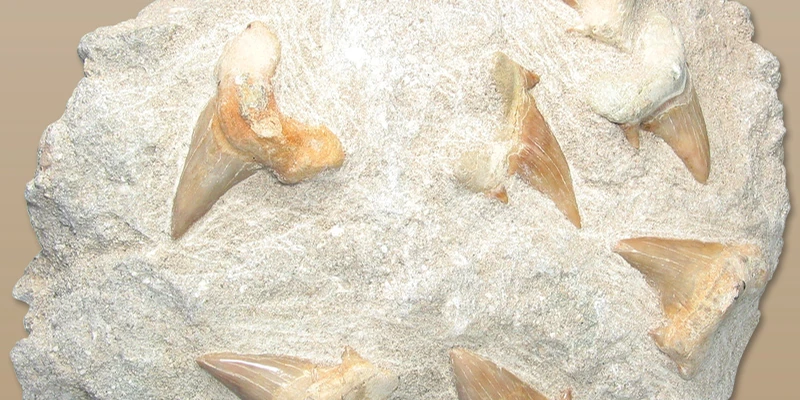
A new study in Cretaceous Research expands the picture of a vanished sea beneath the Egyptian desert. The team examined 14 fossil shark teeth found in the phosphate-rich rock of the plateau. These represent five shark species that had not previously been identified at this site. Together with two species from earlier studies, at least seven shark species are now known to be present in the deposit.
The find dates back to the late Campanian of the Late Cretaceous—more than 70 million years ago. Where an extremely arid desert landscape lies today, a shallow shelf sea once stretched across the northern edge of Africa. The teeth offer a rare glimpse into its community of predators and the conditions that supported a diverse food web.
Not a mass grave where seven species died simultaneously
Media reports vividly describe the site as a “shark graveyard.” Taken literally, however, this term is misleading. The phosphate-rich layer formed during a period of very slow sediment accumulation. Consequently, a thin layer of rock can bring together fossils spanning many centuries or even millennia.
The 14 newly described teeth therefore provide no evidence of a single mass extinction event, nor do they indicate that all seven species existed on the same day, in the same year, or even in the exact same habitat. Experts refer to this as a “time-averaged assemblage.” Furthermore, currents and sediment reworking may have concentrated material from different parts of the shelf into a single layer.
Five new records for Abu-Tartur
The team assigns the new teeth Cretalamna cf. maroccana, Scapanorhynchus cf. raphiodon, Serratolamna cf. serrata, Squalicorax bassanii, and Squalicorax pristodontus. All five are documented for the first time in association with Abu-Tartur. According to the study, Serratolamna cf. serrata and Squalicorax bassanii even represent the first records of their kind in Egypt.

Scapanorhynchus cf. raphiodon is particularly notable. This find could represent the first evidence of this form in Africa, as well as its most recent known fossil occurrence. The “cf.” designation is significant: it indicates that the material resembles a described species, but the classification cannot be definitively confirmed based on the available teeth alone.
Such cautious identification is crucial when dealing with fossil sharks. Their cartilaginous skeletons are rarely preserved; isolated teeth usually serve as the primary material for comparison. While shape, cutting edges, lateral cusplets, and root structure can help narrow down a species, individual characteristics also vary depending on age, position in the jaw, and state of preservation.
Needle-like teeth, cutting teeth, and diverse hunting zones
The teeth differ significantly in shape. Some are long and slender, others broad and serrated; some feature small lateral cusplets. Such forms suggest different methods of capturing prey. Narrow teeth are better suited for gripping smooth prey, whereas broad cutting edges can slice through tissue.
The known distribution of the genera also points to multiple ecological niches. Squalicorax may represent material from areas closer to the coast, while Scapanorhynchus is more closely associated with deeper waters on the outer shelf and continental slope. Cretalamna and Serratolamna correspond to more open-shelf conditions. This is a reconstruction based on fossils and comparative finds, not a direct observation of their behavior.
Upwelling made the Cretaceous sea productive
The Duwi Formation is rich in phosphorite. Such deposits often form where nutrients are intensively cycled and concentrated within the sediment. For Abu-Tartur, the study paints a picture of a productive shelf sea in which upwelling deep water transported phosphorus and other nutrients into the sunlit surface layer.
This upwelling could promote plankton blooms. Small fish and invertebrates benefited from this, which in turn fed larger predators. In this model, a diverse shark fauna is not just a list of species, but an indication that there was enough food and several usable habitats among them.
Similar phosphate-rich fossil deposits are known from other parts of North Africa and the Middle East. Abu-Tartur adds an important Egyptian record to this larger pattern. The region was not an isolated corner in the Upper Cretaceous, but part of an extensive seascape along what was then Tethys space.
What 14 teeth show – and what remains open
The small number of fossils sets clear limits. Fourteen teeth can represent a minimum number of species, but cannot reliably reflect population sizes or relative abundance. An animal could lose several teeth, while rare species may be completely missing in a small sample. The temporal mix of the layer also prevents a snapshot of the ecosystem.
Nevertheless, the find is significant. The evolutionary history of sharks is full of ecological shifts. The teeth of Abu-Tartur now show how several specialized lineages exploited a nutrient-rich Cretaceous sea. At the same time, the site is a reminder that today’s deserts, mountains and plains can be archives of vanished seas.
A starting point for further discoveries
Further systematic excavations could clarify whether the seven species known to date represent only a small section of the diversity at that time. More teeth from precisely documented rock layers would also help to test the tentative “cf.” identifications and place changes within the Duwi Formation in a more precise chronology.
The strongest statement of the study therefore remains deliberately limited: Abu-Tartur preserves at least seven shark species, including five forms that are new to the site. Together they speak for a productive, ecologically structured shelf sea. However, a sudden death of all animals cannot be deduced from the compacted fossil layer.