


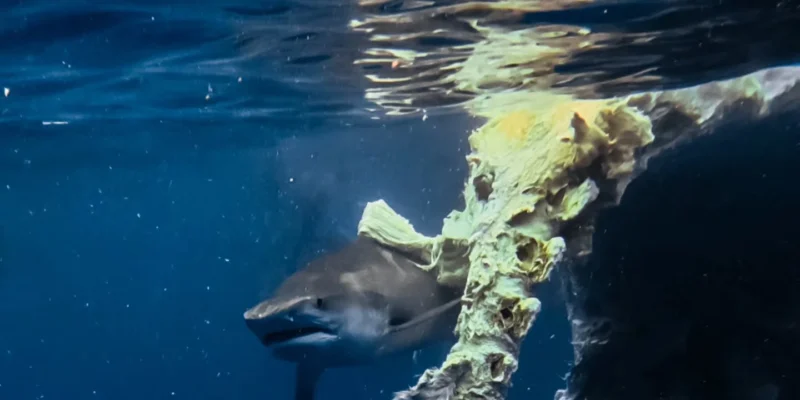
A badly decomposed sperm whale carcass has attracted numerous sharks off the west coast of Hawaii Island. The Hawaii Department of Land and Natural Resources (DLNR) warns people not to approach the carcass or detached pieces from the water, by boat or from shore. Feeding sharks are not the only danger: pathogens may also pose a health risk.
According to officials, the sperm whale was first seen drifting along the Kona coast on Tuesday, October 27, 2026. The following evening, the carcass reached the entrance to Honokōhau Harbor. Responders then towed it back offshore. The agency is not releasing its current location.
People swam among carcass pieces and feeding sharks
Large pieces had already broken away before the tow. According to DLNR, photographs and videos showed many people in the water directly beside the carcass. Some touched or removed pieces even as numerous sharks were feeding. Hawaii News Now also reported on the warning and the continuing coastal monitoring.
A private tour operator estimated that its footage showed about 15 tiger sharks and five oceanic whitetip sharks. Authorities have not confirmed those species or numbers. The only verified official statement is that a large number of sharks fed on the carcass.
Pieces of the carcass could drift back toward shore
DLNR says wind, currents and passing weather systems could carry more pieces of the whale back toward the coast. Anyone who sees oil slicks, blubber or other remains should keep away and report the sighting to the NOAA Marine Wildlife Hotline. Swimming, snorkeling or paddling near such remains is expressly discouraged.
Decomposing whale tissue can carry zoonotic pathogens that spread from animals to people. At the same time, the energy-rich carcass is a valuable food source for large marine predators. The sharks’ presence is therefore a natural ecological process, but it increases the risk of injury for anyone nearby.
Sperm whales remain protected after death
Sperm whales are protected under Hawaii and United States law. DLNR notes that bones, teeth and other body parts may not be removed. The agency is coordinating further monitoring with the National Oceanic and Atmospheric Administration (NOAA) and Hawaiian cultural practitioners from Kiaʻi Kanaloa.
For the cultural practitioners involved, the sperm whale, or palaoa, also carries special spiritual significance. They ask people to let the natural process unfold respectfully and not disturb the remains. Anyone who sees the carcass or pieces of it should call the NOAA Marine Wildlife Hotline at +1 888 256 9840.