


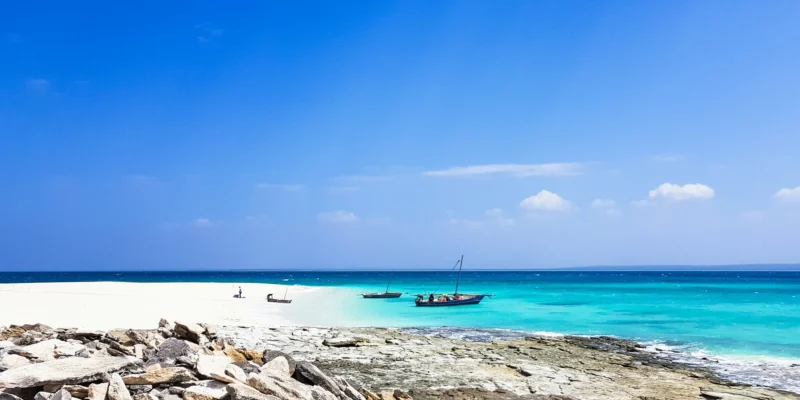
How are the habitats of sharks changing in Mozambique? To answer such questions, observations over many years are needed. The Bazaruto Center for Scientific Studies (BCSS) published two scientific articles on October 1, 2026, about its marine observatory and the associated data. The station on Benguerra Island has been collecting environmental and biodiversity data in the Bazaruto archipelago since 2017.
A measurement network across several habitats
According to the BCSS announcement, the observation area covers around 6,850 square kilometers. At 14 long-term stations, six interconnected habitats are studied, including coral reefs, seagrass meadows, mangroves, and the open ocean. Over eight years, more than 22 million measurements were collected. These include temperature, salinity, oxygen, nutrients, and chlorophyll, as well as records of biodiversity.
The observatory is co-financed and logistically supported through collaboration with the resort Kisawa Sanctuary. The knowledge and participation of the local population also contribute to long-term research. The publication makes this accumulated research foundation accessible for further investigations.
What the shark data record
The paper describing the datasets describes, among other things, scientific dive counts at five stations. A specified species list includes bull sharks, scalloped hammerhead sharks, grey reef sharks, and zebra sharks. Also recorded are the start and end of the survey, depth, visibility, and environmental conditions. Such information helps to compare observations in a reproducible way.
Overall, the repository contains 21 datasets. Measurements and observations are quality-checked and provided with metadata; large specialized archives are partly only available on request. The authors also mention limitations: maintenance, weather, and power outages can cause temporal gaps, and early metadata is partially incomplete.
A basis for further evaluations
The new publication describes the data collection and its methods. It does not yet provide its own evidence that shark populations are increasing or El Niño bringing more sharks into the region. For that, targeted analyses would be necessary, which also take into account differences in observation effort. The value of the long-term data lies in being able to investigate such questions better in the future.
Another long-term study off Mozambique already shows what concrete insights repeated observations allow: Our contribution on zebra sharks off Tofo describes seasonal key reefs. This study is independent of the Bazaruto data platform.