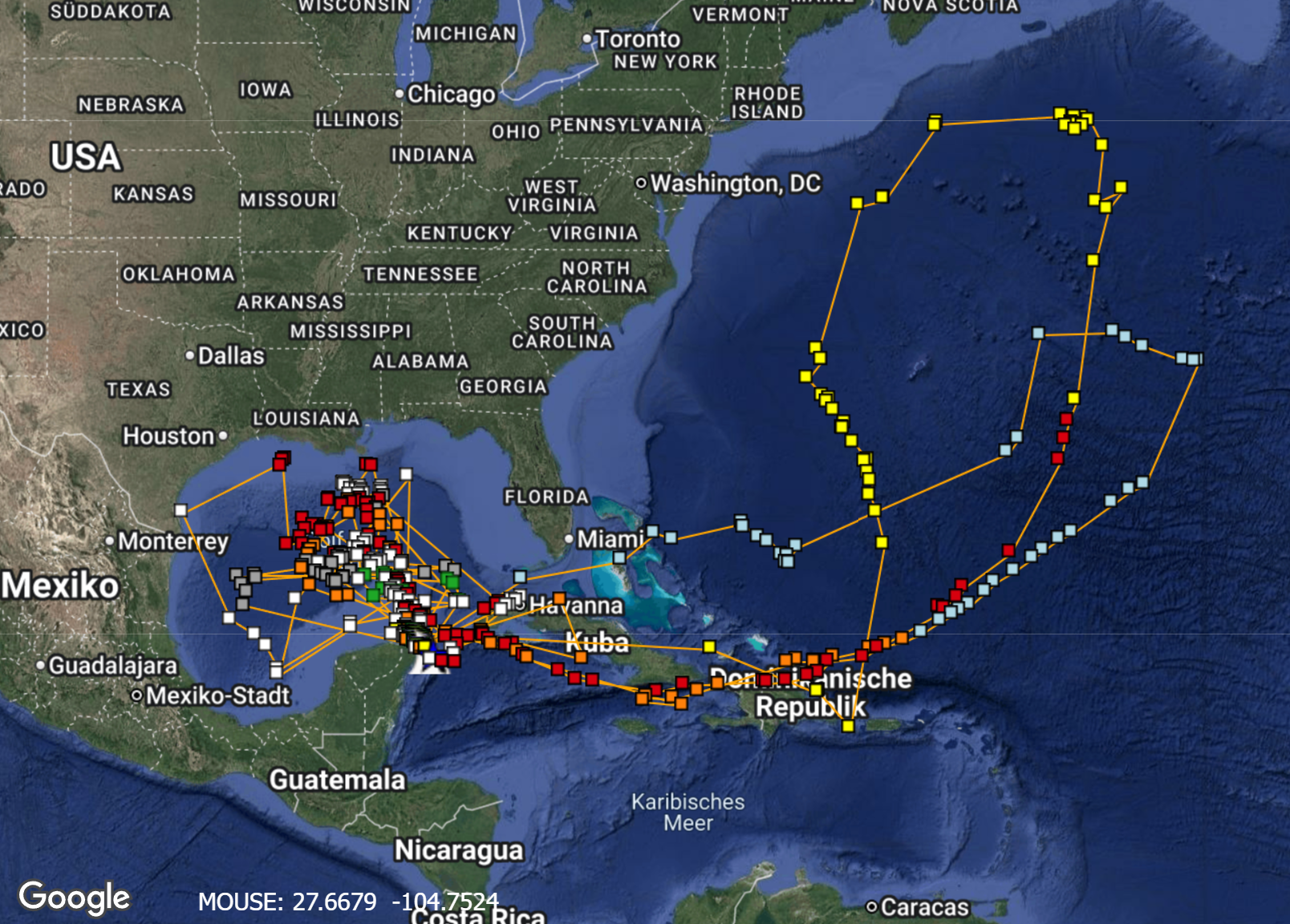
The whale shark Milo is carrying a satellite tag for the fifth time. As InTheBite reports, the male, approximately eight metres long, received a new device off the Yucatán Peninsula in July 2026. Repeated tagging gives the research team an exceptionally long view of the same animal’s movements.
More than 54,000 kilometres documented
Following the first tagging in 2017, further tags were fitted in 2018, 2020, 2023 and 2026. The project report cites over 3,400 days and more than 34,000 miles of documented movements, equivalent to around 54,700 kilometres. Milo travelled through the Gulf of Mexico, the northern Caribbean and far into the Atlantic — as far east as waters beyond Bermuda and north to Massachusetts.
Along the way, he repeatedly returned to the seasonal whale shark aggregation off Yucatán. According to the research team, he combines long journeys with stays lasting months in comparatively small regions. His spot pattern helps researchers recognise an animal they have encountered before.
A long observation series, not a complete life history
The first tag transmitted data for only a few weeks. The figures therefore describe an observation series built up across several devices. The record claimed by those involved should currently be regarded as a project-reported claim.
For researchers, two questions need to be considered separately: how far can an animal travel, and which places does it revisit? A long distance alone does not answer the second question. Repeated identification and tagging data can connect both perspectives.
The Guy Harvey Research Institute makes animal movements available on its public tracking portal. The Guy Harvey Foundation had already described Milo’s repeated tagging in an earlier project report. The new tag extends this story; however, one animal cannot establish a common migration route for all whale sharks.