


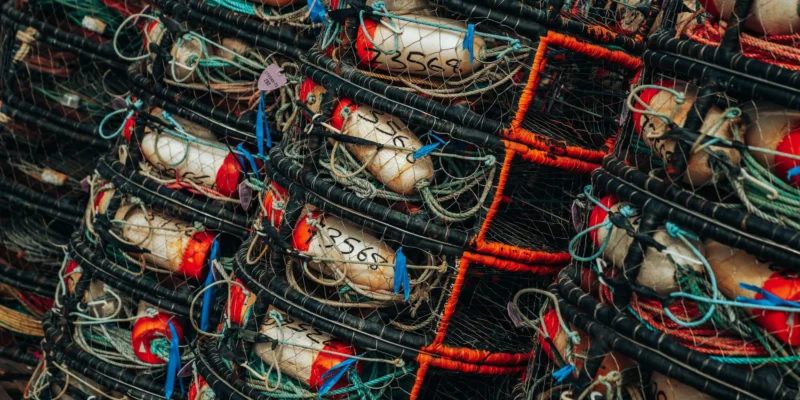
Fish collectors, so-called Fish Aggregating Devices (FADs), don’t just collect fish for fishing. If they are lost or made of nets and lines, they can become long-lasting ghost nets. a new report from the Bonn Convention for the Protection of Migratory Species (CMS) describes this problem for that Mediterranean and specifically mentions sharks and rays among the endangered animal groups.
In the Mediterranean, anchored FADs are predominantly used, among other things for the seasonal dolphin fishery. Floats, ropes, net material and weights attract animals and mark fishing spots. If these structures are not recovered, plastic and fishing material will remain in the sea.
Around 60,000 FADs per year
The report lists reported figures Spain, Italy, Malta, Tunisia and Libya together. This results in 59,507 FADs per year: 1,360 in Spain, 10,440 in Italy, 23,800 in Malta, 17,247 in Tunisia and 6,660 in Libya. Because data from other Mediterranean countries is missing, this is not a complete inventory.
According to the sources evaluated, the majority of the equipment is not collected again at the end of the season. An older study estimated the proportion of lost or abandoned FADs at 76 percent. Over several decades, more than a million structures could have been left behind. This projection is associated with significant data gaps, but shows the possible magnitude.
Why FADs are relevant to sharks
Hanging net material in particular can attract and entangle sharks and rays. The CMS report refers to species that are themselves protected by the Convention. A lost tackle can also continue to catch long after it is no longer of any use to the fishery.
An often cited study from the… shows how great the risk can be Indian Ocean: She estimated that there are 480,000 to 960,000 there annually Silky sharks caught in drifting FADs. This is explicitly not an estimate for the Mediterranean. The CMS report uses it as international evidence that net-like FAD structures can pose a significant risk to sharks.
Those too FAD-Associated Fisheries in the Pacific shows that FADs and the purse-seine fishery operating on them can harm sharks not only through entanglement, but also through bycatch. In the Mediterranean report, however, the focus is primarily on the connection with marine litter.
Non-tangle, non-toxic and retrievable
As countermeasures, report FADs recommends no open mesh material, biodegradable and non-toxic components and more stable, reusable anchors. Markings, better reporting data, return programs and clear responsibilities should also prevent lost devices from remaining permanently abandoned.
Implementation is key: Non-tangle designs can significantly reduce the accidental capture of sharks and other marine animals, but will only solve the waste problem if equipment is captured, maintained and recovered. The Author’s summary Therefore, in addition to technical changes, it also emphasizes binding rules and better controls.