


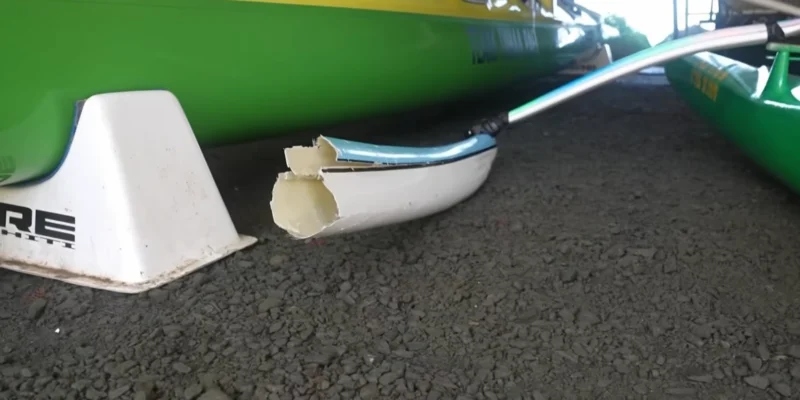
In front of the Côte Blanche in Nouméa, the 38-year-old Va’a paddler Lywaï Manate was seriously injured by a shark on the evening of April 15, 2026. The animal caused his outrigger canoe to capsize and bit him several times. Teammates pulled him out of the water and brought him back to land.
According to information from Les Nouvelles Calédoniennes The emergency call came in around 7 p.m.; other reports say around 6:40 p.m. Manate was training near the coast with his club Tuhaa Pae va’a. Firefighters and SMUR treated him before he was taken to Médipôle. His condition was serious, but according to the first reports his life was not in danger.
The shark rammed the Va’a several times
Manate described in a video published by Nouvelle-Calédonie la 1ère that the shark had rammed Va’a three times. The boom was damaged and it fell into the water. The description comes from the injured person himself; a complete official reconstruction has not been published in the available sources.
According to his own account, Manate was bitten on the back of his body in the water. When the animal approached again, he grabbed its jaws and pressed a finger into one eye. Previous reports cited multiple bite injuries to the lower back and one hand.
His teammates provided immediate help. Radio Rythme Bleu reported that they took him back to Côte Blanche. His condition stabilized in the hospital. More precise medical information about the further course of events has not been publicly confirmed.
The shark species is not confirmed
In the first few hours, a bull shark was mentioned as a possible species. However, Les Nouvelles Calédoniennes specifically stated the following morning that the species was unknown. DNA samples are said to have been taken from damaged parts of the Va’a; No publicly documented result of this investigation could be found.
The article is therefore not related to a specific shark species. The distance information also remains approximate: the early reports place the attack around 100 to 200 meters from the slipway. The map marks the Mise à l’eau de la Côte Blanche and not the exact point in the water.
Nouméa closed sections of the coast and started a fishing campaign
After the attack, the city banned swimming and water sports in a 300-meter-wide coastal strip. The closure also included islands Île aux Canards and Îlot Maître; Designated, secured bathing areas were excluded. The authorities justified the measure with the immediate security risk following the serious incident.
From 17 to 20 April, the province and city had six large sharks caught and killed: five tiger sharks and one bull shark. The attack and this second campaign within a few weeks later became central background to the formal hearings on human–shark coexistence in New Caledonia.
An unprovoked, non-lethal attack
For the attack data, the incident is listed as unprovoked and non-fatal. Manate trained with a Va’a and did not fish or feed. The fact that he fought off the shark in the water was a reaction to the attack that was already in progress and does not provoke the previous contact.
The attack took place in the same year Bite on a scuba diver off Bourail and the fatal attack on a wing foiler Nouméa ago preceded. The case occurred in a heavily used urban coastal area on Pacific Ocean. It documents a serious individual incident, but does not, in and of itself, demonstrate an increase in the population of large sharks or the effectiveness of the subsequent killing campaign. These questions require separate data and transparent assessment.