


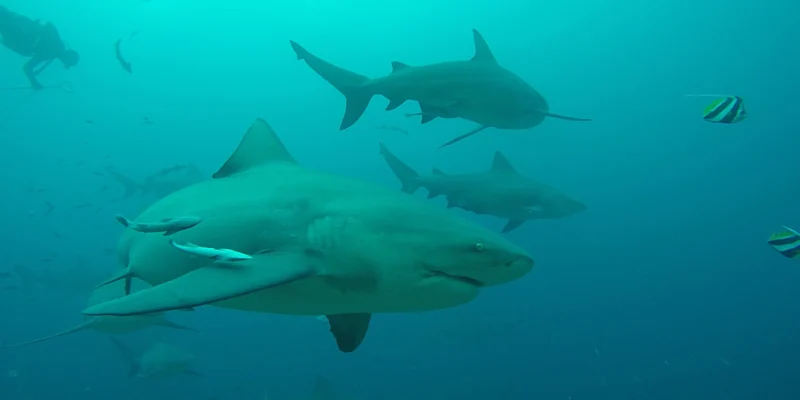
On Wednesday, 19 August 2026, an unusually direct encounter occurred off Roches Noires on the west coast of Réunion between a spearfisher and a large shark. According to a Centre Sécurité Requin account reported by Zinfos974, the animal approached the diver rapidly and head-on twice. The man was unharmed; no bite or physical contact with the shark was reported.
The shark, identified in the report as a roughly 2.5-metre bull shark (Carcharhinus leucas), was observed beyond the reef at a depth of about ten metres. Zinfos974 describes two charging movements. That wording reflects the participants’ account, but an incident without a bite or injury is not automatically a recorded shark attack.
What Centre Sécurité Requin reports
According to the report, the shark first swam directly towards the spearfisher with its mouth open. The diver held his speargun between himself and the animal and pushed it away. The source does not say that he fired; the equipment served as a barrier in that moment.
The published account says the diver then moved towards the shark in an attempt to intimidate it. The animal approached head-on a second time, and the man again warded it off with the speargun. This response is part of one individual account and should not be treated as general advice for other encounters.
The spearfisher ended his dive and swam back towards shore. According to the report, the shark followed him as far as a coral barrier before the encounter ended. No surfers were in the water at the time; Roches Noires beach was closed for construction work.
Why the spearfishing context matters
During spearfishing, injured fish, blood, vibrations or catch attached to a line can attract sharks. In this case, however, Centre Sécurité Requin says the diver had not yet caught a fish. A fresh catch therefore does not appear to have been an immediate stimulus.
That does not reveal the animal’s motivation. Currents, visibility, earlier stimuli in the area and the movements of both participants cannot be fully reconstructed from the published report. The estimated length and species identification also remain field observations unless independently assessable footage or measurements become available.
No confirmed bite and no attack record
Two rapid approaches with the mouth open should be treated as serious and potentially dangerous behaviour. A careful classification must nevertheless distinguish an aggressive approach from a documented bite. No injury, equipment damage or physical contact was reported in this case.
The article is therefore classified as a shark sighting or encounter, not as a shark attack with incident details. Nor does a single event establish the typical behaviour of all bull sharks. The species commonly uses coastal and turbid waters, but an individual animal’s behaviour depends on the circumstances.
Official safety advice applies regardless of this incident
The Prefecture of La Réunion states in a safety notice published on 6 August 2025 that shark risk around the island is real and persistent. The notice does not confirm the incident of 19 August 2026; it provides general guidance for swimming, surfing, diving and other activities at sea.
Its advice includes avoiding dawn, dusk and turbid water, not entering the sea alone and leaving areas where sharks have recently been sighted. It recommends monitored or secured locations such as lagoons and pools and, subject to their current operating status, the net-protected zones at Boucan Canot and Roches Noires. Individual electric shark deterrents are also mentioned for exposed activities.
Whether a beach, net-protected zone or access point is open can change at short notice. Flags, closures and instructions from those responsible on site therefore take precedence, alongside current notices from DORSAL and the Réduction du Risque Requin programme. The improvised use of a speargun as a barrier should not be copied as a generally safe method.
Context for Réunion
Only ten days earlier, a smaller animal had been reported in a used coastal area during a bull-shark sighting near Étang-Salé; the surf spot was evacuated as a precaution. Both events occurred on the island’s west coast, in the wider biological setting of the Indian Ocean, but they differ markedly in their sequence and documented behaviour.
Two reports close together in time establish neither an increase in shark abundance nor a general change in risk. Such conclusions would require standardised observations over a longer period, including confirmed species, locations, environmental conditions and observation effort. This case remains a serious encounter without injury: two reported head-on approaches, no bite and no injury.