



A new study in Nature Communications tests a central assumption in international shark conservation: does banning finning also change trade in shark products? Across 188 countries from 2007 to 2020, the researchers found no statistically robust effect on total export, import or consumption volumes.
This does not mean finning rules are ineffective. Their main purpose is to stop fisheries from removing only the valuable fins and discarding the sharks’ bodies at sea. The analysis asks a different question: whether those rules measurably change how many shark products countries export, import or use domestically. That distinction is essential when interpreting the results.
188 countries and 14 years of trade data
Echelle S. Burns and colleagues used the Aquatic Resource Trade in Species database, known as ARTIS. It combines catch and trade data and converts products into live-weight equivalents. This makes it possible to estimate how much catch weight lies behind fillets, meat and other traded shark products.
The dataset contains 123 shark taxonomic identifiers and 17 product groups. Between 2007 and 2020, an average of about 279,000 metric tonnes of shark products was traded each year. The minimum was roughly 224,000 tonnes in 2008 and the maximum about 305,000 tonnes in 2015. Estimated domestic use averaged almost 496,000 tonnes a year, nearly twice the cross-border trade volume.
During the study period, 94 countries exported shark products and 185 imported them. Exports were highly concentrated: seven countries supplied 75 percent of the exported volume, while 15 countries accounted for three quarters of imports. Spain, Portugal and the United States were important on both sides of the market.
No statistically significant overall effect
The team used a difference-in-differences approach, comparing trends in countries before and after they introduced a finning rule with trends in countries without one. The method is designed to separate global and regional market shifts from the effect of the regulation itself.
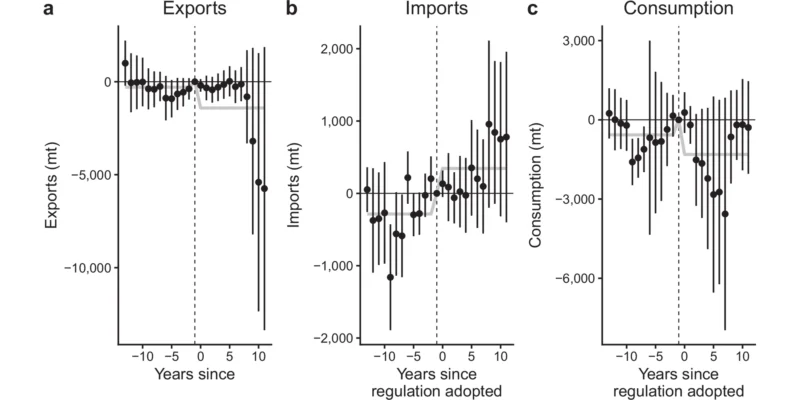
On average, countries with finning rules exported an estimated 351 tonnes less shark product per year than they would have without the rule. Estimated imports were 142 tonnes higher and domestic use 1,672 tonnes lower. In all three cases, however, uncertainty was too large for the differences to be statistically significant. The data therefore do not provide robust causal evidence of a change in total volumes.
Long-term shift rather than a rapid response
The timeline nevertheless shows a pattern. Exports remained broadly stable during the first seven years after a rule was adopted, then tended to decline more strongly in regulated countries than in the comparison group. Imports show a slight increase eight to eleven years after adoption, while an initial fall in domestic use did not persist over the long term.
The number of trading partners did not change immediately either. Only after nine years or more did regulated countries tend to export to a smaller share of markets and import from a larger share of suppliers. These network effects were also not statistically significant: they are indications of possible long-term adjustments, not proven effects.
Spain remains a trade hub
The network analysis identifies the countries shaping the market. Italy and Spain were among the largest importers throughout the study period, while Brazil, China and Portugal also frequently received large volumes. Spain, New Zealand and Portugal regularly led exports. On average, Spain supplied almost half of all countries importing shark products.
The study adds context to current trade statistics. The EU exported fewer shark fins in 2025 than in the record year 2024, but a single customs dataset proves neither lower catches nor a lasting market reversal. The global analysis likewise shows how difficult it is to attribute an observed change to one specific rule.
Why the data have limits
ARTIS improves the resolution of global trade data but cannot reconstruct every supply chain. Crucially, the study could not isolate trade in shark fins. Fins are treated as a co-product in the mass-balance model and are not converted again into live weight, preventing the same shark from being counted twice.
Inaccurate catch reporting creates further uncertainty. When products are recorded only as elasmobranchs, it is impossible to separate the share derived from sharks from the share derived from rays. Such broad categories meant that some important markets were included only partly or not at all in individual analyses. Domestic use is also an estimate derived from catches, imports and exports rather than a directly measured consumption figure.
Finning rules address only part of the problem
The findings are consistent with an earlier global study showing rising shark mortality despite widespread finning bans. Requiring sharks to be landed with fins naturally attached can improve inspections and reduce waste at sea, but it does not automatically limit how many sharks are caught or whether new markets develop for their meat.
Effective shark conservation must therefore connect several levels: evidence-based catch limits, protection for particularly threatened species, spatial protection, enforceable landing rules and transparent supply chains. The new study shows above all that one rule targeting an especially wasteful practice does not automatically change the entire market. Better catch, species and trade data are needed to test whether it reduces mortality when combined with other measures.