


South Pacific angelshark - Squatina armata
Body structure and features
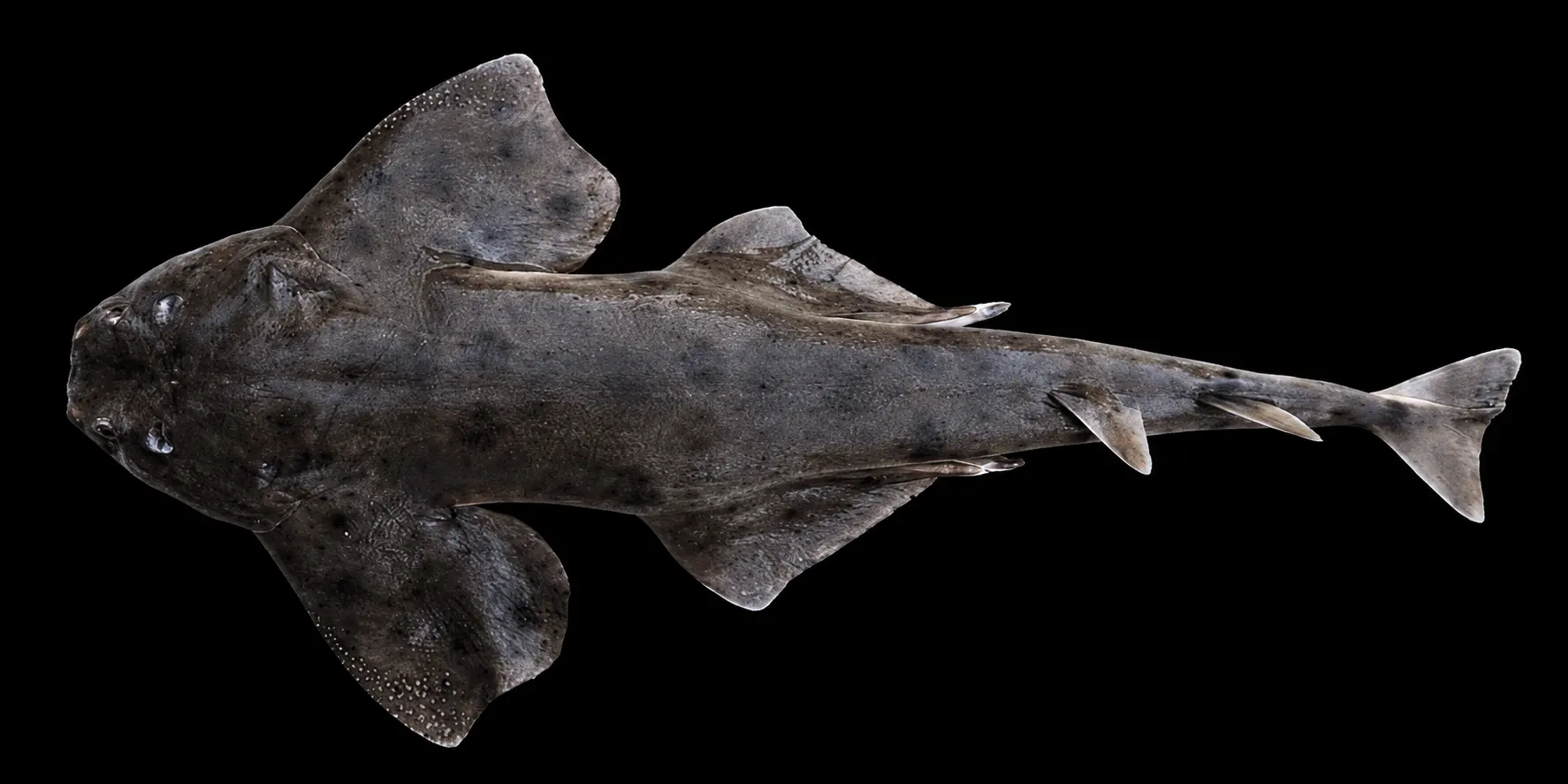
The South Pacific angelshark has the strongly flattened front body typical of angel sharks. The head and large pectoral and pelvic fins form an approximately diamond-shaped silhouette from above, while the rear body remains distinctly shark-like. The eyes are on the upper side; Immediately behind them are large spray holes through which the animal can bring water to its gills even when resting on the bottom.
It gets its name from strong thorns on the snout and head as well as enlarged, hook-shaped thorns along the back and on the front edge of the pectoral fins. One modern new description of the species also highlights the narrow head shape, the nasal barbels and the arrangement of the cutaneous teeth as important identifying characteristics.
The upper surface is ocher to gray-brown and has darker spots or dots. This irregular pattern visually breaks up the body contours on sandy or muddy surfaces. Two small dorsal fins sit far back; an anal fin is missing. As a medium-sized angel shark, the species reaches a total length of around 150 centimeters according to the current threat assessment.
Distribution and habitat
The South Pacific angelshark lives in the southeast Pacific Ocean. Its known distribution range extends along the American West Coast Colombia above Ecuador and Peru to the south of Chile. In the northern part of the area, older evidence should be viewed with caution due to possible confusion with the Pacific angel shark.

The species lives demersally on the continental shelf and stays mainly on or just above the sea floor. The Chilean Biodiversity Platform mentions occurrences of areas near the coast up to 400 meters deep and a center of gravity between around 30 and 70 meters. Sandy and muddy soils provide both camouflage and suitable conditions for ambush hunting.
Extensive migrations or clearly defined breeding areas have not yet been adequately documented. This is another reason why it is difficult to determine local population limits. However, coastal habitats overlap extensively with bottom trawling, gillnet and artisanal fisheries.
Life history and reproduction
The South Pacific angelshark is a ground-level ambush hunter. It can partially burrow into soft ground and dart at passing prey from a short distance. One Study of food in Peru detects fish, molluscs and crustaceans. Which prey dominates changes with body size and local food availability.
Reproduction is aplacental viviparous: The embryos develop in the mother and are nourished by their yolk reserves without forming a placental connection. First detailed examinations of the reproductive organs described several stages of maturity of females from Peru. According to current information, a litter contains around six to ten young animals.
Age at sexual maturity, gestation period, reproductive rhythm and natural maximum age are still poorly known for this species. The IUCN derives a long generation time of around 23 years from related angel sharks. Slow population renewal makes severe losses of adult animals particularly difficult to compensate for.
Threats and conservation
The IUCN lists the South Pacific angelshark as critically endangered. The basis is an estimated population decline of more than 80 percent over three generations. Historical population data are incomplete, but sharp declines in sightings and landing numbers suggest a large-scale collapse.
The main threat is fishing. The flat, bottom-dwelling body is easily caught by bottom trawls and gillnets. Catches also occur on bottom and surface longlines. Some is landed as bycatch; There are also targeted artisanal catches in Peru. The use is therefore concentrated precisely on shelf areas in which the species lives and presumably reproduces.
Effective protection requires species-specific catch data, safe identification on board and in ports, and a reduction in mortality in bottom and gillnet fisheries. Protected areas can only help if they cover important habitat and breeding areas and actually limit bottom-touching fishing gear there.
Encounters with humans
Recreational diving encounters are rare. The South Pacific angelshark is not a regularly offered target on commercial shark dives and can be easily overlooked even in suitable habitats due to its camouflage. An animal lying quietly on the ground should be observed from a distance and should neither be touched nor urged to swim.
Angel sharks do not hunt humans. However, if they are harassed, touched or secured in a net, they can very quickly lift their head and bite. For divers this means: do not hover above the head area, keep escape routes clear and avoid photo or video positions that circle the animal.
The closest contact with people occurs in fishing. One Investigation of the landings in San José de Lambayeque documented sizes, sexes, and reproductive states of captive animals. Such data is valuable for conservation, but at the same time shows that the species continues to end up in small coastal fisheries.
Profile
- First described:
- Max. size:
- Depth:
- Max. age:
- Max. weight:
- Water type:
- IUCN Status:
Taxonomy
- Kingdom:
- Phylum:
- Subphylum:
- Infraphylum:
- Parvphylum:
- Class:
- Subclass:
- Superorder:
- Order:
- Family:
- Genus:

Newsletter
Shark Alert in Your Inbox