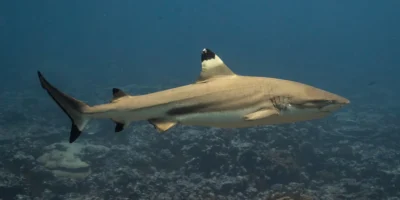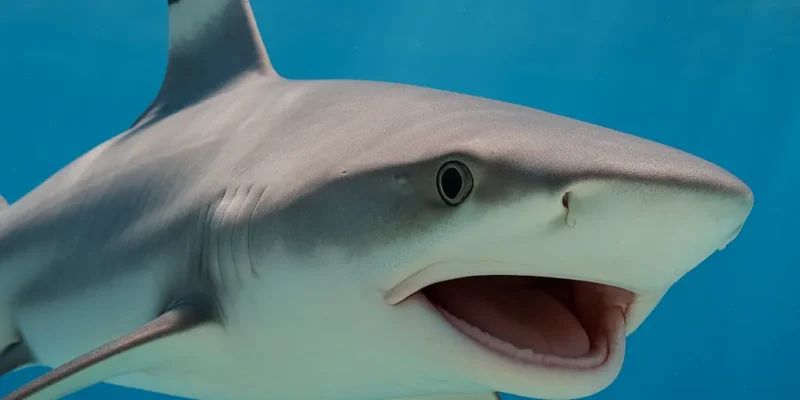
Sharks without sharp teeth may sound reassuring to beachgoers – but for the oceans, it would be disastrous. A new study shows that increasing ocean acidification is attacking the teeth of apex predators, potentially weakening their hunting efficiency. This could have consequences for shark populations and the stability of entire marine ecosystems.
What’s behind the acidification
Ocean acidification occurs when seas rapidly absorb more carbon dioxide, causing the pH to drop. Model calculations suggest that the global average pH could fall from the current 8.1 to 7.3 by the year 2300 – with profound effects on marine organisms.
The experiment: 60 shark teeth in acid test
For the experiment, researchers stored 60 freshly lost teeth from blacktip reef sharks in artificial seawater: once at today’s pH of 8.1, and once at the projected pH of 7.3. The teeth came from a German aquarium (six male, four female animals). After eight weeks, the teeth in the more acidic tank showed about twice as much damage. Particularly noticeable were increased root corrosion and altered serrations, reports study leader Maximilian Baum from the Institute of Zoology and Organismic Interactions at Heinrich Heine University.
“We see increased root corrosion and altered serrations – a clear indication of material-damaging effects.” – Maximilian Baum
More stress for already endangered predators
Damaged teeth add to existing pressures, such as prey scarcity due to overfishing. More sensitive species, with fewer tooth rows or slower replacement, could be affected sooner. Previous studies have already shown damage to skin denticles from acidification.
Can sharks adapt?
Baum believes adaptations are possible: more frequent tooth replacement or improved repair processes. Other experts share this cautiously optimistic view. Palaeobiologist Lisa Whitenack (Allegheny College) emphasises that faster tooth replacement could partially offset losses, and even corroded teeth may still function.
“The key question is whether the observed damage actually impairs cutting or piercing ability.” – Lisa Whitenack
What matters now
To slow acidification, reducing human-made CO₂ emissions is crucial. The study makes clear: even moderate pH decreases can alter the biology of large predators, with far-reaching consequences for food chains and the functioning of the oceans.