


Velvet belly lanternshark - Etmopterus spinax
Body structure, features & anatomy
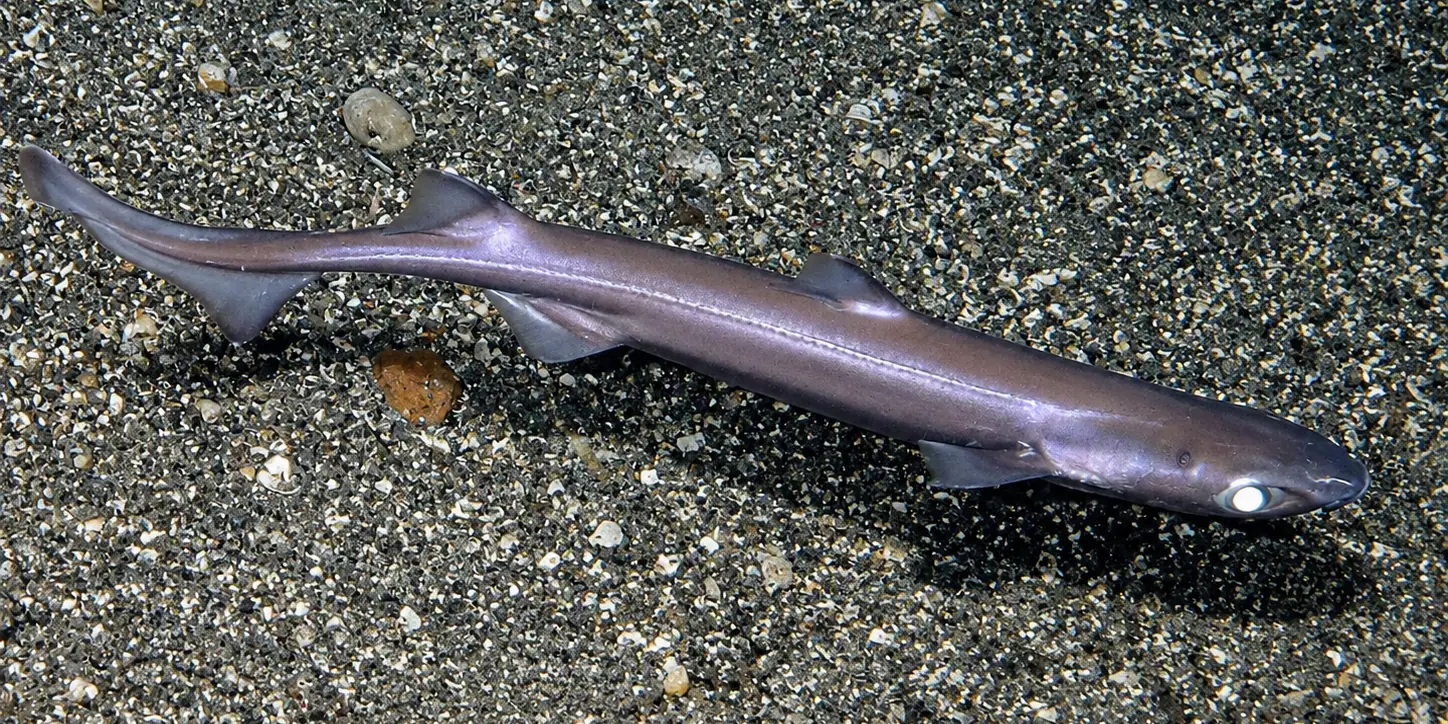
The velvet belly lanternshark Etmopterus spinax is a small, moderately powerfully built lantern shark with a relatively long tail. Most animals remain under 45 centimeters in total length; The maximum value is around 60 centimeters. On average, females are larger than males. The back and flanks are brown to dark brown, the belly is sharply black – hence the English name Velvet belly.
The determination key Sharks of the World mentions two dorsal fins with clearly developed spines and the complete absence of an anal fin as central characteristics. The second dorsal fin is larger than the first. Five very short gill slits are located in front of the base of the pectoral fins; Large eyes and the splash holes behind them adapt to life in the low-light open water above the continental slope.
Teeth, skin and dark markings
The teeth are functionally divided. In the upper jaw there are narrow teeth with a high central tip and small secondary tips; they grab and hold prey. The lower teeth are wider, blade-shaped and form a cutting edge. This allows the shark to safely grab and cut up small fish and invertebrates. The slender, needle-like skin teeth are arranged irregularly instead of in clear longitudinal rows and give the skin its velvety effect.
- Short, rounded pectoral fins and an asymmetrical caudal fin with a small lower lobe.
- A strong spine in front of each dorsal fin; the rear is more noticeable and longer.
- Dark light fields on the belly, on the flanks, around the pelvic fins and on the caudal peduncle.
- Brown upper side and deep black underside with species-specific pattern.
- No nictitating membrane and no anal fin, as is typical for many dogfish sharks.
Bioluminescence from thousands of photophores
There are thousands of tiny light organs, so-called photophores, in the skin. They produce a weak blue-green light without the help of glowing bacteria. The photophores are particularly dense on the ventral side. There the light can adjust the silhouette against the remaining light from above: viewed from below, the dark body outline partially disappears, a camouflage through counter lighting. Hormonal signals control the switching on, duration and dimming of the glow.
One Study on the luminous effect of dorsal spines showed a second function. Photophores next to the dorsal spines make their outline visible in the dark; some of the light even shines through the mineralized, partially translucent spines. Models showed that potential predators can detect this signal from several meters away. The researchers interpret it as a warning sign: a predator not only sees a small, glowing shark, but also the spines that can cause injury.
Lateral light patterns could also help with recognizing members of the same species. These functions are not mutually exclusive: abdominal light camouflages, photophores near the spines warn and species-specific flank fields can transmit signals. Connects with that Etmopterus spinax its most striking anatomical features – dark skin, spines and photophores – into a system adapted to the twilight zone.
Distribution & habitat
The velvet belly lanternshark Etmopterus spinax lives in the east Atlantic and in Mediterranean. Its known range extends from Iceland and Norway southwards along Europe and West Africa to Gabon; There is also evidence in the Azores, Madeira, the Canary Islands and Cape Verde. Further south, the species is also found off South Africa. It is common in many places in the western Mediterranean, but is absent in very shallow and highly enclosed areas of the sea.

The FAO species catalog for the North Atlantic describes the shark as an inhabitant of the outer continental shelf and the upper continental slope. The documented depth range starts at approximately 70 meters and extends to around 2,000 meters; individual data sets mention even greater depths. The center of gravity is usually between 200 and 500 meters. This means that the species is neither a typical coastal shark nor an exclusive resident of the abyssal deep sea.
Between the seabed and mesopelagic open water
Etmopterus spinax is classified as bathydemersal to benthopelagic. It often stays on or near soft mud and clay bottoms, but also swims well above it to search for food. Continental slopes, shelf edges, submarine ridges and island slopes connect bottom-level retreat areas with the open water in which small fish, squid and crustaceans migrate.
The Icelandic habitat study from 2024 evaluated 10,597 scientific trawl hauls from eleven years. In Icelandic waters, the species only appeared in deeper offshore areas south and west of the island and was particularly common around 400 to 500 meters. Late maturing females and small juveniles were concentrated on an area of the southern continental shelf. Such regional patterns show that a large overall area consists of sub-habitats of different importance.
Depth changes with age and reproduction
Size, sex and stage of maturity are not evenly distributed across all depths. Studies off Portugal found larger, older and mature animals predominantly deeper, while smaller and younger sharks were more often found in shallower sections of the continental slope. Late pregnant females can move to shallower nursery areas. This depth separation varies regionally, but has direct consequences for fishing and conservation: fishing gear at a certain depth can primarily affect a single phase of life.
Temperature, salinity, ground slope and food availability influence local abundance. Therefore, the map should not be read as a comprehensive settlement. It shows the large-scale familiar frame; Within this framework lie densely used slopes, possible breeding areas and wide zones with only sporadic evidence. Long-term research trips are necessary to distinguish shifts from real changes in the population.
Lifestyle, diet & reproduction
The velvet belly lanternshark Etmopterus spinax is a small predator of the continental slope and the mesopelagic twilight zone. Its large, oil-rich liver supports buoyancy, allowing it to float above the ground to save energy without a swim bladder. Vision, smell, lateral line, and electroreception help it find prey in dim light; its own luminosity is primarily used for camouflage and signaling, not as a bright searchlight.
Food changes with body size
One Nutritional study from the Gulf of Cadiz confirms a wide range of prey including small bony fish, squid and crustaceans. These include pelagic shrimp, krill and other animals that undertake daily vertical migrations in the water column. Juveniles more often use small crustaceans; As size increases, the proportion of fish and cephalopods increases. Region, season, time of day and available prey shift the exact composition.
The shark does not only hunt directly on the ground. Its dark coloration and backlighting make it difficult for prey and potential predators to see the body against the dim skylight. Larger fish, other deep-sea sharks and marine mammals are possible predators; the brightly highlighted dorsal spines could make an attack on the small but hard-to-swallow shark unattractive.
Slow life cycle despite small body size
The Life cycle study from the Northeast Atlantic arranges Etmopterus spinax as aplacental viviparous. The embryos develop in the mother and are primarily nourished from her yolk sac; a placenta like in mammals does not form. Depending on the examination and the size of the female, one to twenty young animals are mentioned; the number is often in the single-digit to low double-digit range. At birth they measure approximately 12 to 14 centimeters.
Males usually reach sexual maturity at around four years of age, females a little later and with greater body length. The information varies between regions and methods. The gestation period is estimated to be approximately one year; This can be followed by a longer period of rest and maturation. A female therefore does not produce a new litter every year. For a small shark, this reproductive pace is slow and limits recovery from large losses.
Several fathers in one litter
One genetic testing of paternity pointed out Etmopterus spinax Genetic polyandry: Young animals from the same litter can come from several males. This assumes that a female mates with different partners and can store sperm at least temporarily. Such findings are important because direct observations of mating at depths of several hundred meters are virtually absent.
Spatial separation according to size and stage of maturity is also part of the way of life. Animals ready to mate, pregnant females and young animals can use different depth zones. Food, protection and suitable temperatures are weighted differently over the life cycle. This strategy works in a stable deep-sea habitat, but makes the population vulnerable if individual zones are regularly fished.
Threats & conservation status
The IUCN Red List evaluates the velvet belly lanternshark Etmopterus spinax worldwide as at risk (vulnerable). The assessment is based on declines, fishing data and a wide but regionally inconsistent distribution. A frequent occurrence in individual study areas does not contradict this: deep-sea populations can appear to be locally stable, while other subpopulations have collapsed sharply.
Bycatch on the continental slope
The main direct threat is accidental capture. Bottom trawls for Norway lobsters and other deep-sea species, longlines and hand fishing tackles operate at the exact depths used by this shark. Because of their low commercial value, many animals are thrown overboard. However, release does not automatically mean survival: pressure changes, net injuries, long towing times and time on deck can cause high discard mortality.
The Current species report from NatureScot summarizes an estimated decline of 81 percent between 1970 and 2001 for Scotland and the North East Atlantic. Thereafter, ranks in Scottish waters tended to be stable or fluctuating; other surveys also report fluctuations or increases depending on the region. These numbers should not be conflated into a single global trend, but they do show how much historical deep-sea fishing can alter a regional population.
Deep separation creates special risks
When juveniles, adult males, and gravid females prefer different depths, fishing gear does not always hit a random cross-section of the population. It can specifically target large females or nursery areas without intention. The slow, multi-year reproductive cycle reinforces the effect: failed litters and the loss of mature females can only be replaced slowly.
In addition, there are pressures whose impact on the population is still uncertain. In animals from the northwestern Mediterranean, persistent organic pollutants have been detected in muscle tissue and embryos. This proves transmission from mother to offspring; Whether the measured amounts measurably affect growth, reproduction or survival requires further investigation.
Protection requires fewer encounters with fishing gear
- Species-specific recording of catch and discard instead of collection categories for small deep-sea sharks.
- Spatial and depth-related protection measures for reproductive and nursery areas.
- Avoid sensitive depths during times of high concentration of females or young animals.
- Improved catching technique and short handling for animals that reach the deck alive.
- Continuation of standardized research series so that regional trends become visible at an early stage.
In the Northeast Atlantic there are fishing bans or zero quotas for certain deep-sea sharks, and regional regulations also prohibit targeted fishing, landing or transhipment. Such rules only help together with bycatch prevention and control. The core of protection is not better marketing of the catch, but rather that the velvet belly lanternshark ends up in fishing gear less often.
Velvet belly lanternshark & humans
For people in the water, the velvet belly lanternshark Etmopterus spinax does not pose a known danger. It is small, usually lives well below the recreational diving depth and avoids the coastal area. Encounters therefore almost never occur during a normal dive, but rather on board fishing vessels, on research trips or in recordings from deep-sea cameras and remote-controlled vehicles.
FishBase lists the species as harmless to humans and only marginally used commercially. This classification is not an invitation to touch. Both dorsal fins have strong spines, and a live animal can twist violently when freeing itself from a net or hook. Hand protection, suitable tools, the shortest possible air time and distance from the spines and mouth protect animals and people.
Bycatch instead of diving species
Historically and regionally, velvet belly lanternsharks were processed into fishmeal or sold dried and salted. However, there is usually no worthwhile target market, so the species is treated as unwanted bycatch. This makes them less visible economically, but not unimportant biologically: large numbers of discards can put a strain on a slowly reproducing population even if there are hardly any official landings.
For shark divers, realistic expectations are therefore crucial. A targeted encounter in a natural environment cannot be seriously planned with normal diving equipment. Curling, picking up or moving for a photo would be neither necessary nor gentle. Images from scientific surveys, ROV observations and precisely documented coincidence finds are more meaningful.
A model organism for the glow of sharks
In research owns Etmopterus spinax a meaning that far exceeds its size. The structure and hormonal control of photophores, camouflage through counter-lighting, glowing warning signals on the dorsal spines and possible communication between conspecifics were investigated. The shark has thus made a significant contribution to understanding bioluminescence not just as a curiosity, but as a versatile adaptation to the deep sea.
- Document sightings with date, location, depth and observation method.
- Do not grab a trapped animal by its dorsal spines and release it quickly and gently.
- Use caution when taking deep-sea photos without size scale, as lanternshark species can look similar.
- There is no promise of a predictable type of diving if the typical habitat is far below safe recreational diving depths.
The velvet belly lanternshark shows that responsible shark diving can also mean recognizing the distance from a species. Its dark underbelly, weak natural light and brightly marked spines are adaptations to a habitat that humans can usually only access using technology. Good mediation makes exactly this boundary visible instead of creating an unrealistic closeness.
Profile
- First described:
- Max. size:
- Depth:
- Max. age:
- Max. weight:
- Water type:
- IUCN Status:
Taxonomy
- Kingdom:
- Phylum:
- Subphylum:
- Infraphylum:
- Parvphylum:
- Class:
- Subclass:
- Superorder:
- Order:
- Family:
- Genus:
Newsletter
Shark Alert in Your Inbox