


Shortfin mako - Isurus oxyrinchus
Body structure, characteristics & anatomy
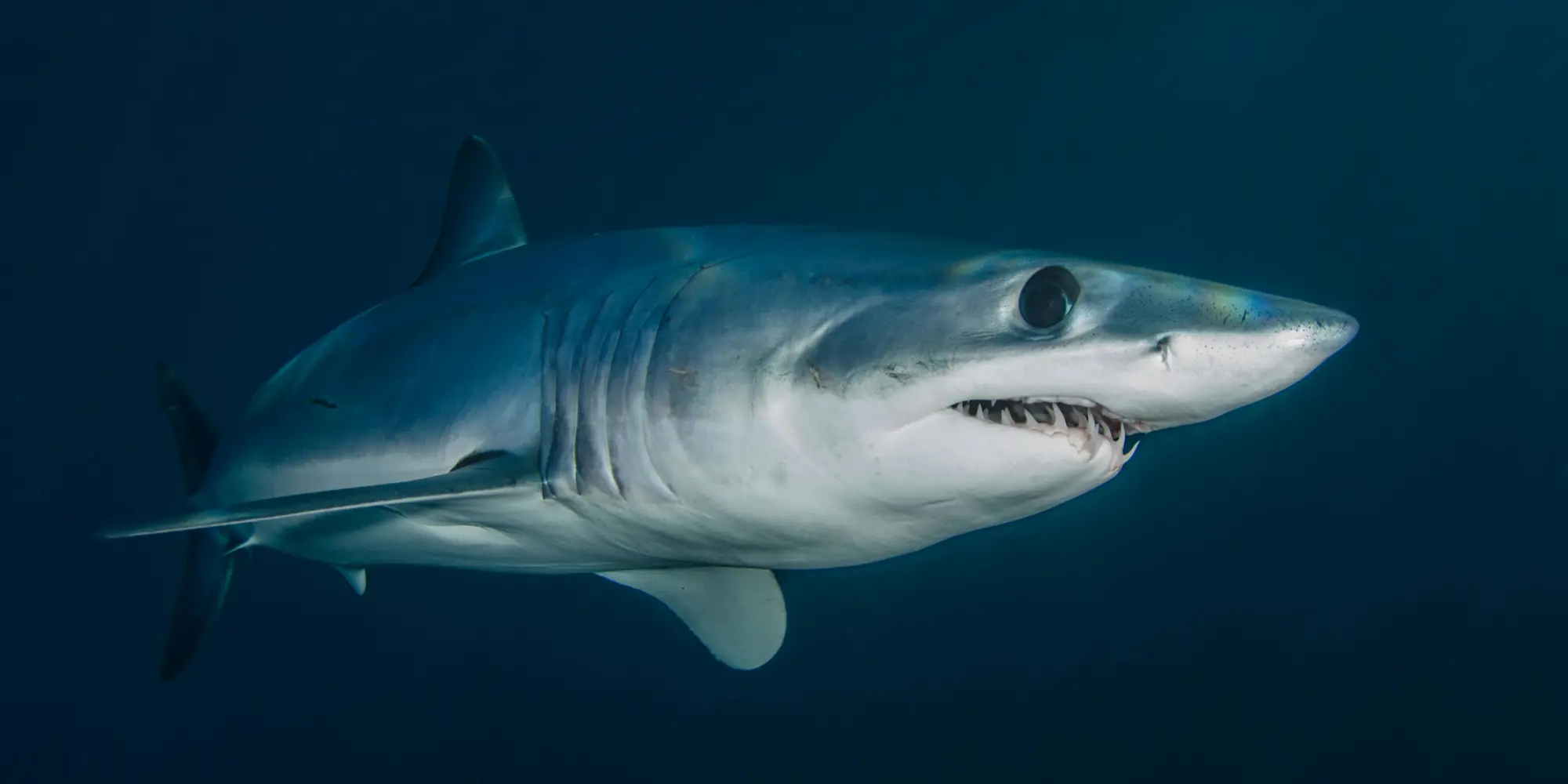
The shortfin mako, scientifically Isurus oxyrinchus, is one of the most impressive open-ocean sharks. Its anatomy is perfectly adapted for speed, hunting success, and life in the open ocean. With its streamlined body, it is considered the fastest shark in the world, reaching impressive speeds of over 70 km/h.
Body shape and basic structure
The silhouette of the shortfin mako is spindle-shaped and extremely hydrodynamic. The body tapers towards the rear, enabling minimal water resistance. Compared to other sharks, the body appears more compact, which, along with the shape of the fins, optimises propulsion.

CC BY-SA 3.0,
via Wikimedia Commons
Head and jaw
The head is characterised by a pointed snout that facilitates water flow while swimming. The lower jaw is powerful and houses a series of sharp, sickle-shaped teeth. These teeth grow in multiple rows and are ideal for securely gripping prey fish such as tuna or mackerel. Unlike many shark species, the shortfin mako actively hunts, relying on lightning-fast attacks.
Fins and locomotor system
A characteristic feature is the relatively short, triangular pectoral fin, which provides stability at high speeds. The dorsal fin is rather small compared to other sharks, while the powerful, crescent-shaped caudal fin enables enormous propulsion. Within its musculature, the mako has a special heat regulation system that allows it to maintain its body temperature slightly above that of the seawater, enabling it to swim with exceptional efficiency.
Skin and colouration
The skin is covered with tiny placoid scales, known as dermal denticles. These act like microscopic scales with a rough surface, reducing water resistance and further enhancing speed. In terms of colouration, the upper side appears deep blue or steel grey, while the underside is white. This contrasting pattern serves as camouflage: from above, the shark blends in with the darkness of the sea, and from below, with the lighter water surface.
Differences between males and females
As with many shark species, there are also gender-specific differences in the shortfin mako, which are recognisable both externally and anatomically.
Male
Male shortfin makos are generally smaller than females. They reach average lengths of about 2 to 2.5 metres. A distinctive feature is the so-called claspers—paired appendages on the pelvic fins that play a role in reproduction. Males also grow more slowly and reach sexual maturity earlier.
Female
Female makos can grow significantly larger, reaching lengths of over 3.5 metres. They have more robust bodies, which is particularly advantageous for carrying their live-born young. Females reach reproductive maturity later, which is linked to their longer growth cycle. Their larger size also gives them advantages when hunting larger prey fish.
Special adaptations
The combination of powerful musculature, specialised fins, and hydrodynamic body shape makes the shortfin mako an excellent hunter. Its physiological adaptations enable it to pursue prey into deeper water layers and quickly return to the surface. Thanks to its temperature adaptation system, it remains particularly energetic.
Distribution & habitat
The shortfin mako, also known as the mako shark, inhabits a vast distribution range in the world’s oceans. This species is found in nearly all tropical and subtropical waters, making it one of the most widely distributed shark species globally. Makos prefer regions with warm water temperatures starting at around 16 degrees Celsius and avoid cold zones.
Global distribution
The distribution range of the shortfin mako spans all oceans:
- Atlantic Ocean: In the west, from the Gulf of Maine to southern Brazil, including the Gulf of Mexico, the Bahamas, and the Caribbean. In the east, habitats range from Norway and the British Isles to South Africa.
- Indian Ocean: The mako is found throughout the Indian Ocean, including the Red Sea.
- Mediterranean Sea: This shark species is also found in the Mediterranean, although the population there has declined sharply in recent decades.
- Pacific Ocean: In the western Pacific, the mako inhabits the coasts of Indonesia, Korea, Japan, Australia, Tasmania, New Zealand, and New Caledonia. In the east, its range extends from the southern Aleutians to Chile.
The shortfin mako is also regularly found on the high seas. It is a strong migrator and covers enormous distances on its travels to reach food sources or suitable breeding grounds. Both juvenile and adult animals are found in temperate to tropical waters between 50° North and 50° South.

Canadaolympic989 / Chris_huh
,
CC BY-SA 3.0
, via Wikimedia Commons
Typical habitats
The habitat of the shortfin mako is highly variable. It is usually found in coastal waters and at the edge of the continental shelf but also ventures into the open sea. It is frequently encountered at depths from the surface down to about 150 metres, although some individuals can dive much deeper.
Makos prefer open, plankton-rich regions where numerous prey fish such as tuna, mackerel, and swordfish live. Proximity to the coast favours hunting, but these sharks are also highly adaptable in the open sea. Water temperature plays a significant role: the mako feels particularly comfortable in waters between 16 and 22 degrees Celsius. Extreme temperatures or oxygen depletion cause it to avoid certain areas.
Peculiarities of habitat selection
Makos are known as fast and enduring swimmers that cover great distances. Their migrations are usually seasonal, for example, for mating or to find sufficient food. In doing so, they cross oceanic boundaries and show a high adaptability to various environmental conditions. Their habitat is therefore determined by the migratory behaviour of their most important prey and the climatic conditions of the oceans.
Lifestyle, Diet & Reproduction
Behaviour and Hunting Strategies
The shortfin mako is one of the fastest predatory fish in the seas and is known for its exceptional agility and strength. It usually lives as a solitary creature and covers great distances in search of food. Typical of its lifestyle are lightning-fast attack techniques: with speeds of up to 70 km/h, the mako surprises its prey, often leaping out of the water in the process—a behaviour primarily observed during hunting. Its hydrodynamic body shape, powerful jaw muscles, and sharp tooth structure are optimally adapted to this type of movement and hunting.
- Lightning-fast attacks in open water
- Jumping out of the water as a hunting technique
- Predominantly solitary behaviour
Diet
As a carnivore, the shortfin mako prefers fast, agile fish such as tuna and mackerel. Swordfish, smaller sharks, and squid also regularly feature on its menu. With its powerful jaws, it can even bite through the robust bodies of its prey. Its role as an apex predator is crucial for maintaining the ecological balance in the sea.
- Main diet: tuna, mackerel, swordfish
- Prey: squid, smaller sharks
- Effective predator with a varied diet
Reproduction and Offspring
The shortfin mako reproduces ovoviviparously. This means the embryos develop in egg cases within the mother’s body and hatch before birth. Females give birth to between four and 16 fully developed young sharks every two to three years, which are immediately independent and measure about 70 centimetres at birth. The young grow very quickly; males reach sexual maturity at around 195 centimetres in length, and females at about 280 centimetres.
- Ovoviviparous reproduction – live-bearing
- Young makos are immediately independent and grow rapidly
- Litter size: 4 to 16 pups per litter
Ecological Importance and Predators
As an apex predator, the shortfin mako plays a vital role in regulating shoals of fish and marine biodiversity. Although adults have few natural enemies, larger sharks, orcas, and sperm whales are among the rare natural predators. The demanding life of a solitary creature, combined with immense speed and strength, makes the mako a fascinating inhabitant of the oceans.
Interaction with Humans
How dangerous is the shortfin mako?
The shortfin mako is often described as a dangerous predatory fish but is one of the shark species that rarely attacks humans. According to international statistics, around nine unprovoked attacks by this species have been recorded worldwide since records began, with only one fatal case. Most incidents occur during deep-sea fishing when a caught mako shark is brought into the boat and attempts to defend itself. In open water, mako sharks usually behave cautiously around swimmers and divers and avoid human proximity. Experts rate the actual danger as very low, especially compared to other shark species such as the great white shark or tiger shark. An attack almost always results from provoked situations, such as when the shark is lured or caught.
- Fewer than ten documented attacks since 1580
- The only fatal incident involved a fisherman in a boat
- Direct threat to bathers and divers practically non-existent
Humans and Sharks: Encounters While Diving and Deep-Sea Fishing
Encounters with makos are particularly relevant for deep-sea anglers, as the shark is prized for its enormous jumping power and fighting strength as a sporting trophy. Many of the documented injuries occurred while trying to free caught animals from hooks and boats. Makos can react very quickly and with great force in such situations. When diving and snorkelling, makos usually display curious but unobtrusive behaviour. Sightings in holiday areas are rare but harmless. The prerequisite for safe encounters is respectful interaction and avoiding hasty movements or attempts to touch the shark.
- Mako is popular among sport fishermen but challenging
- Injuries usually occur on board, not in open water
- Encounters with divers usually proceed peacefully
Threat to the Mako Shark: Humans
While the danger to humans from mako sharks is extremely low, humans, in turn, pose the greatest threat to the populations of this shark species. Strong interest in sport fishing, bycatch in commercial fishing, and the use of mako fins for the Asian market have led to a dramatic global decline in populations. Conservation organisations warn of the ecological consequences of selective hunting pressure. The shortfin mako is now on the Red List of endangered species, and its protection is a crucial goal for the survival of the marine ecosystem.
- Overfishing and bycatch are the greatest threats to makos
- Populations worldwide are severely endangered; protection status is urgently needed
- Humans as responsible users are the focus of global conservation efforts
Profile
- First described:
- Max. size:
- Depth:
- Max. age:
- Max. weight:
- Water type:
- IUCN Status:
Taxonomy
- Kingdom:
- Phylum:
- Subphylum:
- Infraphylum:
- Parvphylum:
- Class:
- Subclass:
- Superorder:
- Order:
- Family:
- Genus:
Dive Centres



Newsletter
Shark Alert in Your Inbox