


Sharptooth houndshark - Triakis megalopterus
Body structure, features & anatomy
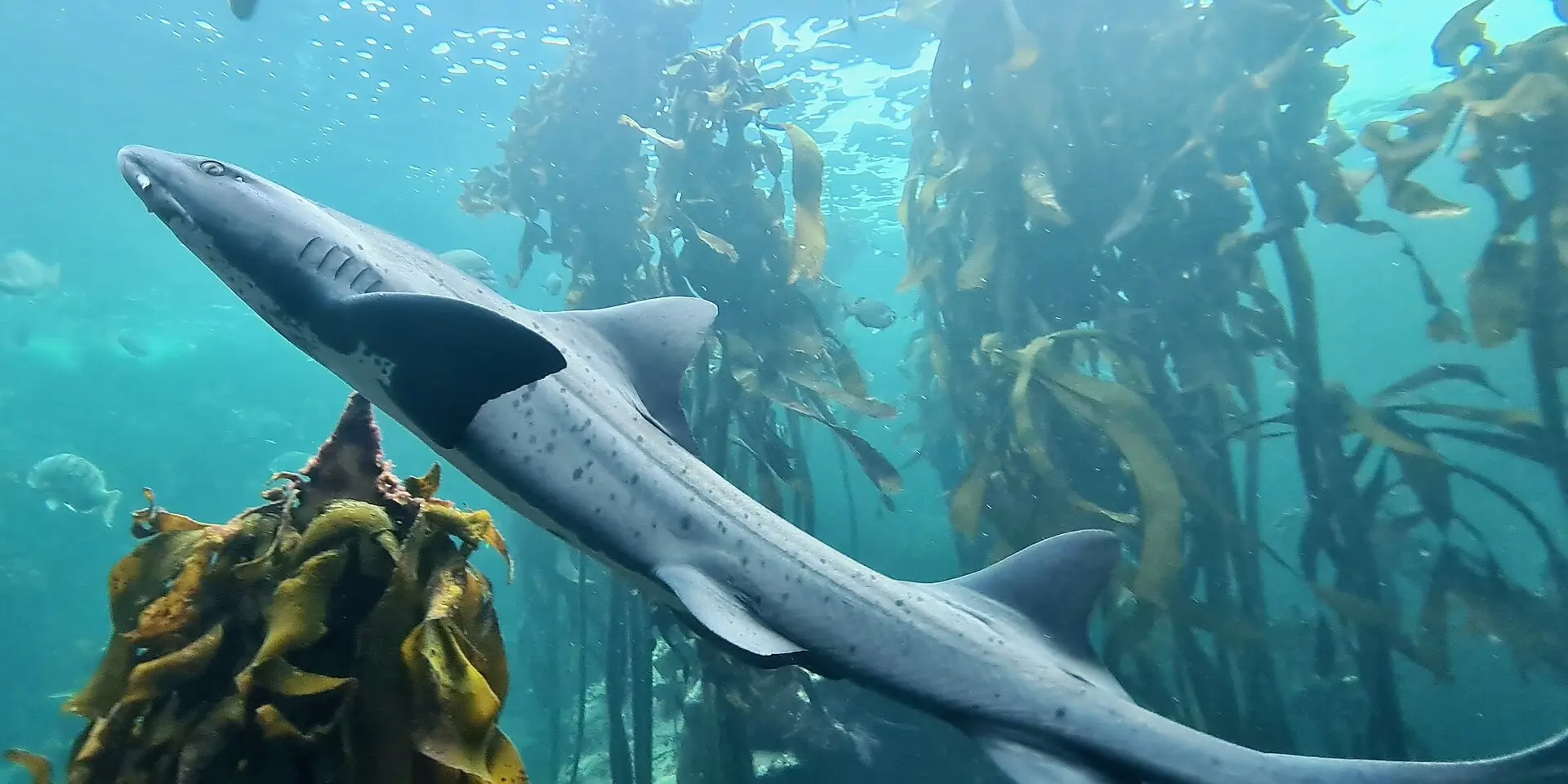
The sharptooth houndshark Triakis megalopterus is a powerfully built, elongated dog shark with a broad head and bluntly rounded snout. The large, arched mouth extends behind the eyes. Adult females are larger than males: well-documented maximum values are around 174 centimeters in total length for females and 142 to 152 centimeters for males. Some older measurement series contain larger animals, but can only be compared to these values to a limited extent due to different measurement methods.
The Species profile of Sharks of the World describes a short, heavy caudal stalk, broad fins and two dorsal fins set far back. The first dorsal fin inserts approximately over the rear part of the base of the pectoral fin; the second is almost as large as the first and faces the anal fin. The caudal fin has a pronounced upper lobe and a much smaller lower lobe. These proportions are appropriate for a bottom-hugging shark that maneuvers in surf channels, between rocks and over sandy surfaces.
Pointed teeth instead of plaster teeth
The German and English names refer to the teeth. Each tooth has a broad, rounded base and an upright, sharply pointed central tip; small lateral tips may be indicated. This distinguishes the species from many smooth sharks in the genus Mustelus, whose flatter teeth form more of a plaster-like crushed dentition. The sharptooth houndshark’s teeth securely grip crabs, squid and fish without having to rely on the large cutting blades of typical requiem sharks.
Coloring and reliable identifying features
The back and flanks are gray, gray-brown or bronze-colored and usually covered with numerous small black dots. The belly side is white. The spotting varies greatly: in some animals it is dense, in others it is only weakly pronounced or almost invisible. Newborns usually have fewer spots than older sharks. Color alone is therefore not sufficient for identification; Body shape, mouth, teeth, fin position and location must be considered together.
- Broadly rounded snout and large mouth with small, pointed teeth.
- Strong body and short, thick tail stalk.
- Two relatively large dorsal fins; the second faces the anal fin.
- Gray to bronze upperside, often with small black dots, white underside.
- Five short gill slits and oval eyes with nictitating membranes, typical of demersal sharks.
Distribution & habitat
The sharptooth houndshark Triakis megalopterus is endemic to southern Africa. Its secured core area extends from the north Namibia along the Atlantic and Cape coasts to Coffee Bay in the Eastern Cape South Africa; Catches from the south Angola expand the familiar framework to the north. The species therefore has a comparatively small, long coastal area in the southeast Atlantic and at the transition to the southwest Indian Ocean. The map shows this rough framework and not a complete settlement of every coast.
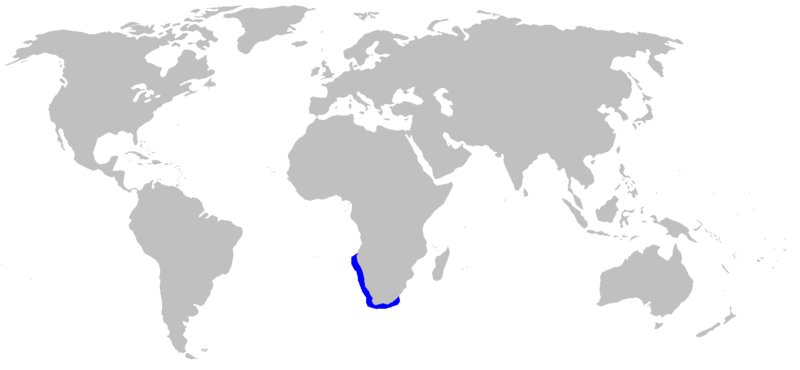
The South African Age and Growth Study classifies the species as a shallow-living, demersal coastal shark. Observations and catches are mainly at depths of less than 50 meters. In a twelve-year study in the Eastern Cape, almost nine out of ten animals examined came from rocky reefs in less than ten meters of water; only a small proportion was recorded below 20 meters. The species can therefore also occur near the surf, provided there are sufficiently deep channels, crevices and rocky cover.
Rocky reefs, gullies and shallow bays
Typical habitats include shallow rocky reefs, rocky coasts, boulder fields, sandy beaches and sheltered bays. Structurally rich areas with crevices and transitions between rock and sand are particularly important. There the shark finds cover and a wide range of crabs, lobsters, octopuses and small reef fish. As a species that lives close to the ground, it usually stays close to the substrate, but can swim freely through the water column to search for food and change location.
Loyalty to location with occasional long-distance movements
Long-term tagging data does not show a simple migration pattern. Many animals are found close to where they were originally caught and use limited coastal areas repeatedly. On average, adults move further than young animals; Individual sharks can still travel several hundred kilometers. Protected areas are therefore particularly effective where they permanently enclose rocky shallow water habitats and not just deep offshore water.
In the South African summer, more animals are caught and occasional gatherings are observed. However, available marking data do not provide clear evidence of regular large-scale mating or birth migration. Young animals are probably born in several parts of the distribution area. For the map this means: The marked area includes many local sub-habitats, the quality and use of which can vary seasonally.
Life history, diet & reproduction
The sharptooth houndshark is a powerful, ground-level predator of the shallow coastal zone. Instead of specializing in a single species of prey, it takes advantage of the rocky reefs and adjacent sandy areas. Crabs, lobsters, bony fish, octopus and squid form the majority of the diet; smaller sharks and shark eggs are only occasionally detected. Its pointed teeth hold moving prey, while the broad tooth base stabilizes when cracking hard crab shells.
The diet changes as we grow
The Study on reproduction and nutrition examined 110 stomachs and found a clear size effect. Animals under one meter ate almost exclusively crabs, especially the Cape rock crab. Crabs remained important between one and 1.4 meters, but cephalopods already made up a large proportion. For sharks over 1.4 meters, bony fish dominated by biomass. Larger sharks not only took larger prey, but also more different species. Young and old animals therefore sometimes occupy different roles in the food web on the same reef.
Slow, viviparous reproduction
Triakis megalopterus is aplacental viviparous. The embryos develop in the two uteruses and are nourished from their yolk sacs; a yolk sac placenta does not form. One study found five to 15 normally developed embryos per litter, an average of just under ten. Larger females tended to carry more young. According to this well-documented population, the young animals measure approximately 42 to 45 centimeters at birth and are immediately independent.
The gestation period is estimated at 19 to 21 months. Including possible rest periods, a female reproductive cycle can last two to three years. Males reach sexual maturity at approximately 132 centimeters, females at around 145 centimeters. Age models estimate maturity at around eleven years for males and 15 years for females. This late maturity and long cycle limits how quickly losses can be replaced.
True to location and more durable than long assumed
One 37-year labeling study with 7,211 tagged sharks and 657 recaptures over the years 1984 to 2021 confirming slow growth. Recaptured animals grew on average about five centimeters per year; The modeling showed a possible maximum age of around 41 years. Two thirds of the recaptures showed behavior that was consistent with their location, but the furthest documented change of location was still 911 kilometers. The sharptooth houndshark therefore combines local habitat binding with the ability to make rare, long-distance coastal movements.
Accumulations and higher catch numbers in the South African summer are known. They do not have to mean that the entire population migrates together. Water temperature, prey, surf, and local reproductive stages can alter visibility and catchability. The date, exact location, depth, gender and size are therefore particularly valuable for the interpretation of individual observations.
Threats & conservation status
The IUCN Red List leads Triakis megalopterus in the category since the 2019 global assessment Least Concern (Not at risk). The previous classification as potentially endangered was thus reduced. This means that the available data currently does not demonstrate a global threat according to the IUCN criteria. It does not mean that local stocks are resilient indefinitely or that all coastal habitats are adequately protected.
Fishing is the main direct pressure
The sharptooth houndshark is commonly caught by rock and surf anglers, as well as from small hook-and-line boats. In addition, it can end up as bycatch in coastal and shark fisheries. Its shallow depth distribution overlaps heavily with accessible fishing spots and inshore fishing gear. Because of the pronounced site loyalty, high local fishing pressure can affect a subpopulation, even if the species still occurs regularly throughout the entire area.
Late maturity makes additional mortality effective
Females do not reach maturity until they are around 15 years old, the gestation period lasts almost two years and there may be periods of rest between pregnancies. Demographic models are therefore particularly sensitive to the survival rate of the young animals. If many small or immature sharks are removed, the consequences only appear with a delay in the number of adult animals. A stable snapshot should therefore not be confused with rapid inventory recovery.
Habitat protection must include shallow rocky areas
Effective protective measures include well-controlled sampling limits, gentle release practices, reliable catch statistics and fishing-free zones in suitable shallow water habitats. A protected area only helps this species if it actually includes the rocky reefs, gullies and adjacent sandy areas used. The high location fidelity of many animals makes such spatial measures promising; Rare long-distance movements require coordination across several coastal regions.
Standardized recapture data are particularly important for monitoring: length, sex, location of capture, depth, release and condition of the animal. The distinction between similar-looking dog sharks must also be reliable. Long-term series can show whether size structure, catch rates or distribution limits change before a decline becomes large enough to create a new global threat category.
Sharptooth houndshark & humans
The FishBase species profile levels Triakis megalopterus as harmless to humans. Although the sharptooth houndshark has functional, pointed teeth and is a powerful wild animal, humans are not its prey. There are no known unprovoked attacks. The risk arises especially when a shark that is caught, harassed or held on defends itself with bites and strong body movements.
Encounters while diving
Since the species uses shallow rocky reefs and bays, snorkelers and divers can generally encounter it. The shark usually stays close to the bottom, resting between structures or swimming calmly along the reef. A sighting is more likely if there is little noise and the animal is not directly harassed from above. In cloudy water, you should keep an extra distance because it is harder to see an alternative route.
- Watch calmly from the side and give the shark a clear path into the open water.
- Do not touch, pursue, surround or drive out of crevices.
- Do not offer food or use fishing or baiting sites for a close-up.
- Keep your distance from fishing hooks, lines and visibly stressed animals.
- Document sightings with location, depth, date, estimated length and photo.
Importance for anglers and coastal fishing
In South Africa, the sharptooth houndshark is a well-known sport fish for rock, surf and boat anglers. The species is persistent and can survive a long period of fighting, but this increases the risk of exhaustion, injury and recapture. When released, short handling times, wet hands or a wet surface, leaving the animal in the water and carefully removing easily accessible hooks help. The current regional regulations always apply to specific fishing and possession rules.
Use and attitude
The species is used commercially on a small scale. The meat is used locally fresh or sold dried as so-called shark biltong. sharptooth houndsharks are also considered comparatively robust and are kept in large public aquariums. However, robustness in husbandry or capture is not evidence of high natural productivity: late maturity and long reproductive cycles remain the crucial limits for sustainable harvesting.
The species is particularly interesting for nature observation because it shows an often overlooked coastal shark lifestyle. It is not a deep-sea hunter, but rather a long-term predator bound to rocky reefs and local feeding areas. Considerate encounters and well-documented sightings can provide knowledge without forcing the animals from their retreats.
Profile
- First described:
- Max. size:
- Depth:
- Max. age:
- Max. weight:
- Water type:
- IUCN Status:
Taxonomy
- Kingdom:
- Phylum:
- Subphylum:
- Infraphylum:
- Parvphylum:
- Class:
- Subclass:
- Superorder:
- Order:
- Family:
- Genus:
Newsletter
Shark Alert in Your Inbox