


Pyjama shark - Poroderma africanum
Body structure, features & anatomy
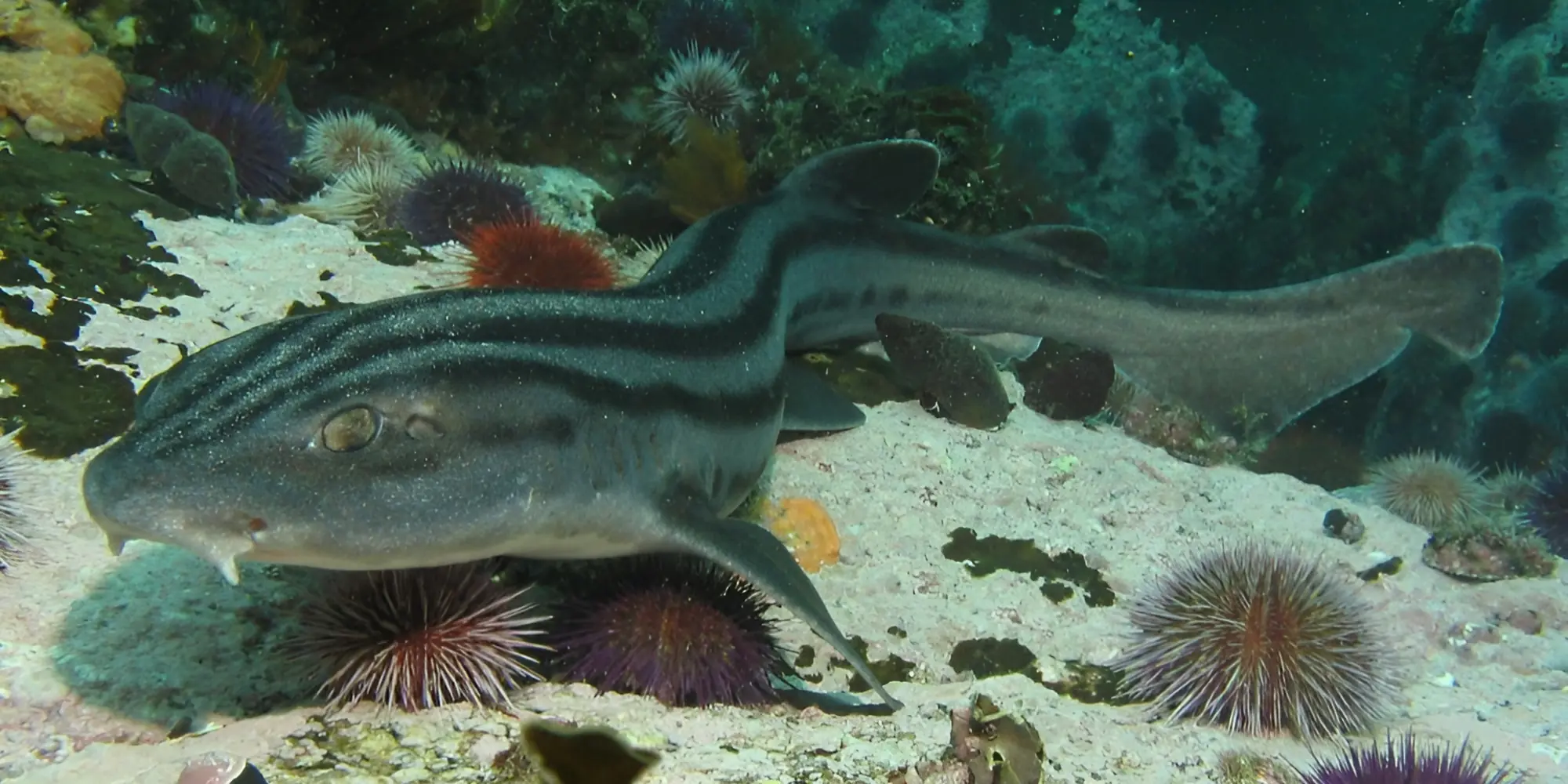
The pyjama shark is a slender catshark with five to seven broad, dark longitudinal stripes running from the head along the body towards the tail. Its pale brown to grey background and the absence of dense dorsal spotting make the pattern particularly distinctive.
The head is short and broad with a bluntly rounded snout. Small nasal barbels do not reach the mouth, the oval eyes sit high on the head, and small spiracles lie behind them. Two spineless dorsal fins are positioned far back, with the second noticeably smaller than the first.
The tail is long, with a strong upper lobe and a poorly developed lower lobe. Adults usually remain well below one metre; published maximum lengths are roughly 95 to 100 centimetres. The FAO species catalogue highlights the combination of stripes, short nasal barbels and rear-set dorsal fins as reliable field characters.
Distribution & habitat
The pyjama shark is endemic to the coast of South Africa. Its confirmed range follows the southeastern Atlantic Ocean around the Cape and into the western Indian Ocean, with the species especially common between Saldanha Bay and East London.
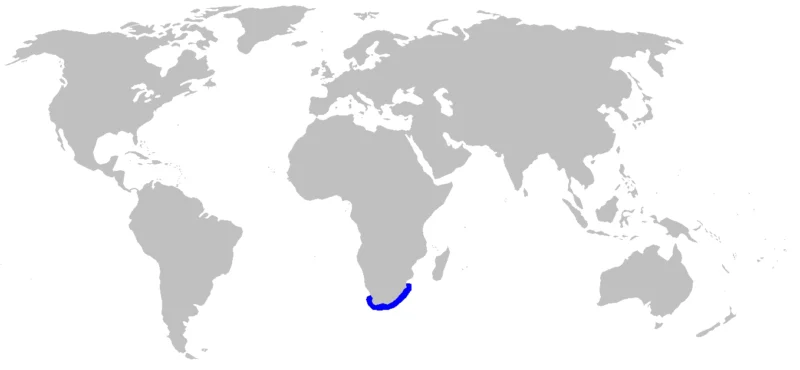
FishBase describes it as a bottom-dwelling shark of the continental shelf. It occurs from the intertidal and surf zones to at least about 100 metres; isolated records have been reported as deep as 282 metres. Older claims from Madagascar, Mauritius and farther north remain unconfirmed.
Rocky reefs, kelp forests, caves and crevices are typical habitat, along with sandy areas immediately beside hard structure. During the day individuals or small groups shelter beneath ledges; after dark they leave these resting places to forage. The map represents a broad historical range rather than a precise boundary for current sightings.
Lifestyle, diet & reproduction
Pyjama sharks are mainly nocturnal and remain close to the bottom. They rest in caves or rocky crevices during daylight and search reefs, kelp and neighbouring sand flats after dark.
The SANBI Biodiversity Advisor lists cephalopods, crustaceans, small bony fishes, bivalves and polychaete worms among their important prey. Small sharks, rays and egg cases may also be eaten. When tackling an octopus or cuttlefish, the shark can tear away pieces with a twisting movement of its body.
A recent study of trophic ecology confirms a broad diet and indicates that the contribution of different prey groups may vary between juveniles and adults. Reproduction is oviparous: females usually deposit two dark, rectangular egg cases at a time, anchoring them to kelp or rock with long tendrils. Hatchlings measure about 14 to 15 centimetres.
Threats & conservation status
The IUCN Red List assesses the pyjama shark as Least Concern. It is widespread in suitable South African coastal habitat, is considered relatively resilient, and the latest assessment did not identify an ongoing population decline.
Nevertheless, the South African species profile documents contact with several fisheries. Bottom trawls, commercial and recreational line fishing, lobster traps, beach seines and gillnets can all take the species as bycatch.
South African rules prohibit retention in certain commercial line fisheries and limit recreational catches. Because this shark shows strong site fidelity and has a restricted geographic range, local groups may be more vulnerable than the global category suggests. Careful release, protection of kelp and rocky reefs, and reliable bycatch records therefore remain important.
Pyjama shark & humans
The Florida Museum describes the pyjama shark as harmless to people. Its clear stripes, shallow coastal range and habit of resting in South African kelp and rocky reefs make it an appealing encounter for divers.
A resting shark should never be pulled from a cave, touched or repositioned for a photograph. Divers can observe natural behaviour by keeping to the side, leaving the exit clear and avoiding prolonged direct light on the eyes.
If caught accidentally, the shark should remain in the water whenever possible and be released promptly without being carried by the tail or gills. Egg cases attached to kelp or rock should not be removed. Public aquariums have contributed observations on growth and egg development, but suitable floor space, shelters, water quality and specialist care are essential.
Profile
- First described:
- Max. size:
- Depth:
- Max. age:
- Max. weight:
- Water type:
- IUCN Status:
Taxonomy
- Kingdom:
- Phylum:
- Subphylum:
- Infraphylum:
- Parvphylum:
- Class:
- Subclass:
- Superorder:
- Order:
- Family:
- Genus:
Newsletter
Shark Alert in Your Inbox