


Pacific spiny dogfish - Squalus suckleyi
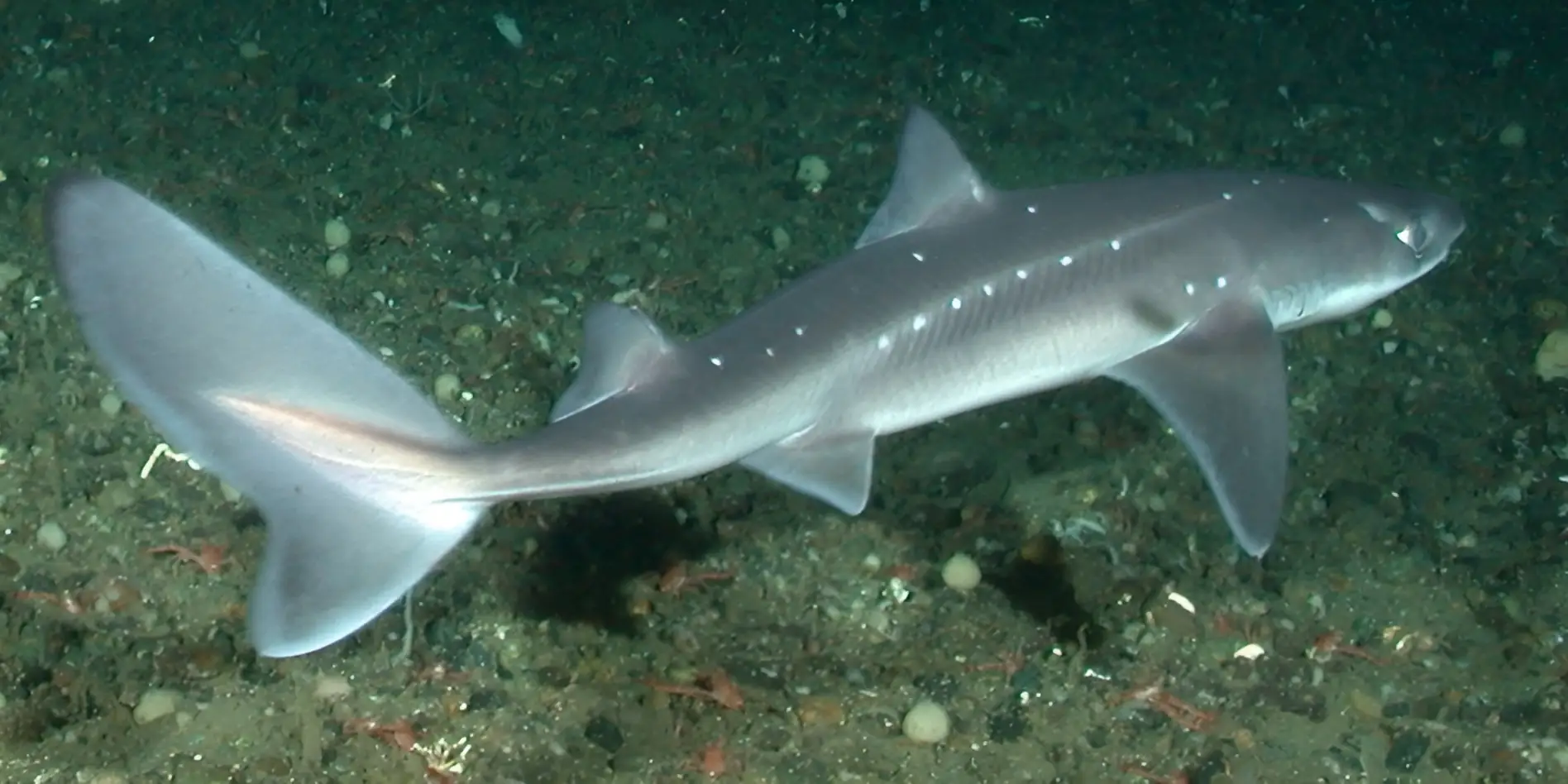
Body structure, features & anatomy
The Pacific dogfish Squalus suckleyi is the North Pacific spiny dogfish from the family of dog sharks. Taxonomically it leads WoRMS as a valid species in the Selachii, within the Squalomorphi, Squaliformes, Squalidae and the genus Squalus. For a long time he was with the Atlantic dogfish Squalus acanthias summarized; today the North Pacific form is treated as a separate species.
The body is slim, firmly built and significantly longer than it is tall. Typical features are two dorsal fins, each with a strong spine, and the absence of an anal fin. The upperside is gray to gray-brown, often with light spots; the underside is lighter. This camouflage suits a shark that hunts close to the bottom but also in open water.
Identifying features
- short, rounded to slightly pointed head with moderately large eyes
- two prominent dorsal fin spines, one in front of each dorsal fin
- slender caudal peduncle and unequally lobed caudal fin
- gray to brown upperside with light spots, light belly
- small, tightly packed skin teeth that give the body a rough surface
Shark-References lifts for Squalus suckleyi Among other things, the slender body shape, the small dorsal fins with spines and the special skin teeth stand out. In the field, the species is still difficult for non-specialists to distinguish from closely related dogfish sharks; The location, proportions and technical purpose remain important.
Distribution & habitat
The Pacific dogfish lives in the northern Pacific. FishBase describes an area from the coasts of Korea, Japan and Russia via the Bering Sea and Aleutian Islands to the Gulf of Alaska, British Columbia, Washington and further south to Baja California. The cold to temperate temperatures are particularly suitable for shark diving Pacific Ocean relevant, non-tropical reef areas.

In the western North Pacific, the occurrence affects coastal areas China, Japan, North Korea, South Korea and Russia. There are waters in the eastern North Pacific Canada, the USA and Mexico to the distribution image. The species can appear near the coast, but also uses shelf and upper slope areas.
Depth, temperature and habitat
The depths range from very shallow coastal areas to more than 1,000 meters. However, the Pacific spiny dogfish is more commonly observed in moderately cold areas of the continental shelf and on the upper continental slope. Juveniles can get into shallower bays and upper layers of water, while adults are often in deeper, near-bottom areas between around 50 and 200 meters.
The species is marine, but also tolerates brackish transition areas. Temperature, season and food availability influence local movements: Pacific spiny dogfish can occur in groups but also migrate to other depths or coastal areas when conditions change.
Life history, diet & reproduction
Pacific spiny dogfish are long-lived, slow-growing predators. NOAA Fisheries describes them as animals that can live more than 80 years; On average, females only reach sexual maturity at around 35 years of age, males much earlier. This slow life history is central if you want to assess the species from a biological and fishing perspective.
Food and activity
The species hunts opportunistically. Larger fish are among the most important prey, as are squid, octopuses, crustaceans, jellyfish, ctenophores and other invertebrates. Pacific spiny dogfish can travel alone, but also form groups, especially where food is concentrated.
In its habitat, the species oscillates between near the ground and the free water column. Young animals are more likely to stay in the upper layers of water, while adult animals are often found deeper and closer to the bottom. This flexibility explains why the species appears in both nearshore observations and deeper shelf fishing data.
Reproduction
Like other dogfish sharks Squalus suckleyi viviparous. The embryos develop in the mother for a long time; The gestation period is given as around 18 to 22 months. A litter can contain up to 22 young animals, often there are fewer. The young animals are born relatively large and make greater use of flatter, more protected areas than many adult animals.
Threats & protection status
The IUCN Red List currently rates the Pacific spiny dogfish as not endangered globally (least concern). But that doesn’t mean that the species is equally well protected everywhere. Their late sexual maturity, long gestation period and low breeding rate make stocks vulnerable if removal or bycatch remains high over a long period of time.
COSEWIC classified the North Pacific spiny dogfish in Canada as of particular concern. The report highlights very slow reproduction, long generation times and uncertainties in population trends. It is this combination of abundance in some areas and slow recovery that can give sharks a false sense of security.
Fishing and bycatch
Pacific spiny dogfish are used directly in parts of their distribution area, but also end up as bycatch in various fisheries. Because they often occur in groups, local catches can quickly affect many animals. Management must therefore work regionally: a seemingly stable population on one coast says little about all sub-populations in the North Pacific.
What is particularly relevant to protection are careful catch quantities, good bycatch data, careful release of live animals and the consideration of young animal and reproductive areas. For a species with such a slow life history, early countermeasures are much easier than late rebuilding of overexploited populations.
Pacific spiny dogfish & humans
The Pacific spiny dogfish is not a typical risky shark for humans. It is rather small to medium-sized, often lives cool and lower and avoids direct contact. When diving or snorkeling, encounters are rare and usually calm unless animals are harassed, fed or held.
Caution is particularly necessary when handling trapped or stranded animals. The spines in front of the dorsal fins can cause painful injuries. Anyone who frees an animal from fishing tackle or misses it for research should respect its mouth, tail and dorsal spines and keep the time out of the water as short as possible.
Observation and handling
- Do not touch, pull or manipulate the dorsal fin spines
- When sightings, keep your distance and let the shark choose its path
- Treat caught animals wet, cool and without unnecessary lifting
- Document observations with location, depth, temperature and photo without harassing the animal
In public, the Pacific dogfish is often confused with the more common name dogfish. The scientific name is important for serious reports: Squalus suckleyi means the North Pacific species, while Squalus acanthias the spiny dogfish of the Atlantic and adjacent seas.
Profile
- First described:
- Max. size:
- Depth:
- Max. age:
- Max. weight:
- Water type:
- IUCN Status:
Taxonomy
- Kingdom:
- Phylum:
- Subphylum:
- Infraphylum:
- Parvphylum:
- Class:
- Subclass:
- Superorder:
- Order:
- Family:
- Genus:

Newsletter
Shark Alert in Your Inbox